
This lesson was drafted by a Local Solar System Foundation team member and could be improved by a qualified reviewer. Are you qualified in this subject? Suggest an edit
Orbit Sandbox
Open full pageWhat is an orbit? Throw a ball sideways and it curves down to the ground. Throw it faster and it lands farther away. Throw it fast enough and the ground curves away beneath it as quickly as it falls, so it never lands: it keeps falling around the planet and always misses. That is an orbit. Nothing holds a satellite up; it is falling all the time.
What happens:
Try this
Falls back Orbits Escapes
·
Fine-tune the orbit (orbital elements and Kepler's laws)
Astronomers describe an orbit with five numbers called orbital elements. Change them here; the height and speed above follow.
How to use it
- Sideways speed
- This one control decides what happens. Too slow and it falls back. Fast enough and it goes round in a circle. Faster and it swings out into an ellipse. Faster than escape speed and it leaves for ever. The coloured bar under the slider shows where each begins at the chosen height.
- Height
- Where it starts. Higher up, gravity is weaker, so a slower speed is enough to stay in orbit.
- Time speed
- Real orbits take hours, days or years, so time runs faster here. Time ×1,000 means each second on screen is 1,000 seconds (about 17 minutes) in space. The planet's turning is sped up by the same amount. The numbers shown are always the real ones.
- Ground track
- The gold trail on the ground is the path directly beneath the satellite. Earth turns underneath the orbit, so each lap passes over different places.
- Gold arrow
- Which way it is moving and how fast: the longer the arrow, the faster.
- Looking around
- Drag to turn the view, scroll or pinch to zoom. The faint grid is the plane of Earth's equator (or, around the Sun, the plane of Earth's orbit).
Data table (text alternative)
| Time step | Distance from the Sun now | Speed now |
|---|
How fast is a spacecraft moving? Tell me how far it is from the planet and how big its orbit is, and one short equation answers the question anywhere along its path. Mission planners use it every day.
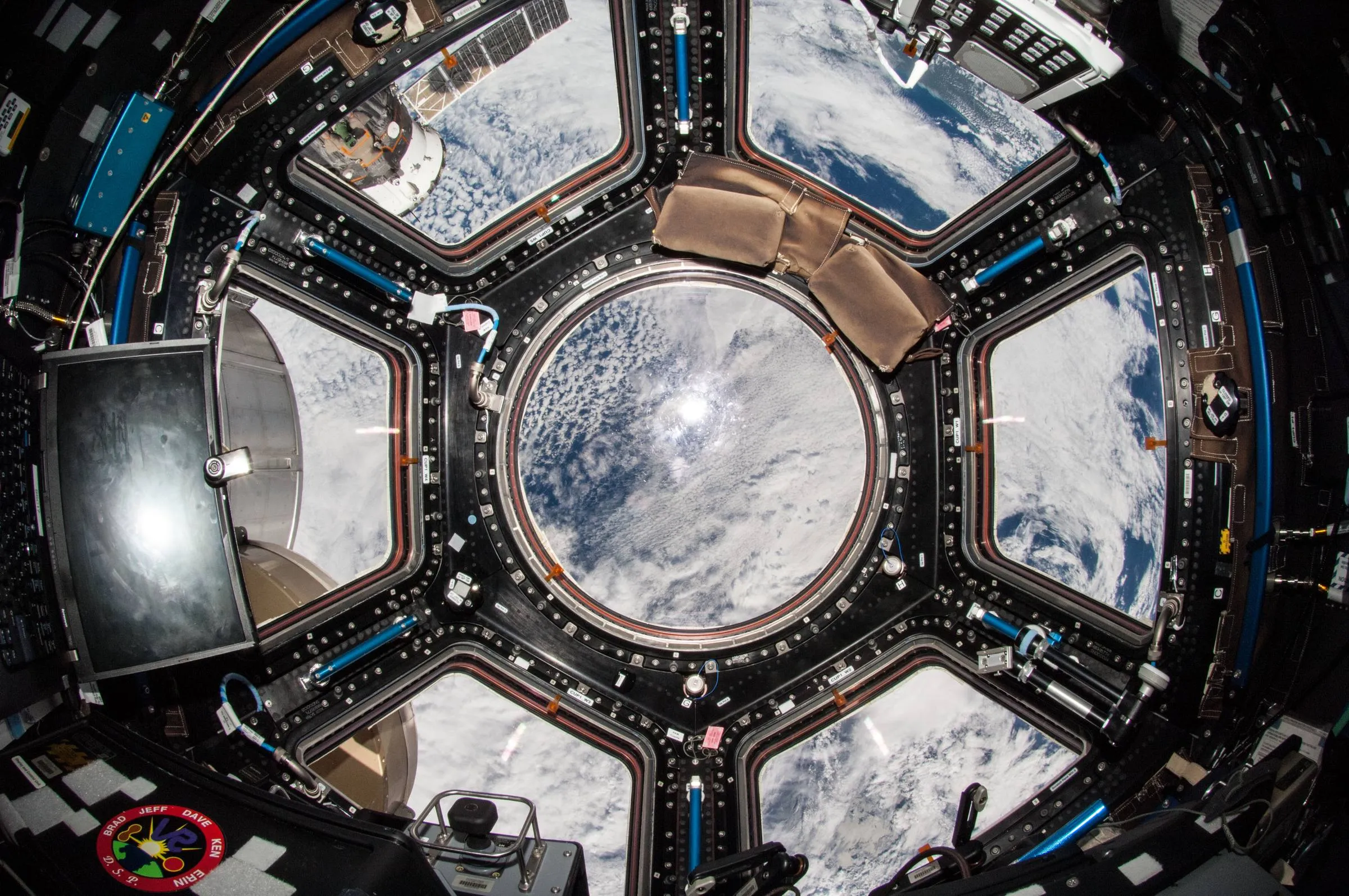
One short equation gives the speed anywhere along an orbit.
Look
Anything in orbit is always trading height for speed, like a skateboarder on a half-pipe.
- Falling closer to the central body, it speeds up.
- Climbing away, it slows down.
In the sandbox the yellow arrow shows the speed: long arrow, fast; short arrow, slow. Watch it grow as the body swings in, and shrink as it climbs out.
Earth does the same thing, just gently because its orbit is almost circular: it moves about 30.3 km/s in early January and about 29.3 km/s in early July.
Understand
The vis-viva equation (“living force”, an old word for energy) gives the speed at any point:
v = √( μ · (2/r − 1/a) )
- v: speed
- μ: the central body’s gravitational parameter (GM)
- r: current distance from the centre of the central body
- a: semi-major axis of the orbit
Check it:
- Circle (r = a): v = √(μ/a). That is the circular speed from the Newton lesson.
- At periapsis, r is smallest, so 2/r is largest and v is fastest.
- Very far away on an escape path (a → ∞): v = √(2μ/r). That is the escape speed, covered in the next lesson.
Worked example: Earth around the Sun, μ = 1.327 × 10¹¹ km³/s², a = 149.6 million km. At aphelion r = 152.1 million km:
v = √(1.327 × 10¹¹ × (2/1.521 × 10⁸ − 1/1.496 × 10⁸)) ≈ 29.3 km/s.
Master
Vis-viva is energy conservation in disguise. The specific orbital energy (energy per kilogram) is
ε = v²/2 − μ/r = −μ / (2a)
Kinetic plus potential energy is constant along the orbit and depends only on a. Solve for v and you get vis-viva. Consequences:
- The sign of ε classifies the orbit: negative for ellipses, zero for a parabola, positive for a hyperbola.
- At any given distance, the speed alone determines a. This is why a single engine burn at one point changes the size of the whole orbit, and why the next lessons can talk about delta-v budgets.
Apsis speeds follow from vis-viva with r = a(1 ± e):
v_p = √(μ/a · (1+e)/(1−e)), v_a = √(μ/a · (1−e)/(1+e))
Their product is v_p · v_a = μ/a = v_circ², so the circular speed is the geometric mean of the two, not the arithmetic mean. That answers the Try it question.
Try it
With the Sun as central body, set a = 1 au and e = 0. Note the speed. Now raise e to 0.6 and compare the fastest and slowest speeds with that number. Is the average of the two equal to the circular speed?
Great. Challenges are where the learning sticks.
Quick quiz
3 quick questions. Pick an answer to see if you are right.
-
In the vis-viva equation, what happens to the speed as the body moves closer to the central body?
- A It increases
- B It decreases
- C It stays constant
- D It becomes zero
Show the answer
A. It increases
-
For a circular orbit (r = a), vis-viva gives:
- A v = √(2μ/r)
- B v = √(μ/r)
- C v = μ/r
- D v = 0
Show the answer
B. v = √(μ/r)
-
Earth moves about 29.8 km/s around the Sun on average. Roughly how fast at perihelion?
- A 29.3 km/s
- B 30.3 km/s
- C 35 km/s
- D 42 km/s
Show the answer
B. 30.3 km/s v_p = √(μ/a · (1+e)/(1−e)) with e = 0.0167 gives about 30.3 km/s.
Finish line
- Played with the interactive
- Read the lesson
- Did the challenge
- Took the quiz
Mark the lesson complete to save it to your progress on this device.
Lesson complete. Well done!
Up next Escape velocityWords in this lesson
Sources
- JPL SSD: astrodynamic parameters (GM of the Sun)
- NASA JPL, Basics of Space Flight, Chapter 3: Gravity and Mechanics
- NASA NSSDCA Planetary Fact Sheet (orbital velocities)
This lesson is licensed CC BY-SA 4.0.