Deze les is opgesteld door een lid van het Local Solar System Foundation team en kan verbeterd worden door een gekwalificeerde reviewer. Ben je gekwalificeerd in dit onderwerp? Stel een bewerking voor
Orbit Sandbox
Volledige pagina openenHet dichtstbijzijnde punt is in het centrale lichaam: deze baan zou crashen.
De animatie speelt elke baan af in 8 seconden; de getoonde periode is de echte.
Gegevenstabel (tekstalternatief)
| Time step | Afstand van de Zon nu | Snelheid nu |
|---|
How fast is a spacecraft moving? Tell me how far it is from the planet and how big its orbit is, and one short equation answers the question anywhere along its path. Mission planners use it every day.
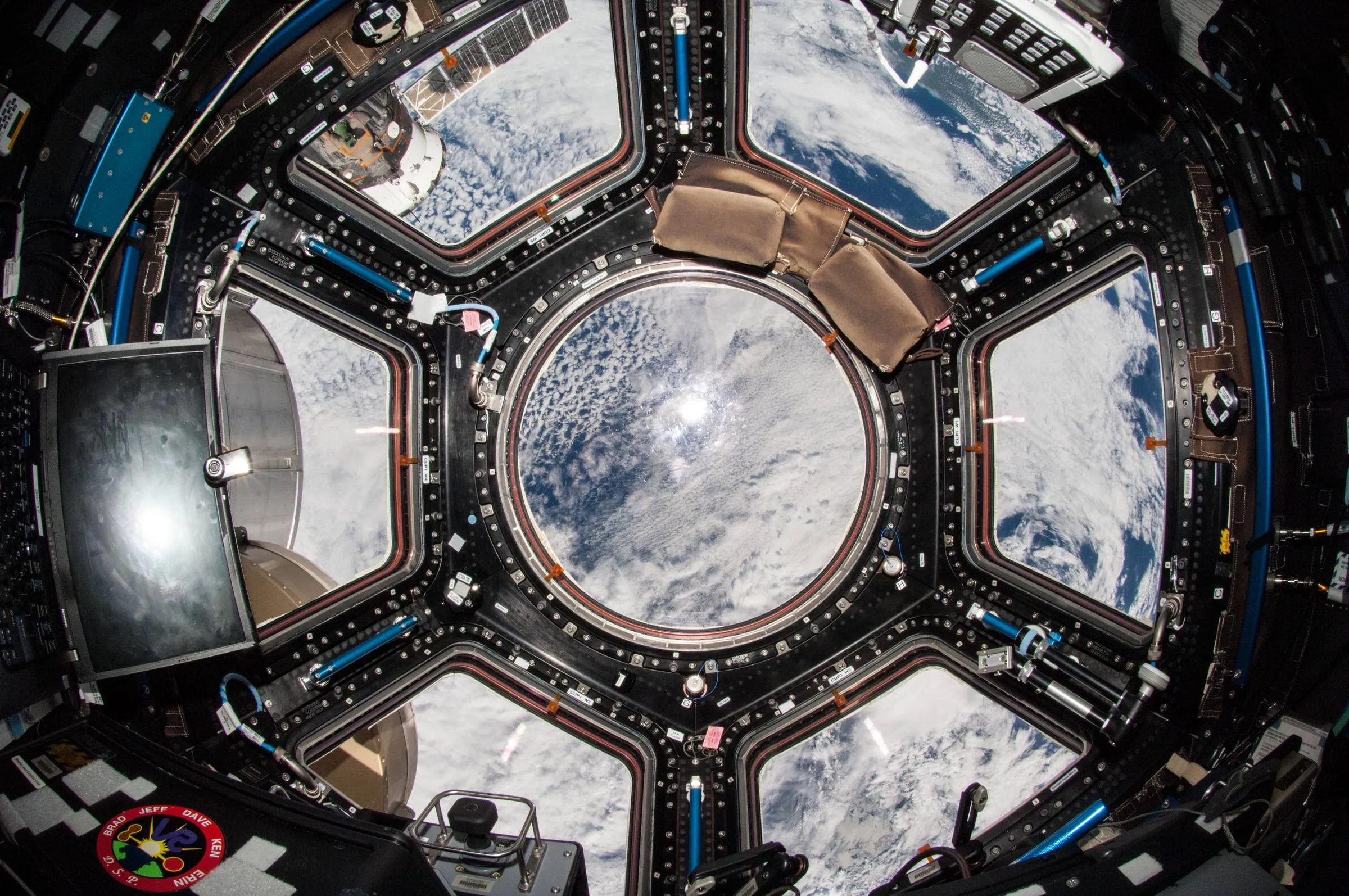
One short equation gives the speed anywhere along an orbit.
Look
Anything in orbit is always trading height for speed, like a skateboarder on a half-pipe.
- Falling closer to the central body, it speeds up.
- Climbing away, it slows down.
In the sandbox the yellow arrow shows the speed: long arrow, fast; short arrow, slow. Watch it grow as the body swings in, and shrink as it climbs out.
Earth does the same thing, just gently because its orbit is almost circular: it moves about 30.3 km/s in early January and about 29.3 km/s in early July.
Understand
The vis-viva equation (“living force”, an old word for energy) gives the speed at any point:
v = √( μ · (2/r − 1/a) )
- v: speed
- μ: the central body’s gravitational parameter (GM)
- r: current distance from the centre of the central body
- a: semi-major axis of the orbit
Check it:
- Circle (r = a): v = √(μ/a). That is the circular speed from the Newton lesson.
- At periapsis, r is smallest, so 2/r is largest and v is fastest.
- Very far away on an escape path (a → ∞): v = √(2μ/r). That is the escape speed, covered in the next lesson.
Worked example: Earth around the Sun, μ = 1.327 × 10¹¹ km³/s², a = 149.6 million km. At aphelion r = 152.1 million km:
v = √(1.327 × 10¹¹ × (2/1.521 × 10⁸ − 1/1.496 × 10⁸)) ≈ 29.3 km/s.
Master
Vis-viva is energy conservation in disguise. The specific orbital energy (energy per kilogram) is
ε = v²/2 − μ/r = −μ / (2a)
Kinetic plus potential energy is constant along the orbit and depends only on a. Solve for v and you get vis-viva. Consequences:
- The sign of ε classifies the orbit: negative for ellipses, zero for a parabola, positive for a hyperbola.
- At any given distance, the speed alone determines a. This is why a single engine burn at one point changes the size of the whole orbit, and why the next lessons can talk about delta-v budgets.
Apsis speeds follow from vis-viva with r = a(1 ± e):
v_p = √(μ/a · (1+e)/(1−e)), v_a = √(μ/a · (1−e)/(1+e))
Their product is v_p · v_a = μ/a = v_circ², so the circular speed is the geometric mean of the two, not the arithmetic mean. That answers the Try it question.
Probeer het eens
With the Sun as central body, set a = 1 au and e = 0. Note the speed. Now raise e to 0.6 and compare the fastest and slowest speeds with that number. Is the average of the two equal to the circular speed?
Uitdagingen zijn waar het leren aan vasthoudt.
Een snelle quiz
3 snelle vragen. Kies een antwoord om te zien of je gelijk hebt.
-
In the vis-viva equation, what happens to the speed as the body moves closer to the central body?
- A It increases
- B It decreases
- C It stays constant
- D It becomes zero
Toon het antwoord
A. It increases
-
For a circular orbit (r = a), vis-viva gives:
- A v = √(2μ/r)
- B v = √(μ/r)
- C v = μ/r
- D v = 0
Toon het antwoord
B. v = √(μ/r)
-
Earth moves about 29.8 km/s around the Sun on average. Roughly how fast at perihelion?
- A 29.3 km/s
- B 30.3 km/s
- C 35 km/s
- D 42 km/s
Toon het antwoord
B. 30.3 km/s v_p = √(μ/a · (1+e)/(1−e)) with e = 0.0167 gives about 30.3 km/s.
De finishlijn
- Gespeeld met de interactieve
- Lees de les
- De uitdaging gedaan
- De quiz gedaan
Markeer de les als voltooid om deze op te slaan in je voortgang op dit apparaat.
Les voltooid. Goed gedaan!
Volgende pagina » Escape velocityWoorden in deze les
Bronnen
- JPL SSD: astrodynamic parameters (GM of the Sun)
- NASA JPL, Basics of Space Flight, Chapter 3: Gravity and Mechanics
- NASA NSSDCA Planetary Fact Sheet (orbital velocities)
Deze les is gelicentieerd onder CC BY-SA 4.0.