
Deze les is opgesteld door een lid van het Local Solar System Foundation team en kan verbeterd worden door een gekwalificeerde reviewer. Ben je gekwalificeerd in dit onderwerp? Stel een bewerking voor
Orbit Sandbox
Volledige pagina openenHet dichtstbijzijnde punt is in het centrale lichaam: deze baan zou crashen.
De animatie speelt elke baan af in 8 seconden; de getoonde periode is de echte.
Gegevenstabel (tekstalternatief)
| Time step | Afstand van de Zon nu | Snelheid nu |
|---|
Six numbers. That is all it takes to describe any orbit in the solar system, from the Moon’s to a comet’s. Learn to read them and you can pin down where any world will be, years ahead.
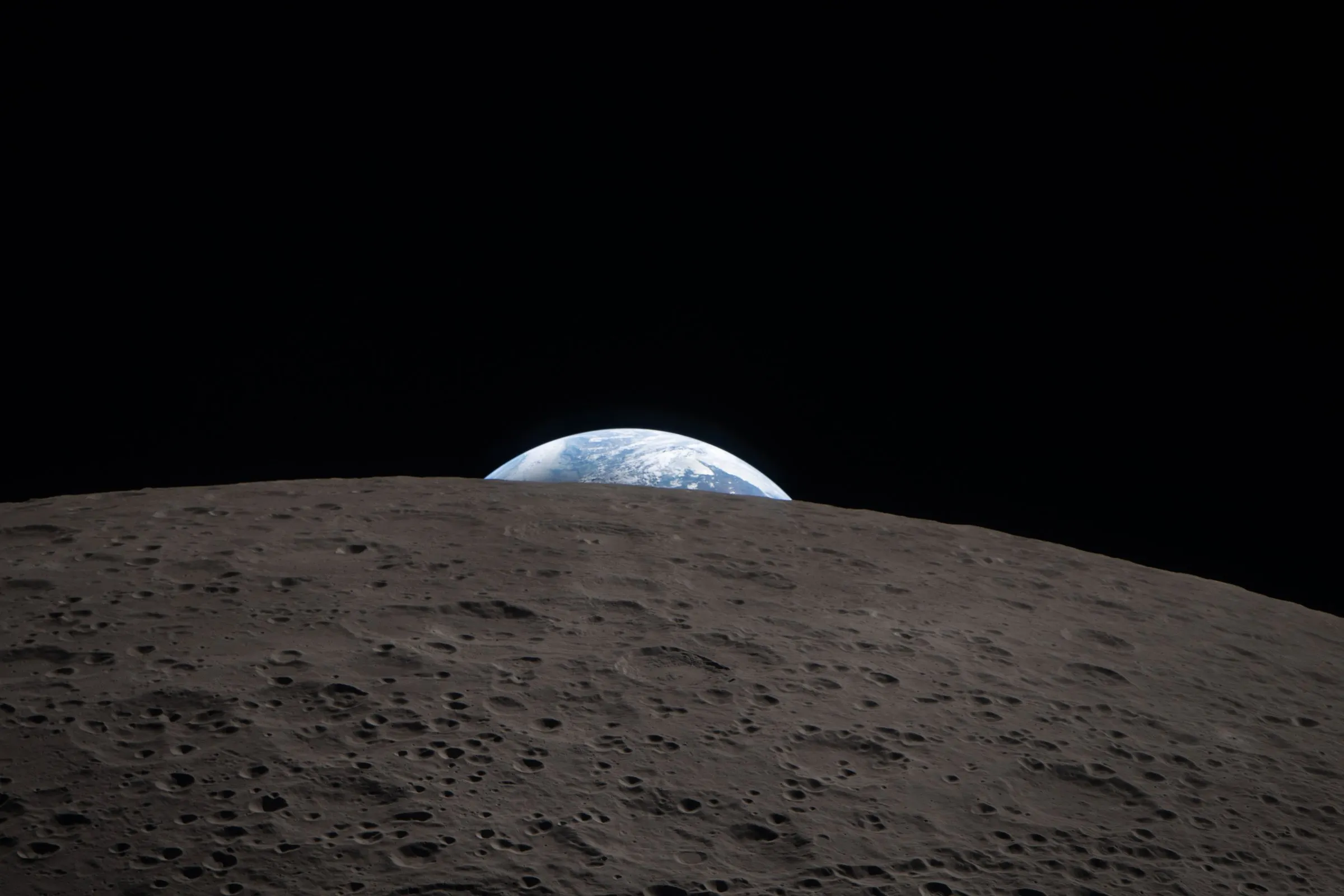
Six numbers describe any orbit in the solar system.
Look
To describe where a satellite or planet goes, you need to answer a few questions:
- How big is the orbit?
- What shape is it: round or stretched?
- How tilted is it?
- Which way is the tilt facing?
- Which way does the stretched part point?
- Where on the orbit is the body right now?
Each answer is one number. Together these six numbers are called the orbital elements, and they describe any orbit.
In the sandbox, the Molniya orbit is loaded. Russian communication satellites use this long, tilted orbit so they hang for hours high above the far north, where geostationary satellites are hard to see. Tick Side view to see the tilt, and play with the sliders.
Understand
| Element | Symbol | What it sets |
|---|---|---|
| Semi-major axis | a | Size |
| Eccentricity | e | Shape |
| Inclination | i | Tilt of the orbital plane against a reference plane |
| Longitude of the ascending node | Ω | Direction in which the orbit crosses the reference plane going “up” |
| Argument of periapsis | ω | Where the closest point lies, measured within the orbital plane from the ascending node |
| Mean anomaly at epoch | M₀ | Where the body is at a given moment (the epoch) |
For planets, the reference plane is usually the ecliptic, the plane of Earth’s orbit, and the reference direction is the March equinox. For Earth satellites, the reference plane is Earth’s equator.
Some meaningful values:
- i = 0°: the orbit lies in the reference plane. A geostationary satellite has i = 0 and e = 0 around Earth’s equator.
- i = 90°: a polar orbit, passing over both poles.
- i > 90°: retrograde, going around backwards.
- The Molniya orbit uses i = 63.4° on purpose: at that tilt, Earth’s bulge does not make the periapsis drift around the orbit.
Master
The three angles are an ordered set of rotations. A point in the orbital plane (x′ towards periapsis, y′ 90° ahead) is carried into the reference frame by R_z(−Ω) · R_x(−i) · R_z(−ω). This is exactly the transformation in JPL’s “Approximate Positions of the Planets”, which the site’s orrery uses:
x = (cos ω cos Ω − sin ω sin Ω cos i) x′ + (−sin ω cos Ω − cos ω sin Ω cos i) y′
and similar expressions for y and z.
Planetary tables often give variants: the longitude of perihelion ϖ = Ω + ω (useful when i is small and Ω is poorly defined), and the mean longitude L = ϖ + M. The JPL tables list a, e, i, L, ϖ, Ω with their rates of change per century, because the other planets slowly perturb every orbit.
Why 63.4°? Earth’s equatorial bulge (the J₂ term) makes the argument of periapsis precess at a rate proportional to (5 cos² i − 1). It vanishes when cos² i = 1/5, i.e. i = 63.43° or 116.57°: the “critical inclinations”. Elements that stay constant in the two-body problem drift slowly in the real world; that is why element sets always come with an epoch, the moment they are valid for.
Probeer het eens
Load the Molniya orbit, tick 'Side view', then change the inclination from 63.4 degrees to 0 and to 180. Describe in one sentence what each of the three angle sliders does to the orbit.
Uitdagingen zijn waar het leren aan vasthoudt.
Een snelle quiz
3 snelle vragen. Kies een antwoord om te zien of je gelijk hebt.
-
Which element tells you how tilted an orbit is?
- A Eccentricity
- B Inclination
- C Semi-major axis
- D Mean anomaly
Toon het antwoord
B. Inclination
-
An orbit with inclination greater than 90 degrees is:
- A Impossible
- B Retrograde: the body goes around backwards
- C Always circular
- D Outside the solar system
Toon het antwoord
B. Retrograde: the body goes around backwards Halley's Comet (162 degrees) and Neptune's moon Triton (about 157 degrees) are retrograde.
-
Which two elements describe the size and shape of the orbit?
- A Inclination and node
- B Semi-major axis and eccentricity
- C Argument of periapsis and mean anomaly
- D Node and mean anomaly
Toon het antwoord
B. Semi-major axis and eccentricity
De finishlijn
- Gespeeld met de interactieve
- Lees de les
- De uitdaging gedaan
- De quiz gedaan
Markeer de les als voltooid om deze op te slaan in je voortgang op dit apparaat.
Les voltooid. Goed gedaan!
Volgende pagina » Orbital speed: the vis-viva equationWoorden in deze les
Bronnen
- NASA JPL, Basics of Space Flight, Chapter 3: Gravity and Mechanics
- JPL SSD: Keplerian elements for approximate positions of the planets
- JPL Small-Body Database API documentation (orbital element definitions)
- JPL SSD: Planetary Satellite Mean Elements
- ESA: Types of orbits
Deze les is gelicentieerd onder CC BY-SA 4.0.