
This lesson was drafted by a Local Solar System Foundation team member and could be improved by a qualified reviewer. Are you qualified in this subject? Suggest an edit
Newton's Cannon
Open full pageWhat is this? Isaac Newton imagined a cannon on a mountain so tall that it pokes out of the air. Fire the ball slowly and it falls back down. Fire it fast enough and the ground curves away beneath it as fast as it falls, so it never lands. That is an orbit.
How to use it: Set the launch speed with the slider or a speed button, then press Fire. Earlier shots stay on screen so you can compare them.
How fast is that?
- Your shot
- Jet airliner, about 900 km/h (0.25 km/s)
- Rifle bullet, about 1 km/s
- Orbit speed
- Escape speed
The mountain is drawn far taller than any real one so you can see it. Air resistance is ignored.
Try this
- Press "Jet airliner" and fire, then "Rifle bullet" and fire.Notice: Both drop back down almost at once. Even very fast everyday things are nowhere near fast enough to orbit.
- Press "Orbit speed" and fire.Notice: The ball goes all the way round and comes back to the cannon. It is falling the whole time, but it keeps missing the ground. This is how the International Space Station stays up.
- Fire a little slower than orbit speed, then a little faster.Notice: Slower: it curves down and lands part of the way round. Faster: the circle stretches into a long oval that swings far out and comes back.
- Press "Escape speed" and fire, then switch the planet to the Moon.Notice: At escape speed the ball leaves and never comes back. On the Moon, with its weaker gravity, orbit speed is only about 1.6 km/s.
The ideas behind it
Why doesn't the orbiting ball fall down?
It does fall, all the time. Earth's surface curves downwards by about 5 metres for every 8 kilometres you travel, and anything dropped falls about 5 metres in its first second. So a ball moving sideways at about 8 kilometres per second falls 5 metres each second while the ground drops away by 5 metres. It never gets any closer to the ground.
Why such a tall mountain?
On Earth the mountain here is about 510 km high (8% of Earth's radius), higher than the International Space Station flies (about 400 km), so the ball starts above almost all of the air. Down in the air, drag would slow and heat the ball long before it reached orbit speed. That is why real rockets climb out of the air first and then speed up sideways.
Sources: planet masses and sizes from NASA/JPL (bodies.json); paths are exact two-body orbits. Everyday speeds are typical round figures: jet airliners cruise at about 900 km/h, and rifle bullets leave the barrel at roughly 0.7 to 1.2 km/s, about 1 km/s for a fast one.
The pull every object has on every other. Earth's gravity pulls everything towards its centre, which is why things fall.
More in the glossary →The path of something that keeps falling around a planet or star without ever hitting it, because it is moving sideways fast enough.
More in the glossary →The speed you must go sideways to circle a planet at a given height without falling in or flying away. Just above Earth's air it is about 7.8 km/s.
More in the glossary →The speed needed to leave a planet for good, never falling back. From Earth's surface it is about 11.2 km/s, ignoring the air.
More in the glossary →Air pushing against a moving object and slowing it down. This tool ignores it; a real cannonball fired this fast would be stopped and burned up by the air.
Data table (text alternative)
Slower than the circular speed: it falls back. Between circular and escape speed: it orbits. At or above escape speed: it leaves for good.
| Planet | Circular orbit speed here | Escape speed here |
|---|---|---|
| Earth | 7.61 km/s | 10.8 km/s |
| Moon | 1.62 km/s | 2.29 km/s |
| Mars | 3.42 km/s | 4.84 km/s |
Throw a ball up and it comes back. Throw it hard enough and it never does. On Earth, that speed is 11.2 kilometres every second, and reaching it is why rockets are so enormous.
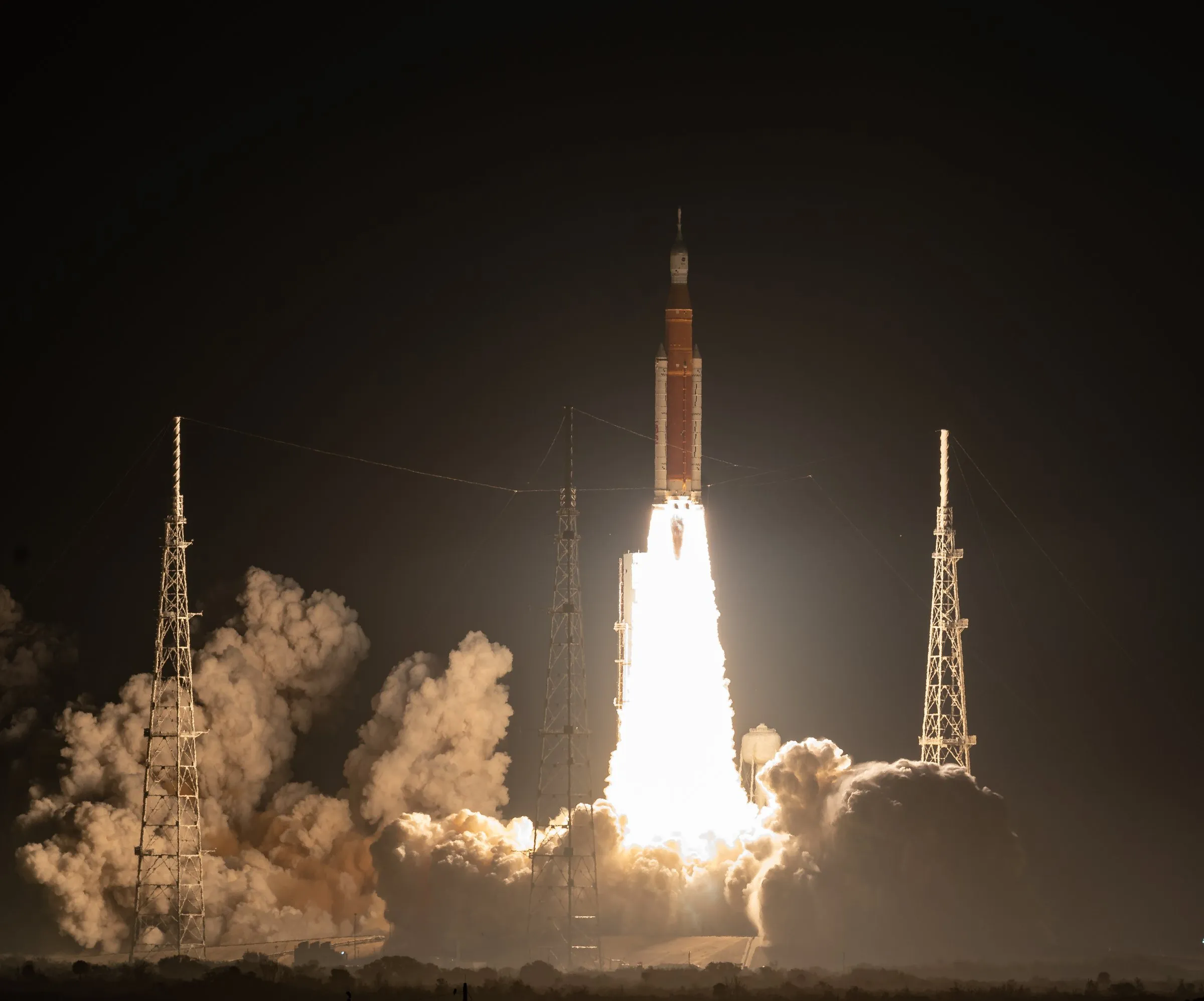
Fast enough, and a thrown object never comes back.
Look
Throw a ball upwards and it comes back down. Throw it faster, it goes higher before falling back. Is there a speed so fast that it never comes back?
Yes. It is called the escape speed (or escape velocity). Go at least that fast, with nothing slowing you down, and gravity can never pull you back.
| World | Escape speed from the surface |
|---|---|
| Moon | 2.4 km/s |
| Mars | 5.0 km/s |
| Earth | 11.2 km/s |
| Jupiter | 59.5 km/s |
| Sun | 617.6 km/s |
The Moon’s escape speed is less than a quarter of Earth’s. That is one reason why the Moon could be a useful place to launch things into space from.
In the cannon tool, the Moon is loaded. Try speeds below and above the escape speed shown in the readout.
Understand
Escape happens when the body’s kinetic energy is enough to climb out of the gravitational “well” completely. Setting kinetic energy equal to the energy needed to reach infinity:
½ v² = μ / r ⇒ v_escape = √(2μ / r)
Compare with the circular speed √(μ/r): escape speed is always √2 ≈ 1.414 times the circular speed at the same distance.
Two important facts:
- It does not depend on your mass. A pebble and a spaceship need the same speed. (The spaceship needs much more energy, of course.)
- It depends on where you start. Farther out, r is bigger and escape is easier. From the height of geostationary orbit, Earth’s escape speed is only about 4.3 km/s.
Rockets never actually fire up to 11.2 km/s at the ground. They climb steadily while their engines keep pushing. Escape speed is the speed needed for an unpowered object, like the cannonball.
Master
In terms of specific orbital energy ε = v²/2 − μ/r, escape means ε ≥ 0. At exactly ε = 0 the path is a parabola and the speed tends to zero at infinity. Faster than that, the path is a hyperbola and the object keeps a leftover speed far away, the hyperbolic excess speed v∞:
v² = v∞² + v_escape², C₃ = v∞²
Mission planners quote launch energy as C₃ (km²/s²). For a Mars transfer, v∞ at departure is about 2.9 km/s, so C₃ ≈ 8.7 km²/s².
This relation hides one of the most useful effects in spaceflight, the Oberth effect: a burn made deep in a gravity well, where you are already moving fast, buys more v∞ than the same burn made far away. From a 200 km parking orbit around Earth (circular speed 7.78 km/s, escape speed 11.0 km/s), reaching v∞ = 2.9 km/s needs only about 3.6 km/s of engine burn, not 3.2 + 2.9 = 6.1 km/s. The Delta-v Map uses this for every departure from low Earth orbit.
Try it
On the Moon, fire at a speed just below the escape speed shown in the readout, then just above. Compare the two paths. Then try the same on Earth and Mars.
Great. Challenges are where the learning sticks.
Quick quiz
3 quick questions. Pick an answer to see if you are right.
-
Earth's escape speed from the surface is about:
- A 7.9 km/s
- B 11.2 km/s
- C 29.8 km/s
- D 617 km/s
Show the answer
B. 11.2 km/s
-
Escape speed is how many times the circular orbit speed at the same distance?
- A 2
- B √2 (about 1.41)
- C 1/2
- D π
Show the answer
B. √2 (about 1.41)
-
Does escape speed depend on the mass of the object being launched?
- A Yes, heavier objects need more
- B Yes, lighter objects need more
- C No, only on the planet's mass and the starting distance
- D Only in an atmosphere
Show the answer
C. No, only on the planet's mass and the starting distance
Finish line
- Played with the interactive
- Read the lesson
- Did the challenge
- Took the quiz
Mark the lesson complete to save it to your progress on this device.
Lesson complete. Well done!
Up next Why an orbit is a fallWords in this lesson
Sources
- NASA JPL, Basics of Space Flight, Chapter 3: Gravity and Mechanics
- NASA NSSDCA Planetary Fact Sheet (escape velocities)
- JPL SSD: Planetary Physical Parameters
- NASA NSSDCA Sun Fact Sheet
This lesson is licensed CC BY-SA 4.0.