
전문가 검토를 기다리고 있습니다. 이 강의는 인공지능을 사용하여 작성되었으며, 아직 자격이 있는 검토자에 의해 확인되지 않았습니다. Are you qualified in this subject? Suggest an edit
뉴턴 대포
전체 페이지 열기산은 실제보다 훨씬 높게 그려져 있어서 보이게 합니다. 공기 저항은 무시됩니다.
데이터 테이블 (텍스트 대체)
원형 속도보다 느리면: 뒤로 떨어집니다. 원형과 탈출 속도 사이에서는: 공전합니다. 탈출 속도 이상일 경우: 영원히 떠납니다.
| 행성 | 원형 궤도 속도 | 탈출속도 여기서 |
|---|---|---|
| 지구 | 7.61 km/s | 10.8 km/s |
| 달 | 1.62 km/s | 2.29 km/s |
| 화성 | 3.42 km/s | 4.84 km/s |
Throw a ball up and it comes back. Throw it hard enough and it never does. On Earth, that speed is 11.2 kilometres every second, and reaching it is why rockets are so enormous.
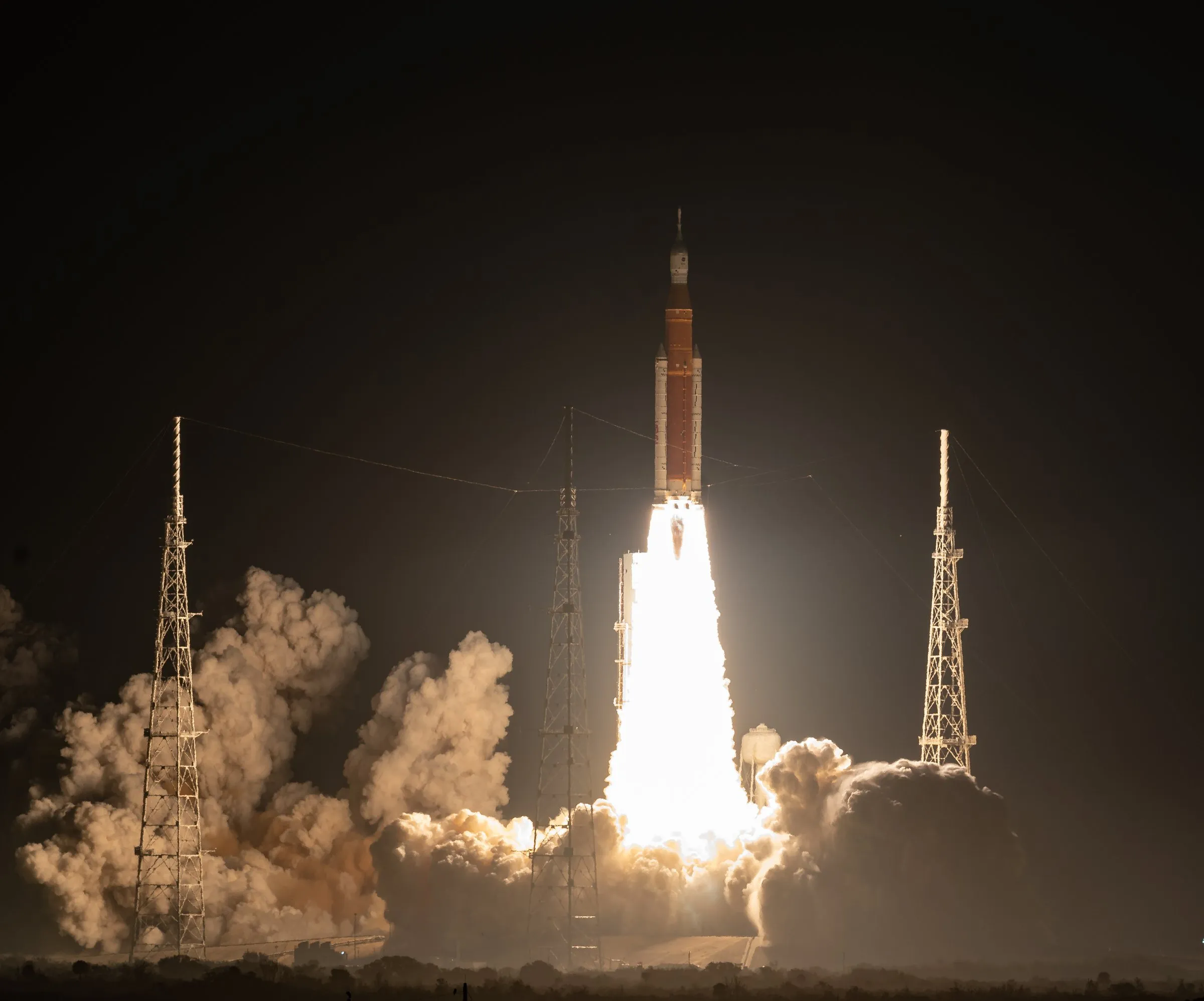
Fast enough, and a thrown object never comes back.
Look
Throw a ball upwards and it comes back down. Throw it faster, it goes higher before falling back. Is there a speed so fast that it never comes back?
Yes. It is called the escape speed (or escape velocity). Go at least that fast, with nothing slowing you down, and gravity can never pull you back.
| World | Escape speed from the surface |
|---|---|
| Moon | 2.4 km/s |
| Mars | 5.0 km/s |
| Earth | 11.2 km/s |
| Jupiter | 59.5 km/s |
| Sun | 617.6 km/s |
The Moon’s escape speed is less than a quarter of Earth’s. That is one reason why the Moon could be a useful place to launch things into space from.
In the cannon tool, the Moon is loaded. Try speeds below and above the escape speed shown in the readout.
Understand
Escape happens when the body’s kinetic energy is enough to climb out of the gravitational “well” completely. Setting kinetic energy equal to the energy needed to reach infinity:
½ v² = μ / r ⇒ v_escape = √(2μ / r)
Compare with the circular speed √(μ/r): escape speed is always √2 ≈ 1.414 times the circular speed at the same distance.
Two important facts:
- It does not depend on your mass. A pebble and a spaceship need the same speed. (The spaceship needs much more energy, of course.)
- It depends on where you start. Farther out, r is bigger and escape is easier. From the height of geostationary orbit, Earth’s escape speed is only about 4.3 km/s.
Rockets never actually fire up to 11.2 km/s at the ground. They climb steadily while their engines keep pushing. Escape speed is the speed needed for an unpowered object, like the cannonball.
Master
In terms of specific orbital energy ε = v²/2 − μ/r, escape means ε ≥ 0. At exactly ε = 0 the path is a parabola and the speed tends to zero at infinity. Faster than that, the path is a hyperbola and the object keeps a leftover speed far away, the hyperbolic excess speed v∞:
v² = v∞² + v_escape², C₃ = v∞²
Mission planners quote launch energy as C₃ (km²/s²). For a Mars transfer, v∞ at departure is about 2.9 km/s, so C₃ ≈ 8.7 km²/s².
This relation hides one of the most useful effects in spaceflight, the Oberth effect: a burn made deep in a gravity well, where you are already moving fast, buys more v∞ than the same burn made far away. From a 200 km parking orbit around Earth (circular speed 7.78 km/s, escape speed 11.0 km/s), reaching v∞ = 2.9 km/s needs only about 3.6 km/s of engine burn, not 3.2 + 2.9 = 6.1 km/s. The Delta-v Map uses this for every departure from low Earth orbit.
한번 해보세요
On the Moon, fire at a speed just below the escape speed shown in the readout, then just above. Compare the two paths. Then try the same on Earth and Mars.
Great. Challenges are where the learning sticks.
빠른 퀴즈
3 quick questions. Pick an answer to see if you are right.
-
Earth's escape speed from the surface is about:
- A 7.9 km/s
- B 11.2 km/s
- C 29.8 km/s
- D 617 km/s
Show the answer
B. 11.2 km/s
-
Escape speed is how many times the circular orbit speed at the same distance?
- A 2
- B √2 (about 1.41)
- C 1/2
- D π
Show the answer
B. √2 (about 1.41)
-
Does escape speed depend on the mass of the object being launched?
- A Yes, heavier objects need more
- B Yes, lighter objects need more
- C No, only on the planet's mass and the starting distance
- D Only in an atmosphere
Show the answer
C. No, only on the planet's mass and the starting distance
Finish line
- Played with the interactive
- Read the lesson
- Did the challenge
- Took the quiz
Mark the lesson complete to save it to your progress on this device.
Lesson complete. Well done!
Up next Why an orbit is a fall이 레슨의 단어
소스
- NASA JPL, Basics of Space Flight, Chapter 3: Gravity and Mechanics
- NASA NSSDCA Planetary Fact Sheet (escape velocities)
- JPL SSD: Planetary Physical Parameters
- NASA NSSDCA Sun Fact Sheet
이 레슨은 CC BY-SA 4.0 라이선스로 제공됩니다.