
Lekti sa a te ekri pa yon Local Solar System Li se yon manm ekip Fondasyon an epi li ka amelyore pa yon revizè ki kalifye. Èske w gen konesans sou sijè sa a? Suggere un changement
Kanon Newton
Ouverture pageMontan an te desene pi wo pase nenpòt ki lòt montan reyèl pou ou ka wè l. Rezistans lè a pa pran an kont.
Tablè done (altènatif tèks)
Pi lent ke vitès ki an cercle: li tonbe tounen. Ant vitès ki an cercle ak vitès escape: li orbite. A oswa pi wo pase vitès escape: li kite pou toutan.
| Planèt | Vitès orbit ki pi piti | Vitès escape la |
|---|---|---|
| Tè | 7.61 km/s | 10.8 km/s |
| Lune | 1.62 km/s | 2.29 km/s |
| Mars | 3.42 km/s | 4.84 km/s |
Throw a ball up and it comes back. Throw it hard enough and it never does. On Earth, that speed is 11.2 kilometres every second, and reaching it is why rockets are so enormous.
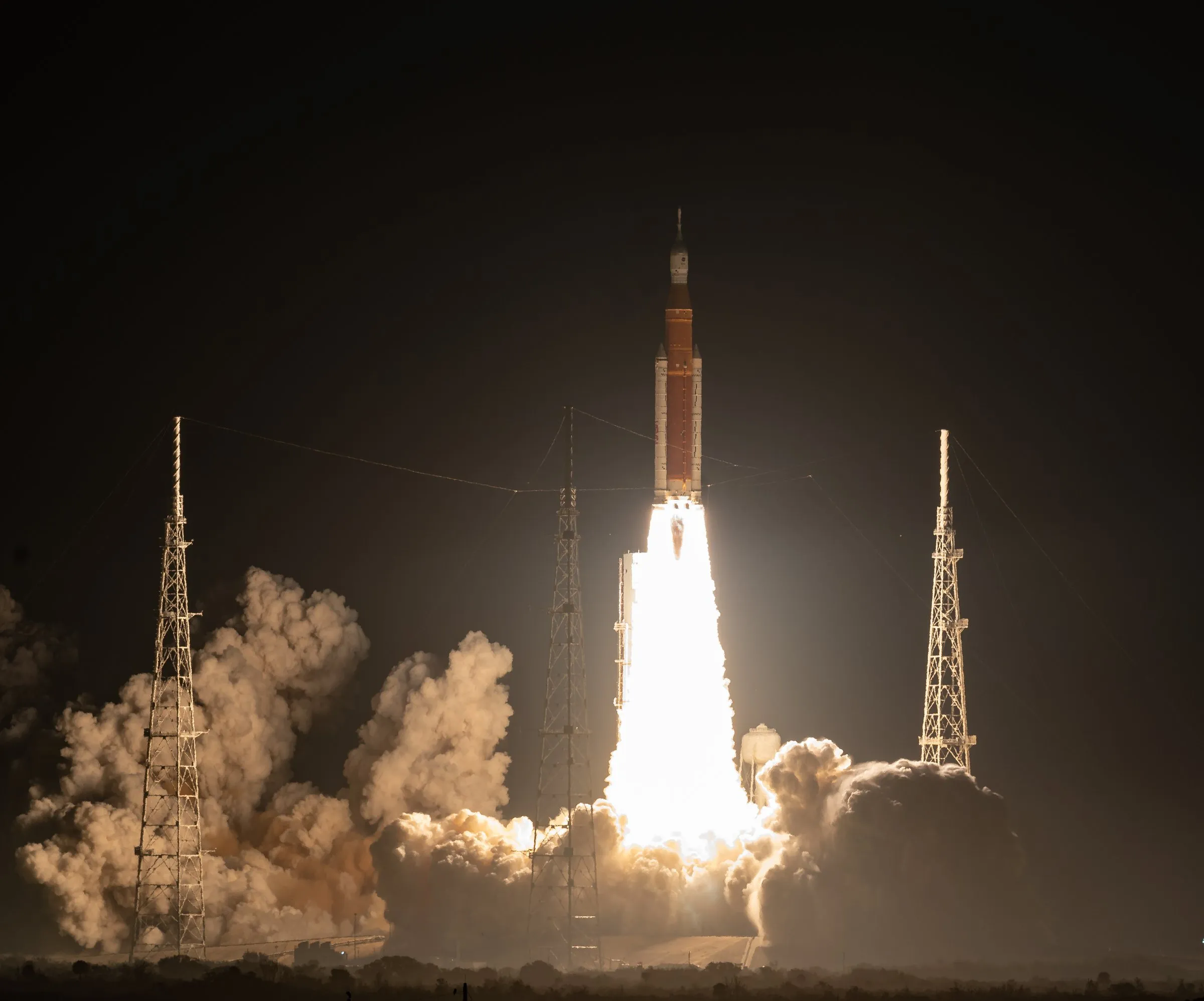
Fast enough, and a thrown object never comes back.
Look
Throw a ball upwards and it comes back down. Throw it faster, it goes higher before falling back. Is there a speed so fast that it never comes back?
Yes. It is called the escape speed (or escape velocity). Go at least that fast, with nothing slowing you down, and gravity can never pull you back.
| World | Escape speed from the surface |
|---|---|
| Moon | 2.4 km/s |
| Mars | 5.0 km/s |
| Earth | 11.2 km/s |
| Jupiter | 59.5 km/s |
| Sun | 617.6 km/s |
The Moon’s escape speed is less than a quarter of Earth’s. That is one reason why the Moon could be a useful place to launch things into space from.
In the cannon tool, the Moon is loaded. Try speeds below and above the escape speed shown in the readout.
Understand
Escape happens when the body’s kinetic energy is enough to climb out of the gravitational “well” completely. Setting kinetic energy equal to the energy needed to reach infinity:
½ v² = μ / r ⇒ v_escape = √(2μ / r)
Compare with the circular speed √(μ/r): escape speed is always √2 ≈ 1.414 times the circular speed at the same distance.
Two important facts:
- It does not depend on your mass. A pebble and a spaceship need the same speed. (The spaceship needs much more energy, of course.)
- It depends on where you start. Farther out, r is bigger and escape is easier. From the height of geostationary orbit, Earth’s escape speed is only about 4.3 km/s.
Rockets never actually fire up to 11.2 km/s at the ground. They climb steadily while their engines keep pushing. Escape speed is the speed needed for an unpowered object, like the cannonball.
Master
In terms of specific orbital energy ε = v²/2 − μ/r, escape means ε ≥ 0. At exactly ε = 0 the path is a parabola and the speed tends to zero at infinity. Faster than that, the path is a hyperbola and the object keeps a leftover speed far away, the hyperbolic excess speed v∞:
v² = v∞² + v_escape², C₃ = v∞²
Mission planners quote launch energy as C₃ (km²/s²). For a Mars transfer, v∞ at departure is about 2.9 km/s, so C₃ ≈ 8.7 km²/s².
This relation hides one of the most useful effects in spaceflight, the Oberth effect: a burn made deep in a gravity well, where you are already moving fast, buys more v∞ than the same burn made far away. From a 200 km parking orbit around Earth (circular speed 7.78 km/s, escape speed 11.0 km/s), reaching v∞ = 2.9 km/s needs only about 3.6 km/s of engine burn, not 3.2 + 2.9 = 6.1 km/s. The Delta-v Map uses this for every departure from low Earth orbit.
Tcheke li
On the Moon, fire at a speed just below the escape speed shown in the readout, then just above. Compare the two paths. Then try the same on Earth and Mars.
Great. Chalè yo se kote lekòl la ranje.
Konplo rapid
3 kesyon rapid. Chwazi yon repons pou wè si ou gen dwa.
-
Earth's escape speed from the surface is about:
- A 7.9 km/s
- B 11.2 km/s
- C 29.8 km/s
- D 617 km/s
Montre repons lan
B. 11.2 km/s
-
Escape speed is how many times the circular orbit speed at the same distance?
- A 2
- B √2 (about 1.41)
- C 1/2
- D π
Montre repons lan
B. √2 (about 1.41)
-
Does escape speed depend on the mass of the object being launched?
- A Yes, heavier objects need more
- B Yes, lighter objects need more
- C No, only on the planet's mass and the starting distance
- D Only in an atmosphere
Montre repons lan
C. No, only on the planet's mass and the starting distance
Finish line
- Jwe ak interaktif
- Li leson an
- Te fè defi a
- Te pran tès la
Mark the lesson complete to save it to your progress on this device.
Leson an fini. Bon travay!
Up next Why an orbit is a fallMo nan leson sa a
Fon
- NASA JPL, Basics of Space Flight, Chapter 3: Gravity and Mechanics
- NASA NSSDCA Planetary Fact Sheet (escape velocities)
- JPL SSD: Planetary Physical Parameters
- NASA NSSDCA Sun Fact Sheet
Lekti sa a gen lisans CC BY-SA 4.0.