
Le ndatshana yabhalwa nguLocal Solar System ilungu leqembu le Foundation futhi ingathuthukiswa ngumbuyekezi oqeqeshiwe. Ingabe uqeqeshiwe kulolu daba? Sicela uhlela
I-Cannon kaNewton
Vula ikhasi eligcweleI-mountain izotshwa phezulu kunanoma iyiphi enye ekhona ukuze ukwazi ukuyibona. Ukumelana nomoya kulahlekile.
Ithebula ledatha (ukhetho lombhalo)
Ehamba kancane kunejubane lokujikeleza: libuyela emuva. Kuphakathi kwejubane lokujikeleza nelokuphuma: lijikeleza. Kuye noma ngaphezu kwejubane lokuphuma: lishiya ngokugcwele.
| Iplanethi | Isivinini sokuhamba nge-orbit esijikelezayo lapha | Isivinini sokuyeka lapha |
|---|---|---|
| Iplanethi | 7.61 km/s | 10.8 km/s |
| Inyanga | 1.62 km/s | 2.29 km/s |
| i-Mars | 3.42 km/s | 4.84 km/s |
The force that pulls an apple to the ground is the same force that holds the Moon in its orbit and the planets around the Sun. Isaac Newton’s great idea was that one law explains them all. Here you will fire his cannon and find out why.
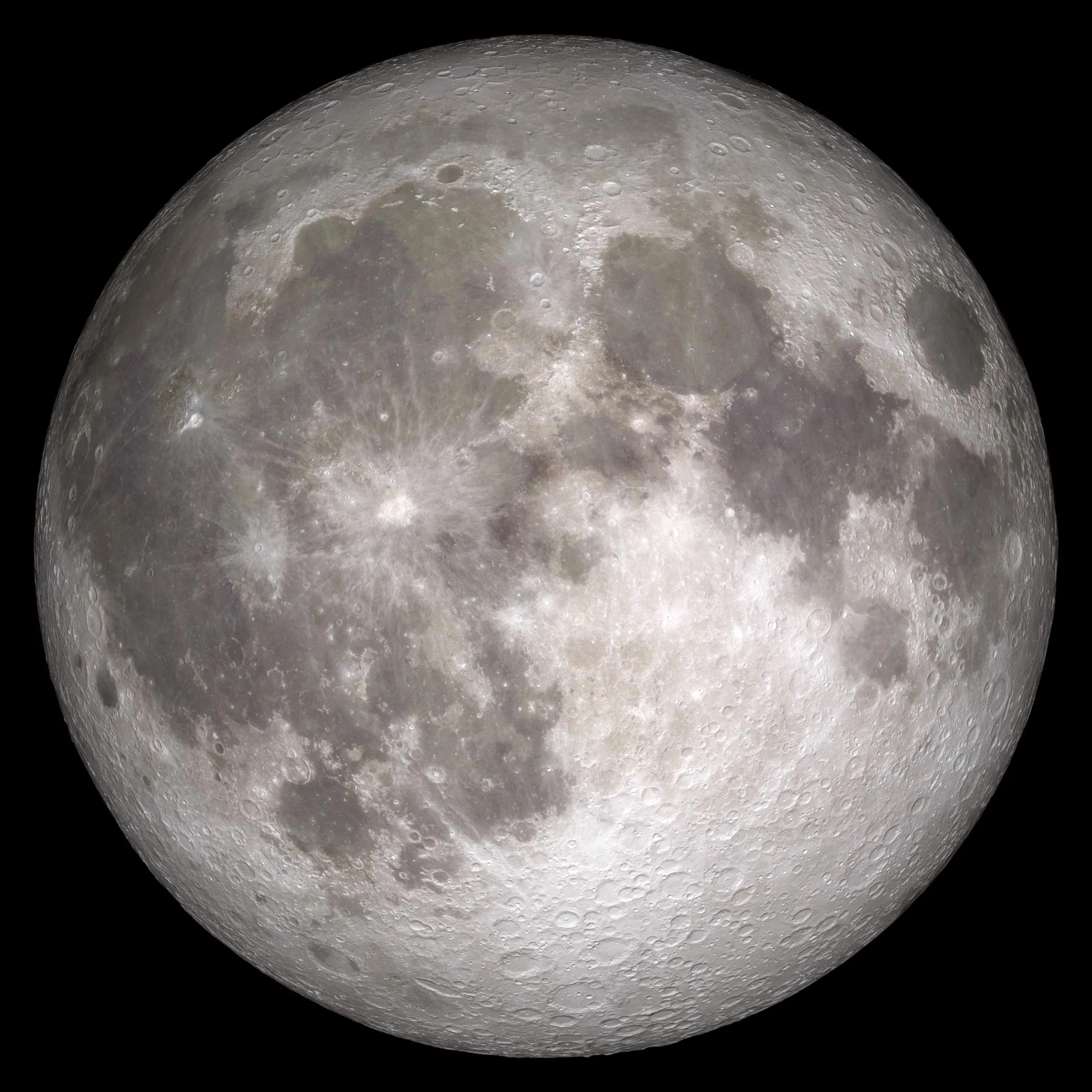
The Moon is falling towards Earth all the time. It just keeps missing.
Look
Drop a ball and it falls. Throw it sideways and it still falls, but it lands farther away. Isaac Newton asked a simple question: what if you threw it really fast?
Imagine a cannon on top of an impossibly tall mountain, above the air. Fire a cannonball slowly and it curves down and hits the ground. Fire it faster and it lands farther away. Because Earth is round, the ground curves away beneath the ball. At just the right speed, the ground curves away exactly as fast as the ball falls. The ball keeps falling, but never lands. It is in orbit.
Try it with the cannon above. Start slow, then go faster:
- Too slow: it falls back (red).
- Just right: it goes all the way around (green).
- Much faster: it escapes and never comes back (yellow).
This is also why astronauts float. They are not beyond gravity. They, and their spacecraft, are falling around Earth together.
Understand
Newton’s law of universal gravitation says every mass pulls on every other mass:
F = G · M · m / r²
- F is the force, M and m the two masses, r the distance between their centres.
- G is the gravitational constant: 6.674 × 10⁻¹¹ N m² kg⁻².
Two ideas are packed into it:
- Heavier things pull harder. Double the mass, double the force.
- Distance weakens it fast. Double the distance and the force drops to a quarter. That is the inverse-square law.
Near a planet, the acceleration of anything falling is g = GM / r². For Earth that gives about 9.8 m/s² at the surface. At the height of the International Space Station (about 420 km), r is only 7% larger, so gravity is still about 88% as strong.
For a circular orbit, gravity must supply exactly the pull needed to keep turning the path:
v_circular = √(GM / r)
Just above Earth’s surface this is about 7.9 km/s. Faster than a rifle bullet: roughly 28,000 km/h.
Master
In practice we almost never use G and M separately. Their product μ = GM, the gravitational parameter, is measured directly and far more precisely from the motion of moons and spacecraft. For Earth, μ = 398,600.4355 km³ s⁻², known to a few parts per billion, while G itself is known only to about 22 parts per million (CODATA 2018). The mass of Earth quoted in tables is really μ divided by G, and it inherits G’s uncertainty.
The cannon tool solves the motion exactly for a two-body problem. A horizontal launch from radius r₀ with speed v gives angular momentum h = r₀v and a conic orbit:
r(ν) = p / (1 + e cos ν), p = h² / μ, e = |p / r₀ − 1|
where ν is the angle from periapsis. If v is below the circular speed, the launch point is the apoapsis and the path dips inward; if it also dips below the surface, the ball hits the ground. At √(μ/r₀) the orbit is a circle (e = 0). At √(2μ/r₀) it becomes a parabola (e = 1) and the ball escapes.
Newton’s law also explains why the tool’s mountain is drawn so absurdly tall: in reality the air would slow any cannonball long before orbital speed, which is why rockets climb above most of the atmosphere before accelerating sideways.
Zama
On Earth, find the slowest launch speed that still gives an orbit. Then switch to the Moon and to Mars. Why is the answer so different? Check it against the numbers in the readout.
Iningi. Izinhlekelele zikhona lapho ukufunda kuqhubeka khona.
Umbuzo osheshayo
3 imibuzo esheshayo. Khetha impendulo ukuze ubone uma ulungile.
-
If you double the distance between two objects, the gravitational force between them becomes:
- A Twice as strong
- B Half as strong
- C A quarter as strong
- D Unchanged
Bonisa impendulo
C. A quarter as strong Gravity follows an inverse-square law: 1/2² = 1/4.
-
Astronauts on the International Space Station float because:
- A There is no gravity in space
- B They are falling around Earth together with the station
- C The station is outside Earth's atmosphere
- D The Moon pulls them up
Bonisa impendulo
B. They are falling around Earth together with the station At the station's height gravity is still about 90% of its surface value.
-
What is the circular orbit speed just above Earth's surface (ignoring air)?
- A About 0.8 km/s
- B About 7.9 km/s
- C About 11.2 km/s
- D About 30 km/s
Bonisa impendulo
B. About 7.9 km/s v = √(GM/r) = √(398,600 / 6,371) ≈ 7.9 km/s. 11.2 km/s is the escape speed.
Ingxenye yelayini
- Idlala nge-interactive
- Funda isifundo
- Ukwenze kanjani isiphakamiso
- Uthathe isifundo
Phawula isifundo siqediwe ukuze uyigcine ekwenzeni kwakho kulolu hlelo.
Isifundo siqediwe. Kulungile!
Phezulu okulandelayo Kepler's lawsAmagama kule ncwadi
Amasu
- NASA JPL, Basics of Space Flight, Chapter 3: Gravity and Mechanics
- I. Newton, Philosophiae Naturalis Principia Mathematica (1687), Book III; the cannon thought experiment is in 'A Treatise of the System of the World' (1728)
- CODATA 2018 value of the Newtonian constant of gravitation (NIST)
- JPL SSD: astrodynamic parameters (GM values)
- NASA NSSDCA Planetary Fact Sheet
Le ndatshana ilayisense CC BY-SA 4.0.