
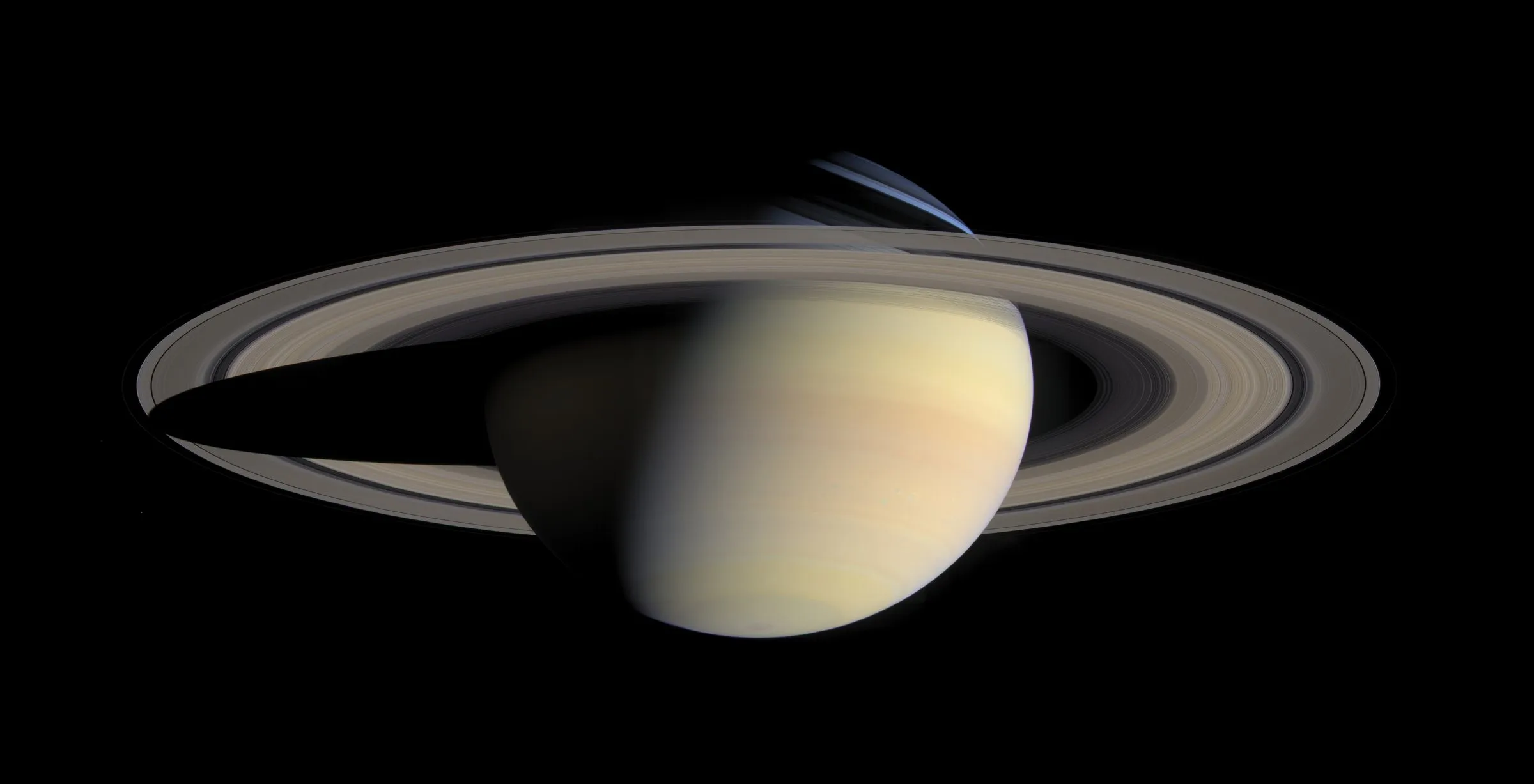
전문가 검토를 기다리고 있습니다. 이 강의는 인공지능을 사용하여 작성되었으며, 아직 자격이 있는 검토자에 의해 확인되지 않았습니다. Are you qualified in this subject? Suggest an edit
뉴턴 대포
전체 페이지 열기산은 실제보다 훨씬 높게 그려져 있어서 보이게 합니다. 공기 저항은 무시됩니다.
데이터 테이블 (텍스트 대체)
원형 속도보다 느리면: 뒤로 떨어집니다. 원형과 탈출 속도 사이에서는: 공전합니다. 탈출 속도 이상일 경우: 영원히 떠납니다.
| 행성 | 원형 궤도 속도 | 탈출속도 여기서 |
|---|---|---|
| 지구 | 7.61 km/s | 10.8 km/s |
| 달 | 1.62 km/s | 2.29 km/s |
| 화성 | 3.42 km/s | 4.84 km/s |
The force that pulls an apple to the ground is the same force that holds the Moon in its orbit and the planets around the Sun. Isaac Newton’s great idea was that one law explains them all. Here you will fire his cannon and find out why.
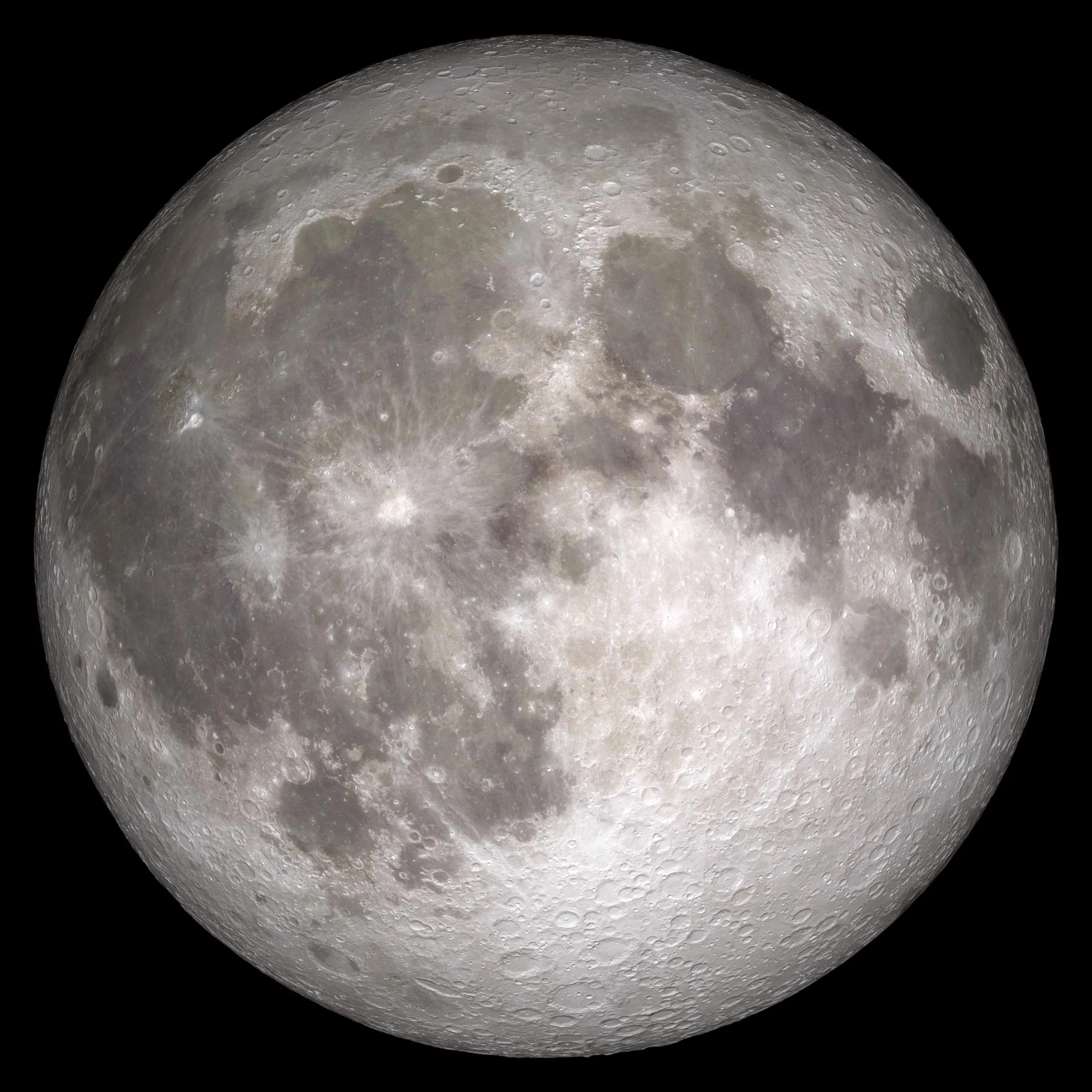
The Moon is falling towards Earth all the time. It just keeps missing.
Look
Drop a ball and it falls. Throw it sideways and it still falls, but it lands farther away. Isaac Newton asked a simple question: what if you threw it really fast?
Imagine a cannon on top of an impossibly tall mountain, above the air. Fire a cannonball slowly and it curves down and hits the ground. Fire it faster and it lands farther away. Because Earth is round, the ground curves away beneath the ball. At just the right speed, the ground curves away exactly as fast as the ball falls. The ball keeps falling, but never lands. It is in orbit.
Try it with the cannon above. Start slow, then go faster:
- Too slow: it falls back (red).
- Just right: it goes all the way around (green).
- Much faster: it escapes and never comes back (yellow).
This is also why astronauts float. They are not beyond gravity. They, and their spacecraft, are falling around Earth together.
Understand
Newton’s law of universal gravitation says every mass pulls on every other mass:
F = G · M · m / r²
- F is the force, M and m the two masses, r the distance between their centres.
- G is the gravitational constant: 6.674 × 10⁻¹¹ N m² kg⁻².
Two ideas are packed into it:
- Heavier things pull harder. Double the mass, double the force.
- Distance weakens it fast. Double the distance and the force drops to a quarter. That is the inverse-square law.
Near a planet, the acceleration of anything falling is g = GM / r². For Earth that gives about 9.8 m/s² at the surface. At the height of the International Space Station (about 420 km), r is only 7% larger, so gravity is still about 88% as strong.
For a circular orbit, gravity must supply exactly the pull needed to keep turning the path:
v_circular = √(GM / r)
Just above Earth’s surface this is about 7.9 km/s. Faster than a rifle bullet: roughly 28,000 km/h.
Master
In practice we almost never use G and M separately. Their product μ = GM, the gravitational parameter, is measured directly and far more precisely from the motion of moons and spacecraft. For Earth, μ = 398,600.4355 km³ s⁻², known to a few parts per billion, while G itself is known only to about 22 parts per million (CODATA 2018). The mass of Earth quoted in tables is really μ divided by G, and it inherits G’s uncertainty.
The cannon tool solves the motion exactly for a two-body problem. A horizontal launch from radius r₀ with speed v gives angular momentum h = r₀v and a conic orbit:
r(ν) = p / (1 + e cos ν), p = h² / μ, e = |p / r₀ − 1|
where ν is the angle from periapsis. If v is below the circular speed, the launch point is the apoapsis and the path dips inward; if it also dips below the surface, the ball hits the ground. At √(μ/r₀) the orbit is a circle (e = 0). At √(2μ/r₀) it becomes a parabola (e = 1) and the ball escapes.
Newton’s law also explains why the tool’s mountain is drawn so absurdly tall: in reality the air would slow any cannonball long before orbital speed, which is why rockets climb above most of the atmosphere before accelerating sideways.
한번 해보세요
On Earth, find the slowest launch speed that still gives an orbit. Then switch to the Moon and to Mars. Why is the answer so different? Check it against the numbers in the readout.
Great. Challenges are where the learning sticks.
빠른 퀴즈
3 quick questions. Pick an answer to see if you are right.
-
If you double the distance between two objects, the gravitational force between them becomes:
- A Twice as strong
- B Half as strong
- C A quarter as strong
- D Unchanged
Show the answer
C. A quarter as strong Gravity follows an inverse-square law: 1/2² = 1/4.
-
Astronauts on the International Space Station float because:
- A There is no gravity in space
- B They are falling around Earth together with the station
- C The station is outside Earth's atmosphere
- D The Moon pulls them up
Show the answer
B. They are falling around Earth together with the station At the station's height gravity is still about 90% of its surface value.
-
What is the circular orbit speed just above Earth's surface (ignoring air)?
- A About 0.8 km/s
- B About 7.9 km/s
- C About 11.2 km/s
- D About 30 km/s
Show the answer
B. About 7.9 km/s v = √(GM/r) = √(398,600 / 6,371) ≈ 7.9 km/s. 11.2 km/s is the escape speed.
Finish line
- Played with the interactive
- Read the lesson
- Did the challenge
- Took the quiz
Mark the lesson complete to save it to your progress on this device.
Lesson complete. Well done!
Up next Kepler's laws이 레슨의 단어
소스
- NASA JPL, Basics of Space Flight, Chapter 3: Gravity and Mechanics
- I. Newton, Philosophiae Naturalis Principia Mathematica (1687), Book III; the cannon thought experiment is in 'A Treatise of the System of the World' (1728)
- CODATA 2018 value of the Newtonian constant of gravitation (NIST)
- JPL SSD: astrodynamic parameters (GM values)
- NASA NSSDCA Planetary Fact Sheet
이 레슨은 CC BY-SA 4.0 라이선스로 제공됩니다.