
Population, consumption and resources
Eight billion people share one planet. How gently we can live on it depends less on how many we are than on what we use, and how we make it.
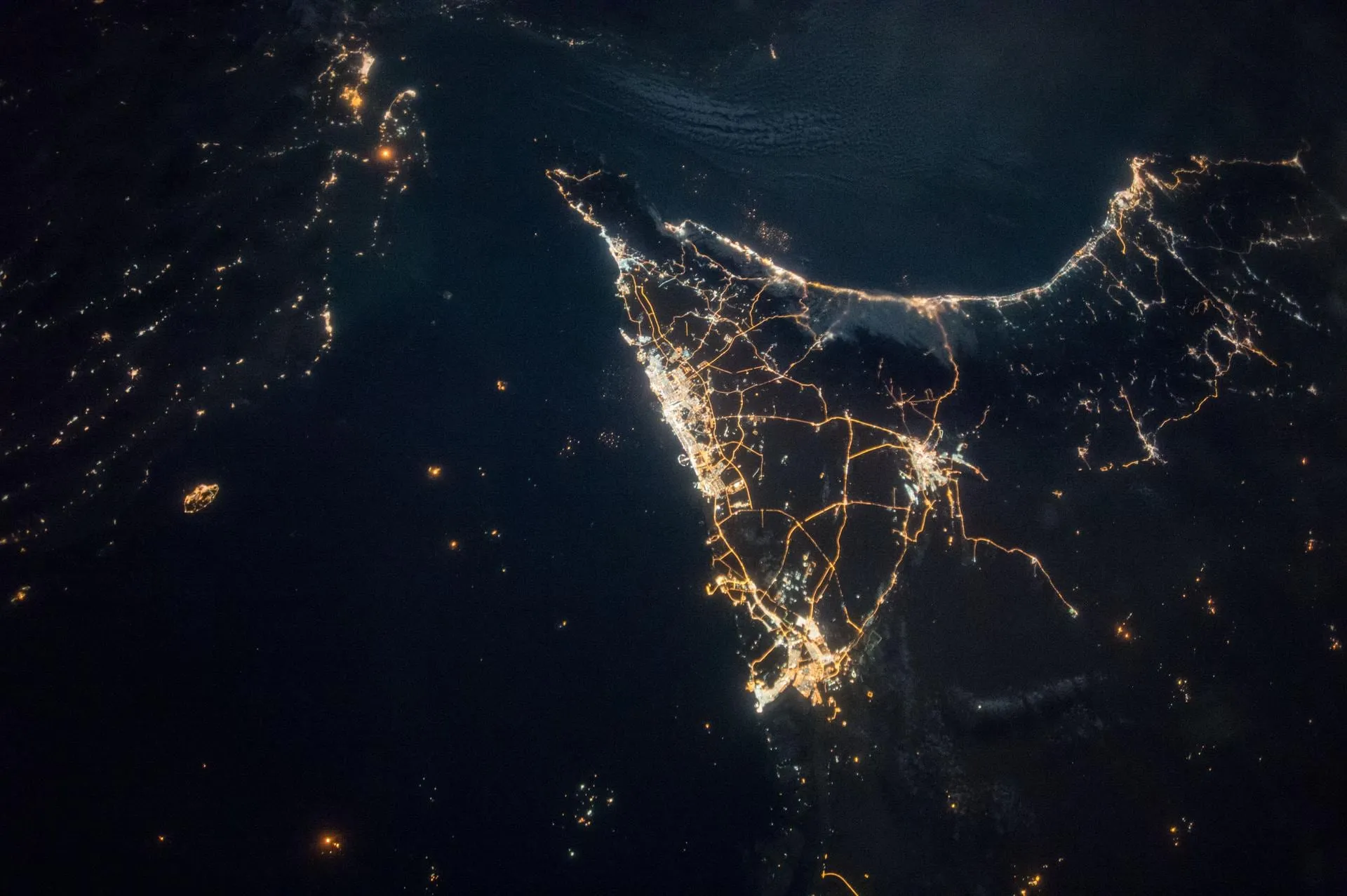
NASA
Seen from orbit at night, the Nile draws a line of light through the desert: tens of millions of people living along one river, as people have for seven thousand years. Humanity passed 8 billion people in 2022 and the United Nations expects the population to peak at about 10.3 billion in the mid-2080s before slowly declining. How that many people can live well on one planet is one of the defining questions of the century. This explainer is educational: Local Solar System takes no position on anyone’s personal choices about family size.
One simple equation
Scientists often summarise human impact with a simple identity: Impact = Population x Affluence x Technology, or IPAT. Population is how many of us there are. Affluence is how much each person consumes. Technology is how much impact each unit of consumption causes: the emissions per kilowatt-hour, the land per tonne of food, the waste per product. It is not a law of nature, but it shows where the levers are.
P: how many of us
Population growth is slowing almost everywhere, because families are choosing to have fewer children as child survival, education (particularly for girls), and incomes improve. More than half of all countries now have fertility below the replacement level of about 2.1 children per woman. Future growth is concentrated in parts of Africa and Asia; elsewhere populations are ageing and, in many countries, already shrinking.
A: how much each of us uses
Consumption is far more unequal than population. The richest tenth of humanity is responsible for roughly half of consumption-based emissions, while the poorest half accounts for about a tenth (Chancel, 2022). The world extracts more than 100 billion tonnes of materials every year, three times as much as in 1970 (UNEP International Resource Panel, 2024). Lifting billions of people out of poverty will raise consumption where it is lowest, which makes the third lever decisive.
T: where engineering helps most
The T is where invention pays off. Electricity from wind and solar, efficient buildings and vehicles, precision farming, recycling and circular design all cut the impact of each unit of consumption. History shows this lever can be enormous: the energy needed to produce a unit of economic output has fallen steadily for decades, and in many rich countries emissions have fallen while incomes kept rising.
Fewer resources per life, not fewer lives, is the lever that engineering can pull.
Cities
More than half of humanity lives in cities, and the UN expects about two thirds to by 2050. Dense cities can be remarkably efficient: shorter trips, shared walls, public transport and shared services. Badly planned sprawl is the opposite. How the next two billion urban homes are built will shape resource use for a century.
How you can help
- Use things longer. Repair, buy second hand, borrow and share tools; the materials already in circulation are the cheapest resource of all.
- Waste less food. Roughly a fifth of food available to consumers is wasted; plan meals, store food well and use leftovers.
- Eat more plants where you can; plant-based meals usually need far less land and water.
- Support education, especially for girls, which improves lives and, as a consequence, is linked to smaller families by choice.
- Ask for circular rules: right to repair, longer warranties, deposit schemes and recycled content standards.
- Join the conversation and help translate this explainer via the contribution board.
Sources and further reading
- United Nations (2024), World Population Prospects 2024
- United Nations, World Urbanization Prospects
- UNEP International Resource Panel (2024), Global Resources Outlook 2024
- Global Footprint Network, Earth Overshoot Day
- UNEP (2024), Food Waste Index Report 2024
- Ehrlich and Holdren (1971), Impact of population growth, Science 171
- Chancel (2022), Global carbon inequality over 1990 to 2019, Nature Sustainability 5
- Our World in Data, Population growth