
Energy sources compared
Every kilowatt-hour has a hidden history: a mine, a factory, a chimney or a blade. Compare them honestly and the picture is clearer than the debate.
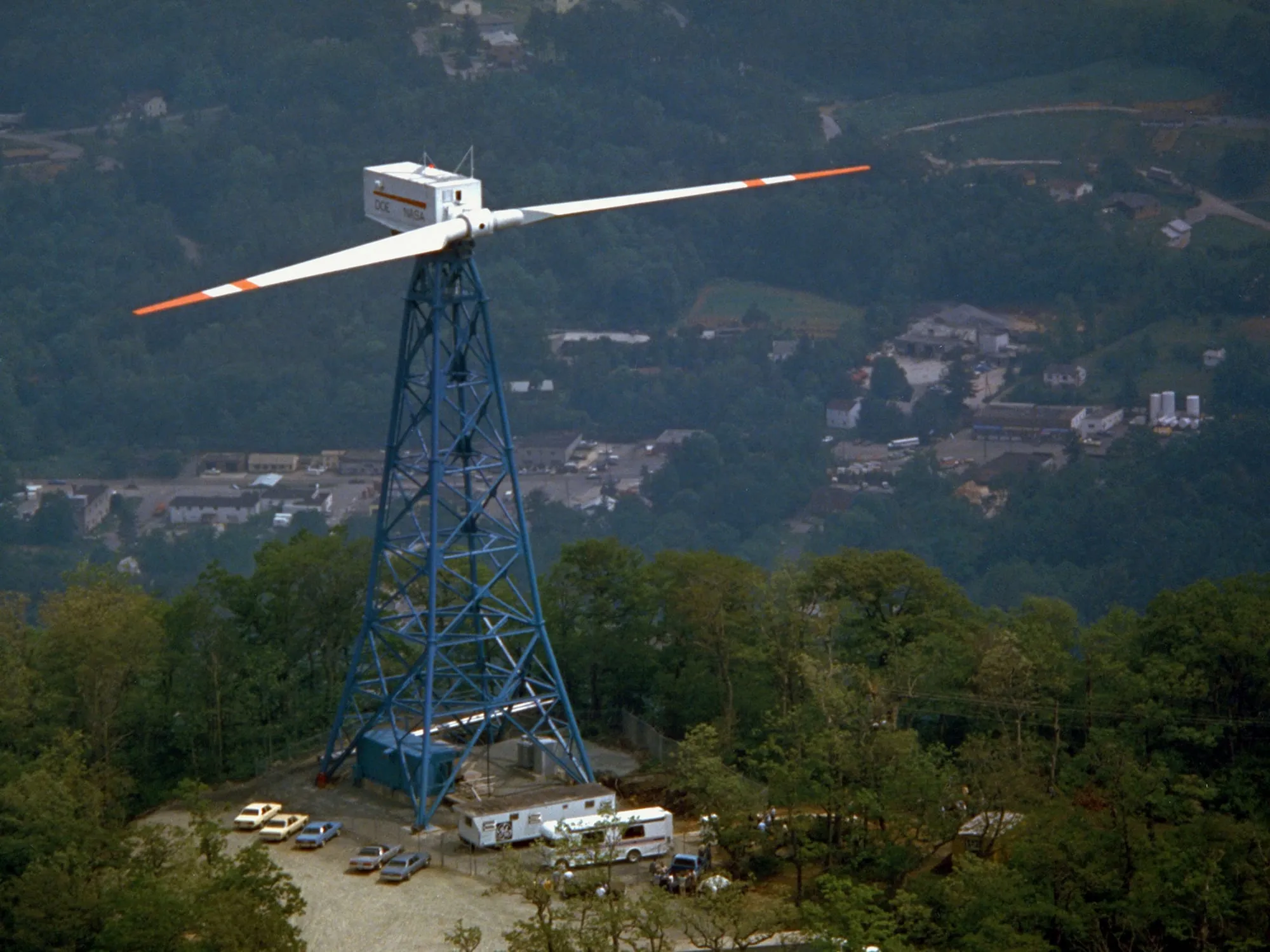
NASA Glenn Research Center
In 1979 NASA switched on the Mod-1, a two-bladed wind turbine with a rotor 61 metres across, on a mountain in North Carolina. It was one of the largest turbines of its day and one of the first attempts to make wind power a serious part of the grid. Four decades later wind and solar are the fastest-growing sources of electricity on the planet. To understand why, and what they still cannot do, it helps to compare every source on the same terms.
The whole life, not just the chimney
A power station’s emissions do not stop at its chimney. Steel and concrete must be made, fuel mined and transported, and everything eventually dismantled. Lifecycle assessments add all of this up per kilowatt-hour. The IPCC’s review of hundreds of such studies gives a clear ranking: coal emits around 820 grams of CO2-equivalent per kilowatt-hour, gas about 490, while wind, nuclear and hydropower are around 10 to 25, and solar around 40 to 50.
Safety tells a similar story. Counting deaths from accidents and from air pollution per unit of electricity, coal and oil are the most dangerous sources by far, because burning them fills the air with particles. Wind, nuclear and solar are hundreds of times safer.
What each source is good at
- Coal and gas can be switched on when needed, but carry the highest emissions and pollution. Gas emits about half as much CO2 as coal when burned, though methane leaks narrow the gap.
- Nuclear runs steadily with very low emissions and a tiny land footprint; it is expensive and slow to build, and waste must be managed for a very long time.
- Hydropower is flexible and low-carbon, but dams flood valleys and change rivers.
- Wind is among the cheapest new electricity; it varies with the weather and needs space, grids and, increasingly, storage.
- Solar is cheap, modular and fits on rooftops from a village to a skyscraper; it produces nothing at night and less in winter.
There is no perfect source. There are only better and worse mixes, and the mix is ours to choose.
The missing piece: flexibility
The challenge of a clean power system is not generating enough energy on average, but matching supply and demand every second. Batteries, pumped hydro, stronger grids that share power across regions, demand that follows the sun and wind, and firm low-carbon sources all fill that gap. This is also why we research modular generation that can sit where power is used, such as the Fan Wall.
How you can help
- Switch your supply to a renewable tariff or community energy scheme where one is available.
- Use power when it is clean. Run washing machines and charge vehicles when wind and solar are plentiful; many grids publish real-time carbon intensity.
- Put panels on roofs. Homes, schools, supermarkets and car parks are ready-made solar sites; ask your council and your employer.
- Save before you generate. Insulation and efficient appliances cut bills and emissions at the same time.
- Ask for the numbers. Ask your electricity supplier and your government for the lifecycle emissions of the power you buy.
- Join the research on the contribution board.
Sources and further reading
- IPCC (2014), AR5 Working Group III, Annex III: Technology-specific cost and performance parameters
- Our World in Data (2020), What are the safest and cleanest sources of energy?
- NASA Glenn Research Center, Wind energy research history
- IEA, Renewables