
Moon Phases and Eclipses
Move the Moon around the Earth and see its phase from Earth, and when eclipses can happen.
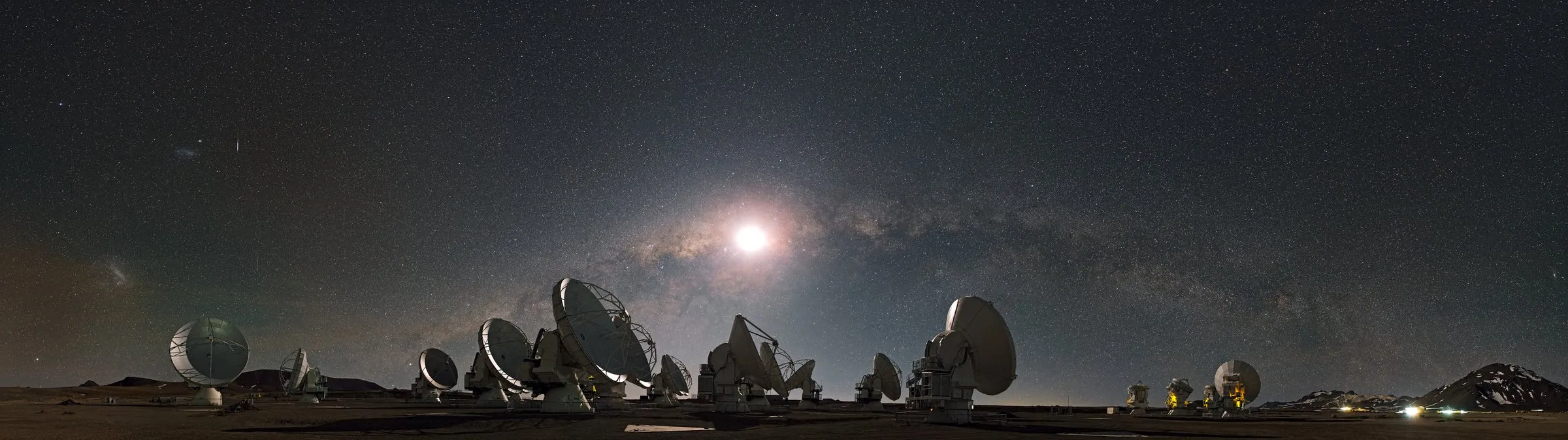
ESO/S. Guisard (www.eso.org/~sguisard) (CC BY 4.0)
Moon Phases and Eclipses
What is this? The Moon makes no light of its own. The Sun always lights one half of it, and as the Moon travels round Earth, about once every 29.5 days, we see more or less of that lit half. Those changing shapes are the phases.
How to use it: Drag the "Days from today" slider, or press Play. The big view looks down on Earth and the Moon from far above; the small picture shows the Moon as you would see it from Earth.
The Moon tonight
Next full Moon: Next new Moon:
View from above
View from Earth
Seen from the southern hemisphere the Moon is upside down compared with the northern view, so the lit side is flipped.
Try this
- Drag until the Moon sits between Earth and the Sun.Notice: That is new Moon. The lit half faces away from us, so we see nothing; the Moon is in the daytime sky, lost in the Sun's glare.
- Keep going about 15 days, to full Moon.Notice: Now Earth is between the Sun and the Moon and we see the whole lit half. A full Moon rises as the Sun sets and is up all night.
- Press Play and watch the message under the numbers at each new and full Moon.Notice: Most months there is no eclipse: the Moon's path is tilted by about 5°, so it usually passes above or below the shadow. Eclipses only happen in "eclipse seasons", about every six months.
- Tick "I live in the southern hemisphere".Notice: The picture turns upside down. From Australia or Argentina the waxing Moon is lit on the left, not the right.
The ideas behind it
Why do we see phases?
Shine a torch on a ball in a dark room and walk round it: from some places you see all of the lit half, from others only a sliver. The Sun is the torch, the Moon is the ball and you are on Earth in the middle. The phase has nothing to do with Earth's shadow; that only matters during a lunar eclipse.
Sources: Moon phase from J. Meeus, Astronomical Algorithms (2nd edition, 1998), chapters 47 to 48; eclipse screening from chapter 54. Next new and full Moon dates are computed from the same formulas and are accurate to within about half a day.
How much of the Moon's sunlit half we can see from Earth. It changes from nothing (new Moon) to all of it (full Moon) and back in about 29.5 days.
Waxing means growing: a little more is lit each night, from new Moon to full Moon. Waning means shrinking: from full Moon back to new Moon.
A crescent Moon is less than half lit, a thin curved sliver. A gibbous Moon is more than half lit but not yet full.
How much of the Moon's face, as we see it from Earth, is lit by the Sun. 50% is a half Moon; 100% is a full Moon.
The number of days since the last new Moon. A full cycle of phases takes about 29.5 days.
More in the glossary →When one body blocks another's light. In a solar eclipse the Moon blocks the Sun; in a lunar eclipse the Moon passes through Earth's shadow and turns dark or coppery red.
More in the glossary →One of the two points where the Moon's tilted path crosses the plane of Earth's path round the Sun. Eclipses can only happen when a new or full Moon falls near a node.
More in the glossary →Data table (text alternative)
| Date | Phase | Illuminated |
|---|---|---|
| Nov 12 | Waxing crescent | 11.4 % |
| Nov 13 | Waxing crescent | 18.1 % |
| Nov 14 | Waxing crescent | 25.9 % |
| Nov 15 | First quarter | 34.6 % |
| Nov 16 | First quarter | 43.9 % |
| Nov 17 | First quarter | 53.6 % |
| Nov 18 | First quarter | 63.4 % |
| Nov 19 | Waxing gibbous | 73 % |
| Nov 20 | Waxing gibbous | 81.9 % |
| Nov 21 | Waxing gibbous | 89.6 % |
| Nov 22 | Waxing gibbous | 95.5 % |
| Nov 23 | Full Moon | 99.1 % |
| Nov 24 | Full Moon | 99.9 % |
| Nov 25 | Full Moon | 97.8 % |
| Nov 26 | Waning gibbous | 92.9 % |
| Nov 27 | Waning gibbous | 85.5 % |
| Nov 28 | Waning gibbous | 76.2 % |
| Nov 29 | Last quarter | 65.7 % |
| Nov 30 | Last quarter | 54.6 % |
| Dec 1 | Last quarter | 43.7 % |
| Dec 2 | Last quarter | 33.3 % |
| Dec 3 | Waning crescent | 24 % |
| Dec 4 | Waning crescent | 15.9 % |
| Dec 5 | Waning crescent | 9.35 % |
| Dec 6 | Waning crescent | 4.45 % |
| Dec 7 | New Moon | 1.33 % |
| Dec 8 | New Moon | 0.0363 % |
| Dec 9 | New Moon | 0.585 % |
| Dec 10 | New Moon | 2.92 % |
| Dec 11 | Waxing crescent | 6.93 % |
Tools and lessons use simplified models for learning only. They must not be used for navigation, mission planning or any operational decision. Certificates are free and non-accredited. Read the educational content disclaimer