
Delta-v Map
How much change in speed it takes to move between Earth, orbit, the Moon, Mars and the asteroids.
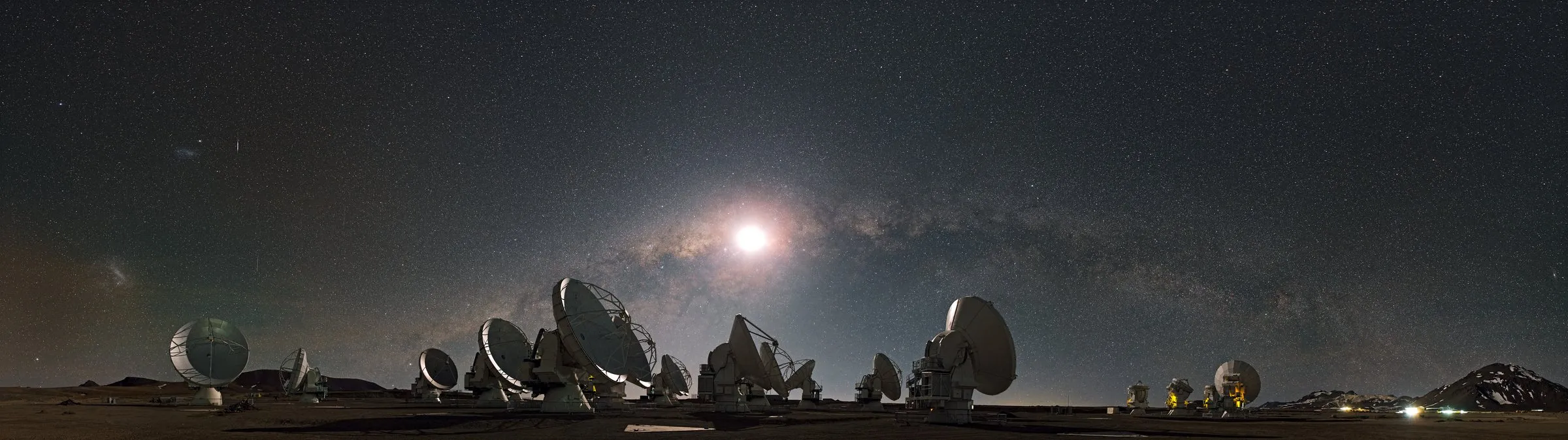
ESO/S. Guisard (www.eso.org/~sguisard) (CC BY 4.0)
Delta-v Map
Total delta-v
Steps
Values are one-way, ideal impulsive manoeuvres unless marked typical. Real missions add losses and plane changes.
Data table (text alternative)
| From | To | → | ← | How it was worked out |
|---|---|---|---|---|
| Earth surface | Low Earth orbit (200 km) | 9.4 km/s | 0 km/s (can use aerobraking) | typical (published): Delta-v budget (Wikipedia, with its cited references), typical values including lossesLaunch to orbit: about 7.8 km/s of orbital speed plus losses to gravity and air drag. |
| Low Earth orbit (200 km) | Geostationary transfer orbit | 2.45 km/s | 2.45 km/s (can use aerobraking) | computed (ideal): Hohmann perigee burn, 200 km to 35,786 km altitude, equatorial |
| Geostationary transfer orbit | Geostationary orbit | 1.48 km/s | 1.48 km/s | computed (ideal): Hohmann apogee burn, no plane changeFrom a launch site away from the equator, also changing the orbit's tilt adds a few hundred metres per second. |
| Low Earth orbit (200 km) | Earth escape | 3.22 km/s | 3.22 km/s (can use aerobraking) | computed (ideal): Escape speed minus circular speed at 200 km |
| Low Earth orbit (200 km) | Transfer to the Moon | 3.13 km/s | 3.13 km/s (can use aerobraking) | computed (ideal): Raise apogee to the Moon's mean distance |
| Transfer to the Moon | Low lunar orbit (100 km) | 0.82 km/s | 0.82 km/s | computed (ideal): Patched conic capture into a 100 km lunar orbit |
| Low lunar orbit (100 km) | Moon surface | 1.63 km/s | 1.63 km/s | computed (ideal): Circular speed at 100 km (ideal, no gravity losses; real landings need more) |
| Low Earth orbit (200 km) | Transfer to Mars | 3.61 km/s | 3.61 km/s (can use aerobraking) | computed (ideal): Earth-Mars Hohmann departure from 200 km, Oberth effect included |
| Transfer to Mars | Low Mars orbit (300 km) | 2.09 km/s (can use aerobraking) | 2.09 km/s | computed (ideal): Capture into a 300 km circular Mars orbit |
| Low Mars orbit (300 km) | Mars surface | 0 km/s (can use aerobraking) | 4.1 km/s | typical (published): Delta-v budget (Wikipedia, with its cited references), typical values including lossesLanding mostly uses the atmosphere (heat shield and parachutes); the ascent back to orbit is the published typical value. |
| Low Earth orbit (200 km) | Near-Earth asteroid (Bennu) | 4.11 km/s | 4.11 km/s (can use aerobraking) | computed (ideal): Heliocentric Hohmann 1 au to Bennu's semi-major axis, coplanar (ignores its 6 degree inclination and its eccentricity); departure from 200 km LEO |
| Low Earth orbit (200 km) | Ceres orbit | 9.48 km/s | 9.48 km/s (can use aerobraking) | computed (ideal): Heliocentric Hohmann 1 au to Ceres, coplanar (ignores its 10.6 degree inclination); departure from 200 km LEO, capture into a 200 km Ceres orbit |
Tools and lessons use simplified models for learning only. They must not be used for navigation, mission planning or any operational decision. Certificates are free and non-accredited. Read the educational content disclaimer