
This lesson was drafted by a Local Solar System Foundation team member and could be improved by a qualified reviewer. Are you qualified in this subject? Suggest an edit
Moon Phases and Eclipses
Open full pageWhat is this? The Moon makes no light of its own. The Sun always lights one half of it, and as the Moon travels round Earth, about once every 29.5 days, we see more or less of that lit half. Those changing shapes are the phases.
How to use it: Drag the "Days from today" slider, or press Play. The big view looks down on Earth and the Moon from far above; the small picture shows the Moon as you would see it from Earth.
The Moon tonight
Next full Moon: Next new Moon:
View from above
View from Earth
Seen from the southern hemisphere the Moon is upside down compared with the northern view, so the lit side is flipped.
Try this
- Drag until the Moon sits between Earth and the Sun.Notice: That is new Moon. The lit half faces away from us, so we see nothing; the Moon is in the daytime sky, lost in the Sun's glare.
- Keep going about 15 days, to full Moon.Notice: Now Earth is between the Sun and the Moon and we see the whole lit half. A full Moon rises as the Sun sets and is up all night.
- Press Play and watch the message under the numbers at each new and full Moon.Notice: Most months there is no eclipse: the Moon's path is tilted by about 5°, so it usually passes above or below the shadow. Eclipses only happen in "eclipse seasons", about every six months.
- Tick "I live in the southern hemisphere".Notice: The picture turns upside down. From Australia or Argentina the waxing Moon is lit on the left, not the right.
The ideas behind it
Why do we see phases?
Shine a torch on a ball in a dark room and walk round it: from some places you see all of the lit half, from others only a sliver. The Sun is the torch, the Moon is the ball and you are on Earth in the middle. The phase has nothing to do with Earth's shadow; that only matters during a lunar eclipse.
Sources: Moon phase from J. Meeus, Astronomical Algorithms (2nd edition, 1998), chapters 47 to 48; eclipse screening from chapter 54. Next new and full Moon dates are computed from the same formulas and are accurate to within about half a day.
How much of the Moon's sunlit half we can see from Earth. It changes from nothing (new Moon) to all of it (full Moon) and back in about 29.5 days.
Waxing means growing: a little more is lit each night, from new Moon to full Moon. Waning means shrinking: from full Moon back to new Moon.
A crescent Moon is less than half lit, a thin curved sliver. A gibbous Moon is more than half lit but not yet full.
How much of the Moon's face, as we see it from Earth, is lit by the Sun. 50% is a half Moon; 100% is a full Moon.
The number of days since the last new Moon. A full cycle of phases takes about 29.5 days.
More in the glossary →When one body blocks another's light. In a solar eclipse the Moon blocks the Sun; in a lunar eclipse the Moon passes through Earth's shadow and turns dark or coppery red.
More in the glossary →One of the two points where the Moon's tilted path crosses the plane of Earth's path round the Sun. Eclipses can only happen when a new or full Moon falls near a node.
More in the glossary →Data table (text alternative)
| Date | Phase | Illuminated |
|---|---|---|
| Nov 12 | Waxing crescent | 11.3 % |
| Nov 13 | Waxing crescent | 18 % |
| Nov 14 | Waxing crescent | 25.8 % |
| Nov 15 | First quarter | 34.4 % |
| Nov 16 | First quarter | 43.7 % |
| Nov 17 | First quarter | 53.4 % |
| Nov 18 | First quarter | 63.3 % |
| Nov 19 | Waxing gibbous | 72.9 % |
| Nov 20 | Waxing gibbous | 81.8 % |
| Nov 21 | Waxing gibbous | 89.5 % |
| Nov 22 | Waxing gibbous | 95.4 % |
| Nov 23 | Full Moon | 99.1 % |
| Nov 24 | Full Moon | 99.9 % |
| Nov 25 | Full Moon | 97.9 % |
| Nov 26 | Waning gibbous | 93 % |
| Nov 27 | Waning gibbous | 85.7 % |
| Nov 28 | Waning gibbous | 76.4 % |
| Nov 29 | Last quarter | 65.9 % |
| Nov 30 | Last quarter | 54.8 % |
| Dec 1 | Last quarter | 43.9 % |
| Dec 2 | Last quarter | 33.5 % |
| Dec 3 | Waning crescent | 24.1 % |
| Dec 4 | Waning crescent | 16 % |
| Dec 5 | Waning crescent | 9.44 % |
| Dec 6 | Waning crescent | 4.51 % |
| Dec 7 | New Moon | 1.36 % |
| Dec 8 | New Moon | 0.0425 % |
| Dec 9 | New Moon | 0.562 % |
| Dec 10 | New Moon | 2.87 % |
| Dec 11 | Waxing crescent | 6.85 % |
The Moon never changes shape. Half of it is always lit by the Sun; what changes is how much of that lit half faces you. Once you see why, eclipses stop being mysterious and start being predictable.
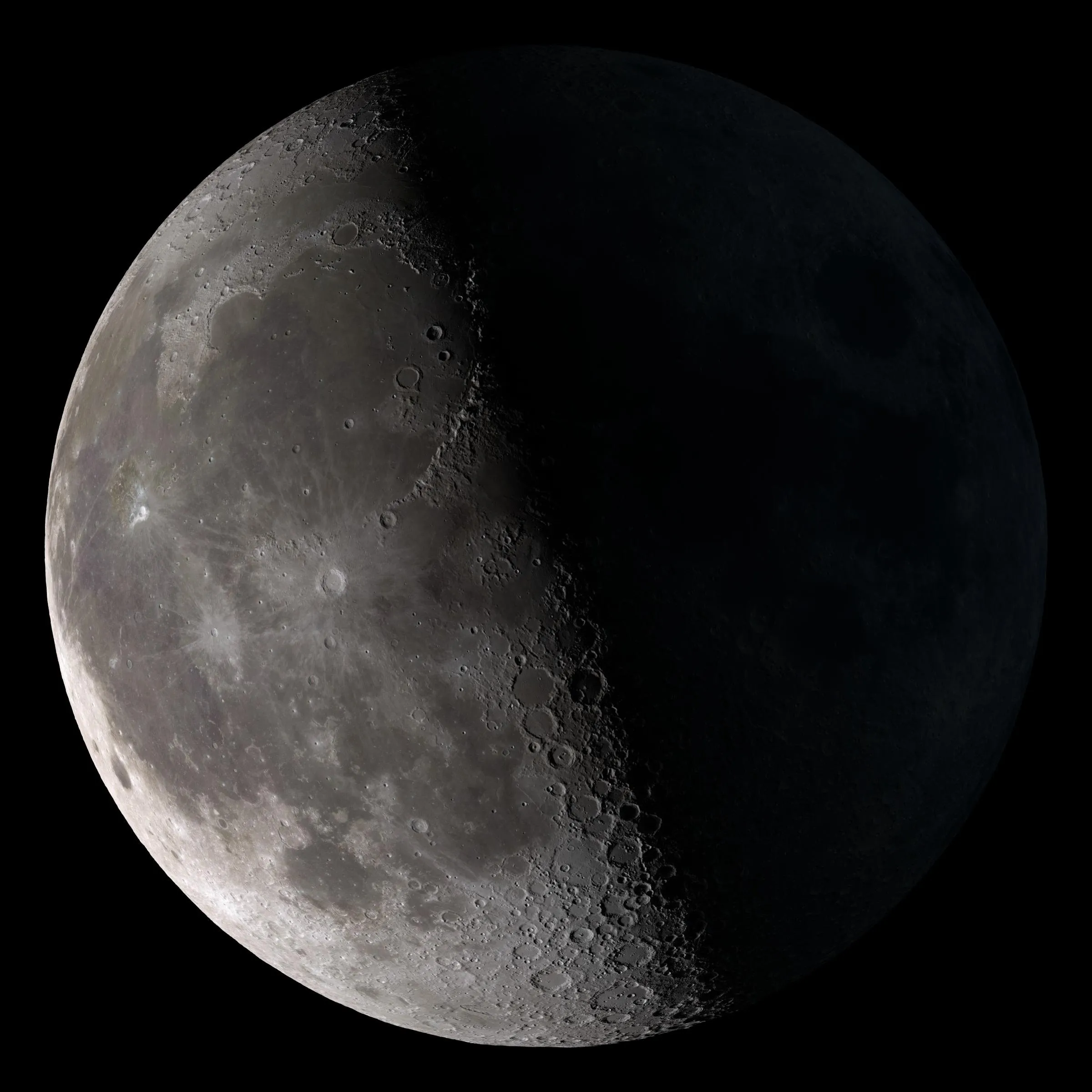
Half of the Moon is always in sunlight. The phases are just our point of view.
Look
The Moon does not make its own light. It shines because sunlight falls on it. At any moment, one half of the Moon is lit by the Sun and the other half is dark, just like Earth has day and night.
As the Moon goes around Earth, we see different amounts of its sunlit half:
- New Moon: the Moon is between Earth and the Sun. The lit half faces away from us, so we cannot see it.
- First quarter: we see half of the disc lit.
- Full Moon: Earth is between the Sun and the Moon. We see the whole lit half.
- Last quarter: half lit again, the other side.
In the tool, the left picture looks down on Earth and the Moon from far above, with the Sun off to the left. The right picture shows what you see from Earth. Move the slider and watch both change together.
Sometimes the Sun, Earth and Moon line up exactly:
- A solar eclipse happens when the Moon’s shadow falls on Earth at new Moon.
- A lunar eclipse happens when Earth’s shadow falls on the Moon at full Moon.
Understand
The Moon goes once around Earth, measured against the stars, in 27.3 days (the sidereal month). But the phases repeat every 29.5 days (the synodic month). Why the difference? While the Moon goes around Earth, Earth moves about 1/12 of the way around the Sun. The Moon needs about two more days to catch up with the new Sun direction.
The fraction of the disc that looks lit depends on the angle between the Sun and the Moon as seen from Earth, called the elongation:
| Elongation | Phase | Lit fraction |
|---|---|---|
| 0° | New Moon | 0% |
| 90° | First quarter | 50% |
| 180° | Full Moon | 100% |
| 270° | Last quarter | 50% |
If the Moon went around exactly in the same plane as Earth goes around the Sun, we would get a solar eclipse every new Moon and a lunar eclipse every full Moon. But the Moon’s orbit is tilted by about 5.1 degrees. Usually the Moon passes a little above or below the Sun-Earth line, and nothing happens.
The two points where the Moon’s orbit crosses Earth’s orbital plane are called nodes. Eclipses can only happen when a new or full Moon falls close to a node. This happens in two “eclipse seasons” each year, about six months apart.
Master
The illuminated fraction k follows from the phase angle i (the Sun-Moon-Earth angle):
k = (1 + cos i) / 2
Because the Sun is about 390 times farther away than the Moon, i ≈ 180° − elongation. The tool computes i with Meeus’s series (Astronomical Algorithms, eq. 48.4), which corrects the mean elongation for the main periodic terms of the Moon’s and the Sun’s orbits. It places new and full Moons to within about half an hour of the precise times, plenty for learning.
The synodic month follows from the two angular speeds: 1/P_syn = 1/P_sid − 1/P_year = 1/27.3217 − 1/365.256, giving 29.531 days.
Whether an eclipse is possible depends on the Moon’s argument of latitude F, its angle from the ascending node. Meeus gives a quick screening rule: at a new or full Moon, if |sin F| > 0.36 (F more than about 21° from a node), there is no eclipse. The tool applies exactly this test. It is a necessary condition, not a prediction of the eclipse type or where it is visible: that needs the Moon’s distance, Earth’s shadow geometry and much more precise positions.
The nodes are not fixed. They drift backwards around the ecliptic once every 18.6 years, which is why eclipse seasons arrive about 19 days earlier each year, and part of why eclipses repeat in the famous 18-year saros cycle.
Try it
Drag the slider to find the next full Moon. Is it close to a node (is an eclipse possible)? Then find a new Moon. Check a news or observatory website to see whether there really is an eclipse on that date.
Great. Challenges are where the learning sticks.
Quick quiz
3 quick questions. Pick an answer to see if you are right.
-
What causes the phases of the Moon?
- A Earth's shadow falling on the Moon
- B How much of the Moon's sunlit half we can see from Earth
- C Clouds on the Moon
- D The Moon changing its distance from Earth
Show the answer
B. How much of the Moon's sunlit half we can see from Earth Earth's shadow only reaches the Moon during a lunar eclipse. Phases are about viewing angle.
-
Why is there not a solar eclipse at every new Moon?
- A The Moon is too small
- B The Moon's orbit is tilted about 5 degrees, so it usually passes above or below the Sun
- C The Sun moves too fast
- D Solar eclipses only happen in summer
Show the answer
B. The Moon's orbit is tilted about 5 degrees, so it usually passes above or below the Sun
-
About how long is it from one full Moon to the next?
- A 27.3 days
- B 29.5 days
- C 30 days exactly
- D 365 days
Show the answer
B. 29.5 days 27.3 days is one orbit against the stars; the phases repeat after 29.5 days because Earth has moved around the Sun meanwhile.
Finish line
- Played with the interactive
- Read the lesson
- Did the challenge
- Took the quiz
Mark the lesson complete to save it to your progress on this device.
Lesson complete. Well done!
Up next The night sky and light pollutionWords in this lesson
Sources
- J. Meeus, Astronomical Algorithms, 2nd ed., Willmann-Bell (1998), ISBN 0-943396-61-1, chapters 47, 48 and 54
- NASA NSSDCA Moon Fact Sheet
- NASA Eclipse Web Site (F. Espenak)
- U.S. Naval Observatory: Phases of the Moon
This lesson is licensed CC BY-SA 4.0.