
Pelajaran ini telah dirakam oleh seorang anggota pasukan Local Solar System Foundation dan boleh diperbaiki oleh seorang penilai yang berkelayakan. Adakah anda berkelayakan dalam subjek ini? Cadangkan penyuntingan
Gerhana Bulan
Buka halaman penuhPaparan dari atas
Paparan dari Bumi
Jadual data (alternatif teks)
| Tarikh | Fase | Tercerahkan |
|---|---|---|
| 29 Sep | Gibbous berkurangan | 88.1 % |
| 30 Sep | Gibbous berkurangan | 79.7 % |
| 1 Okt | Gibbous berkurangan | 69.7 % |
| 2 Okt | Kuartal terakhir | 58.6 % |
| 3 Okt | Kuartal terakhir | 47.2 % |
| 4 Okt | Kuartal terakhir | 35.9 % |
| 5 Okt | Bulan purnama | 25.5 % |
| 6 Okt | Bulan purnama | 16.4 % |
| 7 Okt | Bulan purnama | 9.04 % |
| 8 Okt | Bulan Baru | 3.79 % |
| 9 Okt | Bulan Baru | 0.776 % |
| 10 Okt | Bulan Baru | 0.0311 % |
| 11 Okt | Bulan Baru | 1.47 % |
| 12 Okt | Bulan sabit | 4.89 % |
| 13 Okt | Bulan sabit | 10.1 % |
| 14 Okt | Bulan sabit | 16.6 % |
| 15 Okt | Bulan sabit | 24.4 % |
| 16 Okt | Kuartal pertama | 32.9 % |
| 17 Okt | Kuartal pertama | 42 % |
| 18 Okt | Kuartal pertama | 51.5 % |
| 19 Okt | Kuartal pertama | 61 % |
| 20 Okt | Gibbous melembut | 70.3 % |
| 21 Okt | Gibbous melembut | 79 % |
| 22 Okt | Gibbous melembut | 86.8 % |
| 23 Okt | Gibbous melembut | 93.1 % |
| 24 Okt | Bulan Penuh | 97.6 % |
| 25 Okt | Bulan Penuh | 99.8 % |
| 26 Okt | Bulan Penuh | 99.4 % |
| 27 Okt | Bulan Penuh | 96.3 % |
| 28 Okt | Gibbous berkurangan | 90.6 % |
The Moon never changes shape. Half of it is always lit by the Sun; what changes is how much of that lit half faces you. Once you see why, eclipses stop being mysterious and start being predictable.
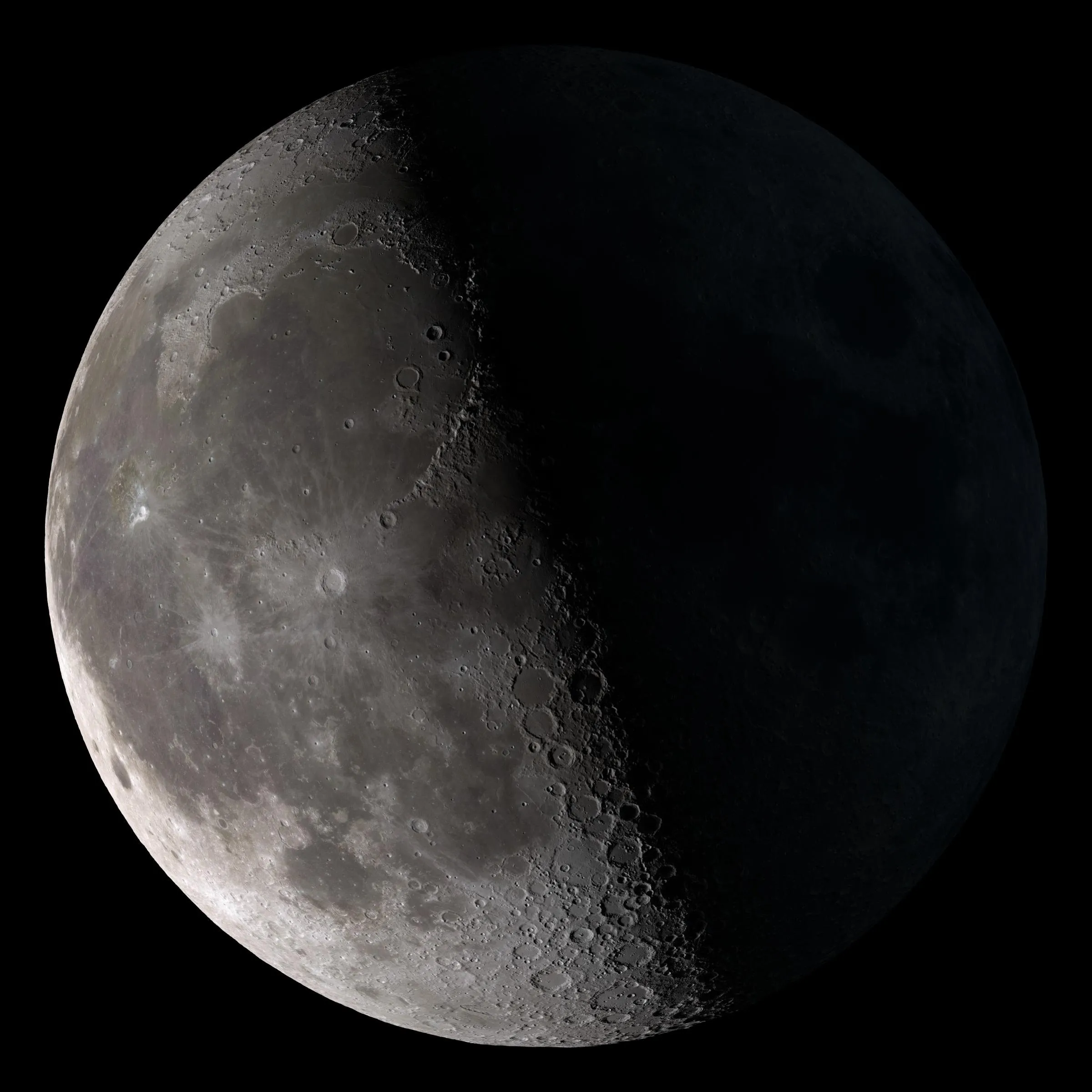
Half of the Moon is always in sunlight. The phases are just our point of view.
Look
The Moon does not make its own light. It shines because sunlight falls on it. At any moment, one half of the Moon is lit by the Sun and the other half is dark, just like Earth has day and night.
As the Moon goes around Earth, we see different amounts of its sunlit half:
- New Moon: the Moon is between Earth and the Sun. The lit half faces away from us, so we cannot see it.
- First quarter: we see half of the disc lit.
- Full Moon: Earth is between the Sun and the Moon. We see the whole lit half.
- Last quarter: half lit again, the other side.
In the tool, the left picture looks down on Earth and the Moon from far above, with the Sun off to the left. The right picture shows what you see from Earth. Move the slider and watch both change together.
Sometimes the Sun, Earth and Moon line up exactly:
- A solar eclipse happens when the Moon’s shadow falls on Earth at new Moon.
- A lunar eclipse happens when Earth’s shadow falls on the Moon at full Moon.
Understand
The Moon goes once around Earth, measured against the stars, in 27.3 days (the sidereal month). But the phases repeat every 29.5 days (the synodic month). Why the difference? While the Moon goes around Earth, Earth moves about 1/12 of the way around the Sun. The Moon needs about two more days to catch up with the new Sun direction.
The fraction of the disc that looks lit depends on the angle between the Sun and the Moon as seen from Earth, called the elongation:
| Elongation | Phase | Lit fraction |
|---|---|---|
| 0° | New Moon | 0% |
| 90° | First quarter | 50% |
| 180° | Full Moon | 100% |
| 270° | Last quarter | 50% |
If the Moon went around exactly in the same plane as Earth goes around the Sun, we would get a solar eclipse every new Moon and a lunar eclipse every full Moon. But the Moon’s orbit is tilted by about 5.1 degrees. Usually the Moon passes a little above or below the Sun-Earth line, and nothing happens.
The two points where the Moon’s orbit crosses Earth’s orbital plane are called nodes. Eclipses can only happen when a new or full Moon falls close to a node. This happens in two “eclipse seasons” each year, about six months apart.
Master
The illuminated fraction k follows from the phase angle i (the Sun-Moon-Earth angle):
k = (1 + cos i) / 2
Because the Sun is about 390 times farther away than the Moon, i ≈ 180° − elongation. The tool computes i with Meeus’s series (Astronomical Algorithms, eq. 48.4), which corrects the mean elongation for the main periodic terms of the Moon’s and the Sun’s orbits. It places new and full Moons to within about half an hour of the precise times, plenty for learning.
The synodic month follows from the two angular speeds: 1/P_syn = 1/P_sid − 1/P_year = 1/27.3217 − 1/365.256, giving 29.531 days.
Whether an eclipse is possible depends on the Moon’s argument of latitude F, its angle from the ascending node. Meeus gives a quick screening rule: at a new or full Moon, if |sin F| > 0.36 (F more than about 21° from a node), there is no eclipse. The tool applies exactly this test. It is a necessary condition, not a prediction of the eclipse type or where it is visible: that needs the Moon’s distance, Earth’s shadow geometry and much more precise positions.
The nodes are not fixed. They drift backwards around the ecliptic once every 18.6 years, which is why eclipse seasons arrive about 19 days earlier each year, and part of why eclipses repeat in the famous 18-year saros cycle.
Cubalah.
Drag the slider to find the next full Moon. Is it close to a node (is an eclipse possible)? Then find a new Moon. Check a news or observatory website to see whether there really is an eclipse on that date.
Tantangan adalah tempat belajar.
Kuiz Cepat
3 soalan cepat. Pilih jawapan untuk lihat jika anda betul.
-
What causes the phases of the Moon?
- A Earth's shadow falling on the Moon
- B How much of the Moon's sunlit half we can see from Earth
- C Clouds on the Moon
- D The Moon changing its distance from Earth
Papar jawapan
B. How much of the Moon's sunlit half we can see from Earth Earth's shadow only reaches the Moon during a lunar eclipse. Phases are about viewing angle.
-
Why is there not a solar eclipse at every new Moon?
- A The Moon is too small
- B The Moon's orbit is tilted about 5 degrees, so it usually passes above or below the Sun
- C The Sun moves too fast
- D Solar eclipses only happen in summer
Papar jawapan
B. The Moon's orbit is tilted about 5 degrees, so it usually passes above or below the Sun
-
About how long is it from one full Moon to the next?
- A 27.3 days
- B 29.5 days
- C 30 days exactly
- D 365 days
Papar jawapan
B. 29.5 days 27.3 days is one orbit against the stars; the phases repeat after 29.5 days because Earth has moved around the Sun meanwhile.
Baris akhir
- Dimainkan dengan interaktif
- Baca pelajaran
- Adakah cabaran
- Menjawab soalan
Tandakan pengajaran selesai untuk menyimpannya ke kemajuan anda pada peranti ini.
Pelajaran selesai.
Seterusnya The night sky and light pollutionPerkataan dalam pengajaran ini
Sumber
- J. Meeus, Astronomical Algorithms, 2nd ed., Willmann-Bell (1998), ISBN 0-943396-61-1, chapters 47, 48 and 54
- NASA NSSDCA Moon Fact Sheet
- NASA Eclipse Web Site (F. Espenak)
- U.S. Naval Observatory: Phases of the Moon
Pelajaran ini dilesenkan CC BY-SA 4.0.