전문가 검토를 기다리고 있습니다. 이 강의는 인공지능을 사용하여 작성되었으며, 아직 자격이 있는 검토자에 의해 확인되지 않았습니다. Are you qualified in this subject? Suggest an edit
달의 위상과 일식
전체 페이지 열기위에서 보기
지구에서 보기
데이터 테이블 (텍스트 대체)
| 날짜 | 위상 | 조명 |
|---|---|---|
| 9월 29일 | 잿빛 기브스 | 88.1 % |
| 9월 30일 | 잿빛 기브스 | 79.7 % |
| 10월 1일 | 잿빛 기브스 | 69.7 % |
| 10월 2일 | 마지막 분기 | 58.6 % |
| 10월 3일 | 마지막 분기 | 47.2 % |
| 10월 4일 | 마지막 분기 | 35.9 % |
| 10월 5일 | 점점 줄어드는 초승달 | 25.5 % |
| 10월 6일 | 점점 줄어드는 초승달 | 16.4 % |
| 10월 7일 | 점점 줄어드는 초승달 | 9.04 % |
| 10월 8일 | 새달 | 3.79 % |
| 10월 9일 | 새달 | 0.776 % |
| 10월 10일 | 새달 | 0.0311 % |
| 10월 11일 | 새달 | 1.47 % |
| 10월 12일 | 왁싱 크레센트 | 4.89 % |
| 10월 13일 | 왁싱 크레센트 | 10 % |
| 10월 14일 | 왁싱 크레센트 | 16.6 % |
| 10월 15일 | 왁싱 크레센트 | 24.4 % |
| 10월 16일 | 첫째 분기 | 32.9 % |
| 10월 17일 | 첫째 분기 | 42 % |
| 10월 18일 | 첫째 분기 | 51.5 % |
| 10월 19일 | 첫째 분기 | 61 % |
| 10월 20일 | 왁싱 기부스 | 70.3 % |
| 10월 21일 | 왁싱 기부스 | 79 % |
| 10월 22일 | 왁싱 기부스 | 86.8 % |
| 10월 23일 | 왁싱 기부스 | 93.1 % |
| 10월 24일 | 보름달 | 97.6 % |
| 10월 25일 | 보름달 | 99.8 % |
| 10월 26일 | 보름달 | 99.4 % |
| 10월 27일 | 보름달 | 96.3 % |
| 10월 28일 | 잿빛 기브스 | 90.6 % |
The Moon never changes shape. Half of it is always lit by the Sun; what changes is how much of that lit half faces you. Once you see why, eclipses stop being mysterious and start being predictable.
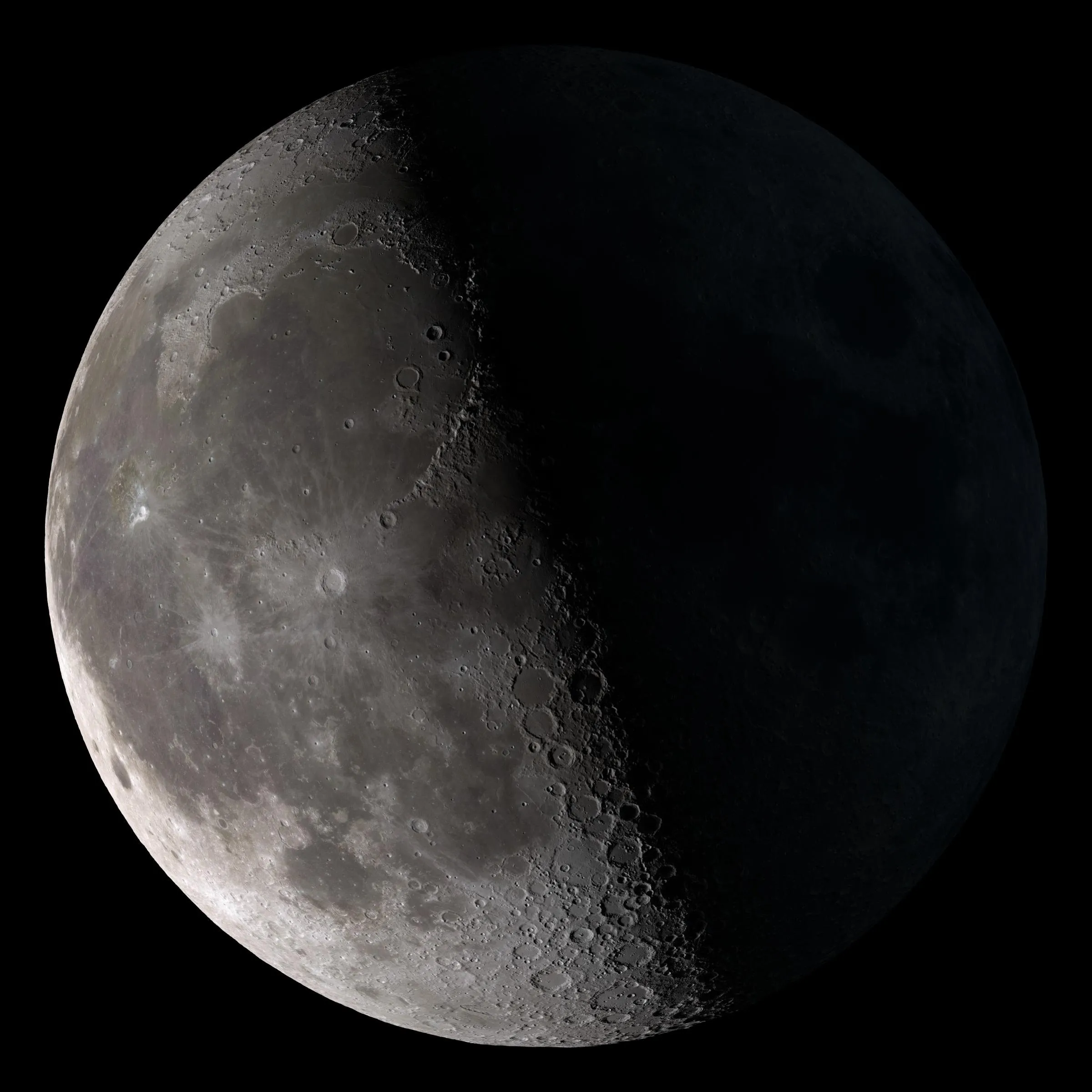
Half of the Moon is always in sunlight. The phases are just our point of view.
Look
The Moon does not make its own light. It shines because sunlight falls on it. At any moment, one half of the Moon is lit by the Sun and the other half is dark, just like Earth has day and night.
As the Moon goes around Earth, we see different amounts of its sunlit half:
- New Moon: the Moon is between Earth and the Sun. The lit half faces away from us, so we cannot see it.
- First quarter: we see half of the disc lit.
- Full Moon: Earth is between the Sun and the Moon. We see the whole lit half.
- Last quarter: half lit again, the other side.
In the tool, the left picture looks down on Earth and the Moon from far above, with the Sun off to the left. The right picture shows what you see from Earth. Move the slider and watch both change together.
Sometimes the Sun, Earth and Moon line up exactly:
- A solar eclipse happens when the Moon’s shadow falls on Earth at new Moon.
- A lunar eclipse happens when Earth’s shadow falls on the Moon at full Moon.
Understand
The Moon goes once around Earth, measured against the stars, in 27.3 days (the sidereal month). But the phases repeat every 29.5 days (the synodic month). Why the difference? While the Moon goes around Earth, Earth moves about 1/12 of the way around the Sun. The Moon needs about two more days to catch up with the new Sun direction.
The fraction of the disc that looks lit depends on the angle between the Sun and the Moon as seen from Earth, called the elongation:
| Elongation | Phase | Lit fraction |
|---|---|---|
| 0° | New Moon | 0% |
| 90° | First quarter | 50% |
| 180° | Full Moon | 100% |
| 270° | Last quarter | 50% |
If the Moon went around exactly in the same plane as Earth goes around the Sun, we would get a solar eclipse every new Moon and a lunar eclipse every full Moon. But the Moon’s orbit is tilted by about 5.1 degrees. Usually the Moon passes a little above or below the Sun-Earth line, and nothing happens.
The two points where the Moon’s orbit crosses Earth’s orbital plane are called nodes. Eclipses can only happen when a new or full Moon falls close to a node. This happens in two “eclipse seasons” each year, about six months apart.
Master
The illuminated fraction k follows from the phase angle i (the Sun-Moon-Earth angle):
k = (1 + cos i) / 2
Because the Sun is about 390 times farther away than the Moon, i ≈ 180° − elongation. The tool computes i with Meeus’s series (Astronomical Algorithms, eq. 48.4), which corrects the mean elongation for the main periodic terms of the Moon’s and the Sun’s orbits. It places new and full Moons to within about half an hour of the precise times, plenty for learning.
The synodic month follows from the two angular speeds: 1/P_syn = 1/P_sid − 1/P_year = 1/27.3217 − 1/365.256, giving 29.531 days.
Whether an eclipse is possible depends on the Moon’s argument of latitude F, its angle from the ascending node. Meeus gives a quick screening rule: at a new or full Moon, if |sin F| > 0.36 (F more than about 21° from a node), there is no eclipse. The tool applies exactly this test. It is a necessary condition, not a prediction of the eclipse type or where it is visible: that needs the Moon’s distance, Earth’s shadow geometry and much more precise positions.
The nodes are not fixed. They drift backwards around the ecliptic once every 18.6 years, which is why eclipse seasons arrive about 19 days earlier each year, and part of why eclipses repeat in the famous 18-year saros cycle.
한번 해보세요
Drag the slider to find the next full Moon. Is it close to a node (is an eclipse possible)? Then find a new Moon. Check a news or observatory website to see whether there really is an eclipse on that date.
Great. Challenges are where the learning sticks.
빠른 퀴즈
3 quick questions. Pick an answer to see if you are right.
-
What causes the phases of the Moon?
- A Earth's shadow falling on the Moon
- B How much of the Moon's sunlit half we can see from Earth
- C Clouds on the Moon
- D The Moon changing its distance from Earth
Show the answer
B. How much of the Moon's sunlit half we can see from Earth Earth's shadow only reaches the Moon during a lunar eclipse. Phases are about viewing angle.
-
Why is there not a solar eclipse at every new Moon?
- A The Moon is too small
- B The Moon's orbit is tilted about 5 degrees, so it usually passes above or below the Sun
- C The Sun moves too fast
- D Solar eclipses only happen in summer
Show the answer
B. The Moon's orbit is tilted about 5 degrees, so it usually passes above or below the Sun
-
About how long is it from one full Moon to the next?
- A 27.3 days
- B 29.5 days
- C 30 days exactly
- D 365 days
Show the answer
B. 29.5 days 27.3 days is one orbit against the stars; the phases repeat after 29.5 days because Earth has moved around the Sun meanwhile.
Finish line
- Played with the interactive
- Read the lesson
- Did the challenge
- Took the quiz
Mark the lesson complete to save it to your progress on this device.
Lesson complete. Well done!
Up next The night sky and light pollution이 레슨의 단어
소스
- J. Meeus, Astronomical Algorithms, 2nd ed., Willmann-Bell (1998), ISBN 0-943396-61-1, chapters 47, 48 and 54
- NASA NSSDCA Moon Fact Sheet
- NASA Eclipse Web Site (F. Espenak)
- U.S. Naval Observatory: Phases of the Moon
이 레슨은 CC BY-SA 4.0 라이선스로 제공됩니다.