
في انتظار استعراض الخبراء - صيغ هذا الدرس بمساعدة من منظمة التعلم الآلي ولم يراجعه بعدُ مستعرض مؤهل. Are you qualified in this subject? Suggest an edit
المشي على السلم
الصفحة الكاملةEverything here is at true scale: sizes and distances in the same proportion. Each pixel you scroll carries you 3,000 km.
Keep scrolling. Every picture you have seen of the solar system squeezed this emptiness out.
Mercury is ahead, where sunlight is almost seven times stronger than on Earth.
Still nothing. You have crossed 16.8 مليون km since الزئبق.
The sunlight passing you now left the Sun 5 د 5 ث ago.
Earth is ahead. Watch how small home turns out to be.
آذار/مارس is still 58.8 مليون km ahead.
A radio message from Earth takes between 3 and 22 minutes to reach Mars, depending on where the two planets are.
You could line up 4,611 Earths side by side in the space you have crossed since الأرض.
You are 14% of the way from آذار/مارس to سيريس.
Still nothing. You have crossed 53.1 مليون km since آذار/مارس.
The sunlight passing you now left the Sun 17 د 6 ث ago.
سيريس is still 79.6 مليون km ahead.
You are inside the asteroid belt. Did you hit anything? On average the asteroids are about a million kilometres apart.
You could line up 12,497 Earths side by side in the space you have crossed since آذار/مارس.
You are 17% of the way from سيريس to المشتري.
Still nothing. You have crossed 122 مليون km since سيريس.
The sunlight passing you now left the Sun 33 د 8 ث ago.
المشتري is still 122 مليون km ahead.
You could line up 23,846 Earths side by side in the space you have crossed since سيريس.
You are 10% of the way from المشتري to زحل.
Still nothing. You have crossed 130 مليون km since المشتري.
The sunlight passing you now left the Sun 54 د 5 ث ago.
زحل is still 389 مليون km ahead.
Voyager 1 took about 20 months to fly from Jupiter to Saturn.
You could line up 30,529 Earths side by side in the space you have crossed since المشتري.
You are 70% of the way from المشتري to زحل.
Still nothing. You have crossed 519 مليون km since المشتري.
The sunlight passing you now left the Sun 1 س 16 د ago.
أورانوس is still 1.31 مليار km ahead.
You could line up 20,605 Earths side by side in the space you have crossed since زحل.
You are 27% of the way from زحل to أورانوس.
Still nothing. You have crossed 525 مليون km since زحل.
Uranus orbits twice as far from the Sun as Saturn. The farther out you go, the emptier it gets.
The sunlight passing you now left the Sun 2 س 3 د ago.
أورانوس is still 525 مليون km ahead.
You could line up 82,418 Earths side by side in the space you have crossed since زحل.
You are 82% of the way from زحل to أورانوس.
Still nothing. You have crossed 1.31 مليار km since زحل.
The sunlight passing you now left the Sun 2 س 48 د ago.
نبتون is still 1.33 مليار km ahead.
You could line up 34,840 Earths side by side in the space you have crossed since أورانوس.
You are 36% of the way from أورانوس to نبتون.
Still nothing. You have crossed 740 مليون km since أورانوس.
Voyager 2 needed about three and a half years to cross this gap, from Uranus in 1986 to Neptune in 1989.
The sunlight passing you now left the Sun 3 س 37 د ago.
نبتون is still 444 مليون km ahead.
You could line up 104,519 Earths side by side in the space you have crossed since أورانوس.
You are 91% of the way from أورانوس to نبتون.
Still nothing. You have crossed 129 مليون km since نبتون.
The sunlight passing you now left the Sun 4 س 24 د ago.
The Kuiper belt: a ring of icy worlds so spread out that after Pluto, New Horizons flew close to just one of them.
بلوتو is still 906 مليون km ahead.
You could line up 50,798 Earths side by side in the space you have crossed since نبتون.
You are 55% of the way from نبتون to بلوتو.
Still nothing. You have crossed 906 مليون km since نبتون.
New Horizons, one of the fastest spacecraft ever launched, took nine and a half years to reach Pluto. Sunlight gets to Pluto's average distance in about five and a half hours.
The sunlight passing you now left the Sun 5 س 15 د ago.
بلوتو is still 129 مليون km ahead.
Scroll down inside the frame to fly outward, or start the autopilot below.
Journey's end
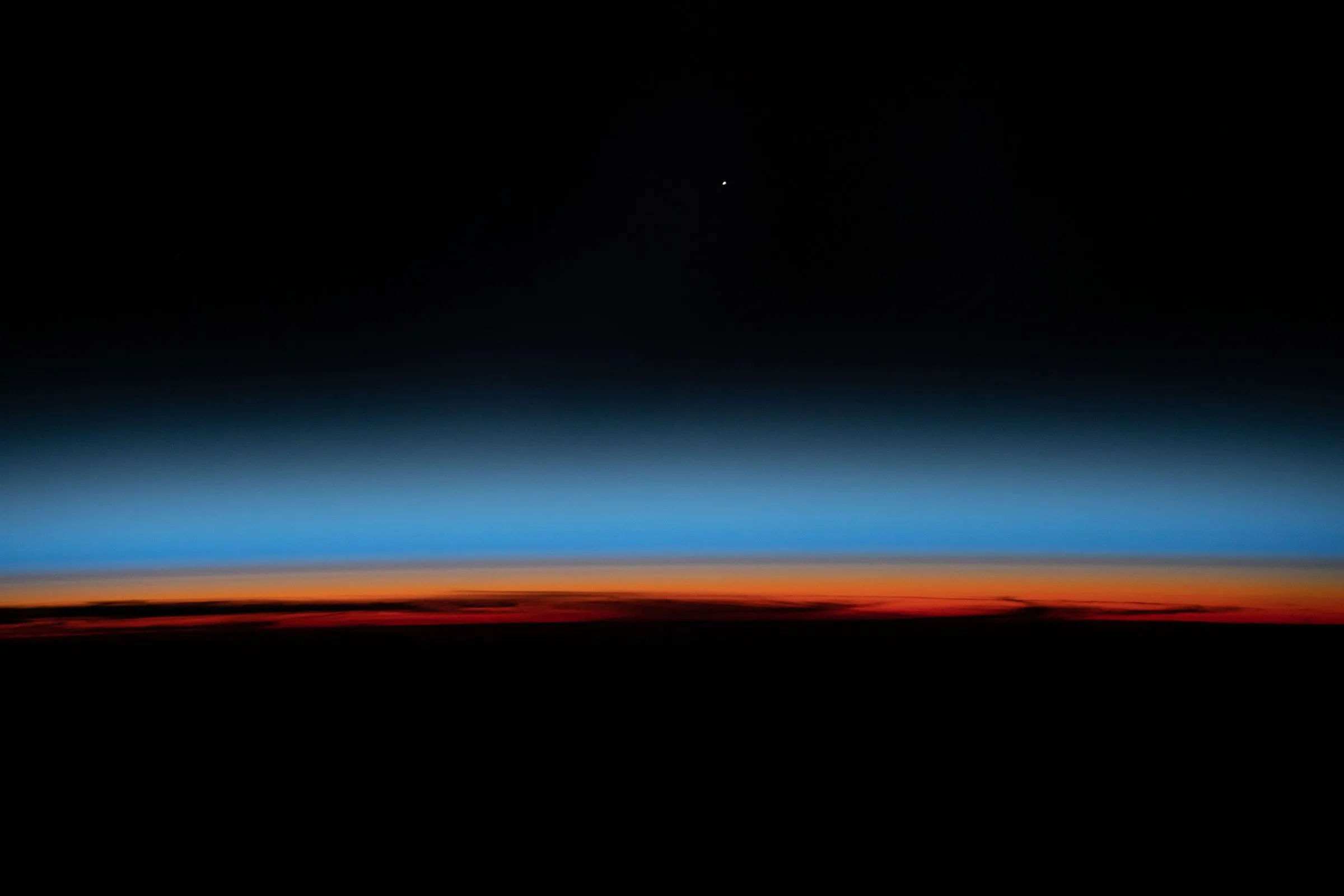
Look back. That bright star is the Sun.
جدول البيانات (نص بديل)
| العالم | القطر | المسافة من الشمس | زمن سفر الضوء من الشمس | px |
|---|---|---|---|---|
| الزئبق | 4,879 km | 0.387 au | 3 د 13 ث | 19,303 |
| الزهرة | 12,104 km | 0.723 au | 6 د 1 ث | 36,070 |
| الأرض | 12,742 km | 1 au | 8 د 19 ث | 49,866 |
| آذار/مارس | 6,779 km | 1.52 au | 12 د 40 ث | 75,981 |
| سيريس | 939 km | 2.77 au | 23 د 0 ث | 137,907 |
| المشتري | 139,822 km | 5.2 au | 43 د 16 ث | 259,447 |
| زحل | 116,464 km | 9.54 au | 1 س 19 د | 475,555 |
| أورانوس | 50,724 km | 19.2 au | 2 س 40 د | 956,886 |
| نبتون | 49,244 km | 30.1 au | 4 س 10 د | 1,499,465 |
| بلوتو | 2,377 km | 39.6 au | 5 س 29 د | 1,974,125 |
Almost every picture of the solar system lies. To fit on a page, the planets are squeezed together and blown up in size. Walk it at true scale and you discover the real star of the show: empty space.
The solar system is mostly empty space, and that emptiness is the whole story.
Look
Most pictures of the solar system squeeze the planets together like beads on a string, and draw them far too big. They have to: at true scale, a page would be almost completely empty.
Guess first: if the Sun were a beach ball, how far away would Earth be? A step? A room? A street?
A street. With the Sun as a 1-metre ball, Earth is a 9 mm pea about 107 metres away: roughly the length of a football pitch. Keep that picture in mind as you travel.
The Scale Walk above is drawn at true scale: sizes and distances in the same proportion. Every pixel you scroll carries you 3,000 km. Scroll inside the frame, press Next world, or tap a planet on the journey map at the top.
- The journey map is to scale too. The white marker is you. Notice how the Sun and the four inner planets crowd together at the far left.
- The odometer counts kilometres and the time sunlight has needed to get where you are.
- When you stop near a world, the camera locks on and leans in (the zoom is shown next to the scale bar), and a card tells you where you are.
- Earth, a globe 12,742 km across, is almost 50,000 scrolled pixels from the Sun. Neptune is about 1.5 million pixels away.
Notice how much of the trip is just black, with only a few lines of narration drifting past. That is the real solar system: tiny worlds separated by enormous emptiness.
Understand
A scale model divides every length by the same number. Here the number is 3,000: 3,000 km of real space becomes 1 pixel.
| World | Real diameter | Diameter at 1 px = 3,000 km | Distance from Sun | At this scale |
|---|---|---|---|---|
| Sun | 1,391,400 km | 464 px | 0 | 0 |
| Earth | 12,742 km | 4 px | 149.6 million km | 49,866 px |
| Jupiter | 139,822 km | 47 px | 778.3 million km | 259,437 px |
| Neptune | 49,244 km | 16 px | 4,498 million km | 1,499,000 px |
A handy comparison uses the Sun as a 1-metre ball. Divide everything by the Sun’s diameter (1.39 million km):
- Earth is a 9 mm pea, 107 m away.
- Jupiter is a 10 cm grapefruit, 560 m away.
- Neptune is a 3.5 cm marble, 3.2 km away.
- The nearest star, Proxima Centauri, would be another ball about 29,000 km away: more than two thirds of the way around the real Earth.
Try the autopilot at 1×, the real speed of light. You move 100 pixels per second, which feels slow on screen. Real sunlight really does need 8 minutes to reach Earth and more than 4 hours to reach Neptune. The faster settings compress time, not distance: the autopilot still brakes and pauses at every world.
Guess first: scrolling with a mouse wheel, are you moving faster or slower than light?
Much faster. A brisk scroll carries you millions of kilometres per second, often ten or more times the speed of light; the speed readout under the odometer shows it. Even so, the outer planets take a long time to reach. That is how big the distances are.
Master
Two separate compressions distort normal diagrams: the size scale and the distance scale. The ratio of the Sun-Neptune distance (4.5 × 10⁹ km) to Earth’s diameter (1.27 × 10⁴ km) is about 350,000. A screen 1,000 pixels tall can resolve a range of about 1,000, so no single static image can show both the planets and their spacing. Interactive zoom, logarithmic axes or a scroll-length model like this one are the only honest options.
This is also why the orrery on this site offers two modes. Readable scale compresses distance with a square root (r_screen ∝ √r) and draws planets at fixed legible sizes. True scale is linear in both size and distance, so the planets shrink to sub-pixel dots.
The emptiness has consequences for spaceflight. Travelling between planets is not like driving between cities: the planets move, the distances are huge, and the energy cost depends far more on changes of speed than on distance. That idea, delta-v, is at the heart of the Navigator path.
A last scale fact: the asteroid belt, often drawn as a crowded field of rocks, is so sparse that spacecraft cross it without any special manoeuvres. The Kuiper belt beyond Neptune is emptier still.
جربها
Set the autopilot speed to 1× and press 'Travel at the speed of light'. Watch the light-time clock as you reach Earth: about 8 minutes 20 seconds. Before you look at the table, guess how long the same trip takes to Neptune, then check.
Great. Challenges are where the learning sticks.
اختبار سريع
3 quick questions. Pick an answer to see if you are right.
-
If the Sun were a ball 1 metre wide, about how big would Earth be?
- A A football
- B A grapefruit
- C About 9 millimetres, like a pea
- D About 1 millimetre
Show the answer
C. About 9 millimetres, like a pea The Sun is about 109 times wider than Earth, so 1 m ÷ 109 ≈ 9 mm.
-
At that same scale, how far away would Earth be from the 1-metre Sun?
- A About 1 metre
- B About 10 metres
- C About 107 metres
- D About 1 kilometre
Show the answer
C. About 107 metres 1 au is about 107.5 Sun diameters, so Earth would be a pea about the length of a football pitch away.
-
Why do most drawings of the solar system show the planets close together?
- A Because they really are close
- B Because at true scale the planets would be too small to see on the page
- C Because the drawings show the planets at their closest approach
- D Because of light pollution
Show the answer
B. Because at true scale the planets would be too small to see on the page
Finish line
- Played with the interactive
- Read the lesson
- Did the challenge
- Took the quiz
Mark the lesson complete to save it to your progress on this device.
Lesson complete. Well done!
Up next Days and years on each worldالكلمات في هذا الدرس
المصادر
- NASA NSSDCA Planetary Fact Sheet (diameters, distances)
- JPL SSD: Approximate Positions of the Planets (semi-major axes)
- NASA NSSDCA: Schoolyard Solar System scale model
هذا الدرس مرخص CC BY-SA 4.0.