
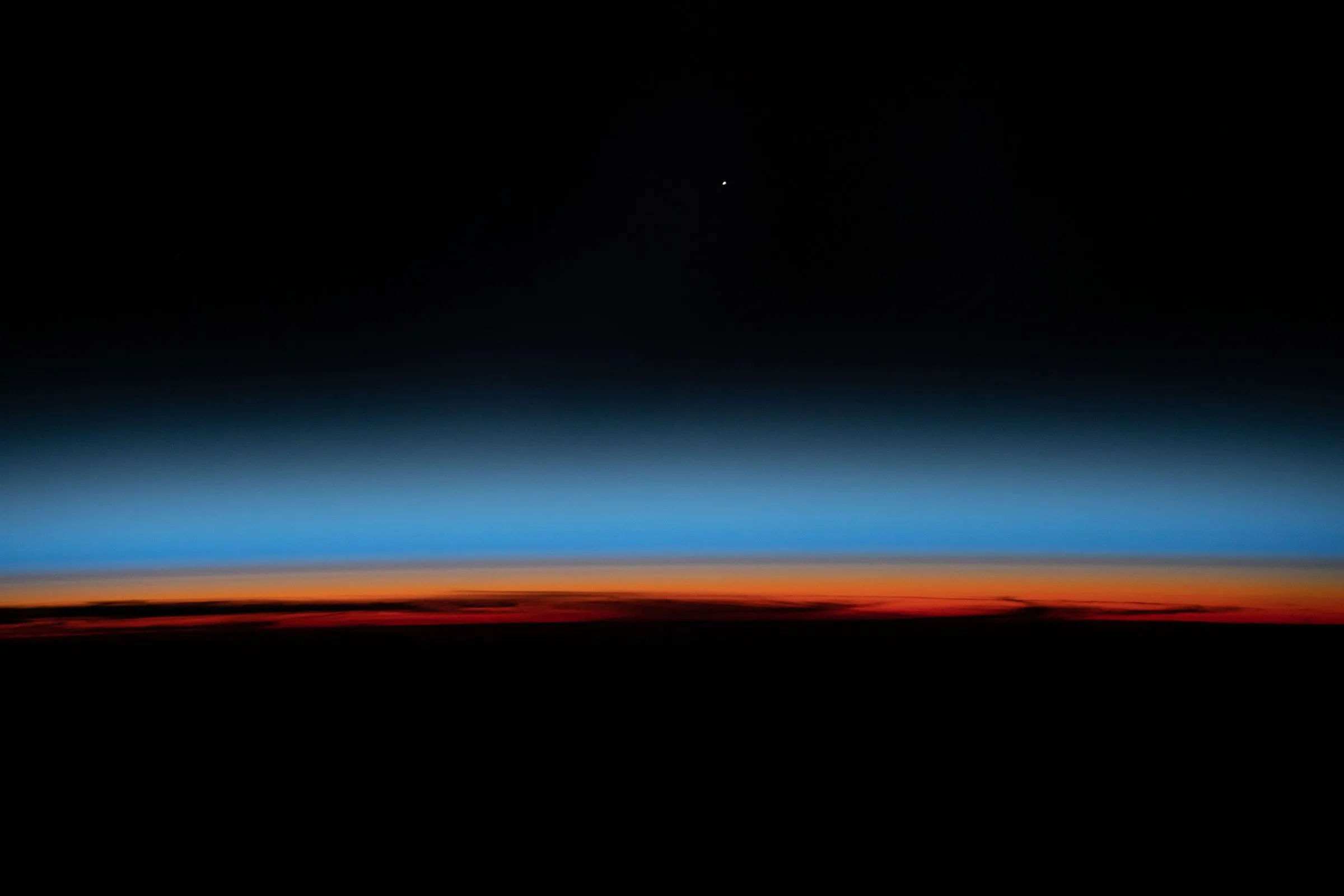
Tato lekce byla vypracována Local Solar System Tento článek je členem týmu nadace a mohl by být vylepšen kvalifikovaným recenzentem. Jste kvalifikovaní v tomto oboru? Navrhnout úpravu
Scale Walk
Otevřít celou stránkuVšechno je zde ve skutečném měřítku: velikosti a vzdálenosti jsou ve stejné proporci, každý pixel vás přenese 3 000 km.
Každý obrázek sluneční soustavy, který jste viděli, vytlačil tuto prázdnotu ven.
Merkur je před námi, kde je sluneční světlo téměř sedmkrát silnější než na Zemi.
Překročili jste 16,8 milionu km od Merkur.
Sluneční světlo, které teď prochází kolem vás, opustilo Slunce před 5 min 5 s lety.
Země je před námi. Podívejte se, jak malý domov se ukáže být.
Mars je stále 58,8 milionu km před námi.
Rádiové zprávě ze Země trvá 3 až 22 minut, než se dostane na Mars, v závislosti na tom, kde jsou obě planety.
Mohli byste seřadit 4 611 Země vedle sebe v prostoru, který jste překročili od Země.
Jste 14% cesty z Mars do Ceres.
Překročili jste 53,1 milionu km od Mars.
Sluneční světlo, které teď prochází kolem vás, opustilo Slunce před 17 min 6 s lety.
Ceres je stále 79,6 milionu km před námi.
Jste uvnitř pásu asteroidů, narazili jste do něčeho? Průměrná vzdálenost mezi asteroidy je asi milion kilometrů.
Mohli byste seřadit 12 497 Země vedle sebe v prostoru, který jste překročili od Mars.
Jste 17% cesty z Ceres do Jupiter.
Překročili jste 122 milionů km od Ceres.
Sluneční světlo, které teď prochází kolem vás, opustilo Slunce před 33 min 8 s lety.
Jupiter je stále 122 milionů km před námi.
Mohli byste seřadit 23 846 Země vedle sebe v prostoru, který jste překročili od Ceres.
Jste 10% cesty z Jupiter do Saturn.
Překročili jste 130 milionů km od Jupiter.
Sluneční světlo, které teď prochází kolem vás, opustilo Slunce před 54 min 5 s lety.
Saturn je stále 389 milionů km před námi.
Voyager 1 trvalo asi 20 měsíců, než letěl z Jupiteru na Saturn.
Mohli byste seřadit 30 529 Země vedle sebe v prostoru, který jste překročili od Jupiter.
Jste 70% cesty z Jupiter do Saturn.
Překročili jste 519 milionů km od Jupiter.
Sluneční světlo, které teď prochází kolem vás, opustilo Slunce před 1 h 16 min lety.
Uran je stále 1,31 miliardy km před námi.
Mohli byste seřadit 20 605 Země vedle sebe v prostoru, který jste překročili od Saturn.
Jste 27% cesty z Saturn do Uran.
Překročili jste 525 milionů km od Saturn.
Uran obíhá dvakrát tak daleko od Slunce jako Saturn, takže čím dál od Slunce, tím je jeho oběžná dráha prázdnější.
Sluneční světlo, které teď prochází kolem vás, opustilo Slunce před 2 h 3 min lety.
Uran je stále 525 milionů km před námi.
Mohli byste seřadit 82 418 Země vedle sebe v prostoru, který jste překročili od Saturn.
Jste 82% cesty z Saturn do Uran.
Překročili jste 1,31 miliardy km od Saturn.
Sluneční světlo, které teď prochází kolem vás, opustilo Slunce před 2 h 48 min lety.
Neptun je stále 1,33 miliardy km před námi.
Mohli byste seřadit 34 840 Země vedle sebe v prostoru, který jste překročili od Uran.
Jste 36% cesty z Uran do Neptun.
Překročili jste 740 milionů km od Uran.
Voyager 2 trvalo asi tři a půl roku, než překročil tuto mezeru, z Uranu v roce 1986 na Neptun v roce 1989.
Sluneční světlo, které teď prochází kolem vás, opustilo Slunce před 3 h 37 min lety.
Neptun je stále 444 milionů km před námi.
Mohli byste seřadit 104 519 Země vedle sebe v prostoru, který jste překročili od Uran.
Jste 91% cesty z Uran do Neptun.
Překročili jste 129 milionů km od Neptun.
Sluneční světlo, které teď prochází kolem vás, opustilo Slunce před 4 h 24 min lety.
Kuiperův pás: prstenec ledových světů tak roztroušených, že po Plutu se New Horizons přiblížila jen k jednomu z nich.
Pluto je stále 906 milionů km před námi.
Mohli byste seřadit 50 798 Země vedle sebe v prostoru, který jste překročili od Neptun.
Jste 55% cesty z Neptun do Pluto.
Překročili jste 906 milionů km od Neptun.
New Horizons, jedna z nejrychleji vypuštěných sond, trvalo devět a půl let, než se dostala k Plutu, zatímco sluneční světlo dosáhne průměrné vzdálenosti od Pluta asi za pět a půl hodiny.
Sluneční světlo, které teď prochází kolem vás, opustilo Slunce před 5 h 15 min lety.
Pluto je stále 129 milionů km před námi.
Posuňte se dolů uvnitř rámečku k letu ven, nebo spustit autopilota níže.
Konec cesty
Podívejte se zpět. Ta jasná hvězda je Slunce.
Tabulka dat (textová alternativa)
| Svět | Průměr | Vzdálenost od Slunce | Doba cesty světla od Slunce | px |
|---|---|---|---|---|
| Merkur | 4 879 km | 0,387 au | 3 min 13 s | 19 303 |
| Venuše | 12 104 km | 0,723 au | 6 min 1 s | 36 070 |
| Země | 12 742 km | 1 au | 8 min 19 s | 49 866 |
| Mars | 6 779 km | 1,52 au | 12 min 40 s | 75 981 |
| Ceres | 939 km | 2,77 au | 23 min 0 s | 137 907 |
| Jupiter | 139 822 km | 5,2 au | 43 min 16 s | 259 447 |
| Saturn | 116 464 km | 9,54 au | 1 h 19 min | 475 555 |
| Uran | 50 724 km | 19,2 au | 2 h 40 min | 956 886 |
| Neptun | 49 244 km | 30,1 au | 4 h 10 min | 1 499 465 |
| Pluto | 2 377 km | 39,6 au | 5 h 29 min | 1 974 125 |
Almost every picture of the solar system lies. To fit on a page, the planets are squeezed together and blown up in size. Walk it at true scale and you discover the real star of the show: empty space.
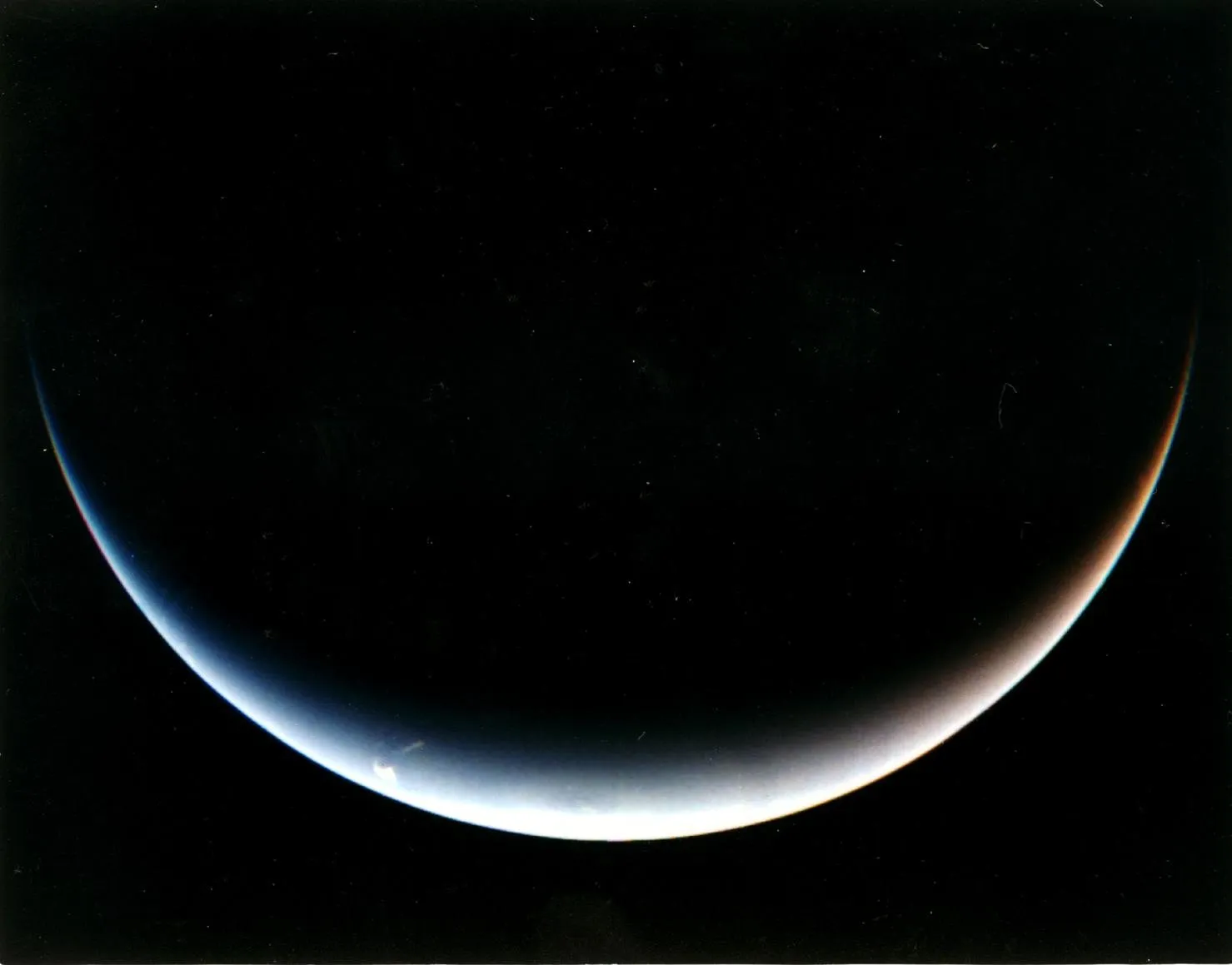
The solar system is mostly empty space, and that emptiness is the whole story.
Look
Most pictures of the solar system squeeze the planets together like beads on a string, and draw them far too big. They have to: at true scale, a page would be almost completely empty.
Guess first: if the Sun were a beach ball, how far away would Earth be? A step? A room? A street?
A street. With the Sun as a 1-metre ball, Earth is a 9 mm pea about 107 metres away: roughly the length of a football pitch. Keep that picture in mind as you travel.
The Scale Walk above is drawn at true scale: sizes and distances in the same proportion. Every pixel you scroll carries you 3,000 km. Scroll inside the frame, press Next world, or tap a planet on the journey map at the top.
- The journey map is to scale too. The white marker is you. Notice how the Sun and the four inner planets crowd together at the far left.
- The odometer counts kilometres and the time sunlight has needed to get where you are.
- When you stop near a world, the camera locks on and leans in (the zoom is shown next to the scale bar), and a card tells you where you are.
- Earth, a globe 12,742 km across, is almost 50,000 scrolled pixels from the Sun. Neptune is about 1.5 million pixels away.
Notice how much of the trip is just black, with only a few lines of narration drifting past. That is the real solar system: tiny worlds separated by enormous emptiness.
Understand
A scale model divides every length by the same number. Here the number is 3,000: 3,000 km of real space becomes 1 pixel.
| World | Real diameter | Diameter at 1 px = 3,000 km | Distance from Sun | At this scale |
|---|---|---|---|---|
| Sun | 1,391,400 km | 464 px | 0 | 0 |
| Earth | 12,742 km | 4 px | 149.6 million km | 49,866 px |
| Jupiter | 139,822 km | 47 px | 778.3 million km | 259,437 px |
| Neptune | 49,244 km | 16 px | 4,498 million km | 1,499,000 px |
A handy comparison uses the Sun as a 1-metre ball. Divide everything by the Sun’s diameter (1.39 million km):
- Earth is a 9 mm pea, 107 m away.
- Jupiter is a 10 cm grapefruit, 560 m away.
- Neptune is a 3.5 cm marble, 3.2 km away.
- The nearest star, Proxima Centauri, would be another ball about 29,000 km away: more than two thirds of the way around the real Earth.
Try the autopilot at 1×, the real speed of light. You move 100 pixels per second, which feels slow on screen. Real sunlight really does need 8 minutes to reach Earth and more than 4 hours to reach Neptune. The faster settings compress time, not distance: the autopilot still brakes and pauses at every world.
Guess first: scrolling with a mouse wheel, are you moving faster or slower than light?
Much faster. A brisk scroll carries you millions of kilometres per second, often ten or more times the speed of light; the speed readout under the odometer shows it. Even so, the outer planets take a long time to reach. That is how big the distances are.
Master
Two separate compressions distort normal diagrams: the size scale and the distance scale. The ratio of the Sun-Neptune distance (4.5 × 10⁹ km) to Earth’s diameter (1.27 × 10⁴ km) is about 350,000. A screen 1,000 pixels tall can resolve a range of about 1,000, so no single static image can show both the planets and their spacing. Interactive zoom, logarithmic axes or a scroll-length model like this one are the only honest options.
This is also why the orrery on this site offers two modes. Readable scale compresses distance with a square root (r_screen ∝ √r) and draws planets at fixed legible sizes. True scale is linear in both size and distance, so the planets shrink to sub-pixel dots.
The emptiness has consequences for spaceflight. Travelling between planets is not like driving between cities: the planets move, the distances are huge, and the energy cost depends far more on changes of speed than on distance. That idea, delta-v, is at the heart of the Navigator path.
A last scale fact: the asteroid belt, often drawn as a crowded field of rocks, is so sparse that spacecraft cross it without any special manoeuvres. The Kuiper belt beyond Neptune is emptier still.
Zkus to
Set the autopilot speed to 1× and press 'Travel at the speed of light'. Watch the light-time clock as you reach Earth: about 8 minutes 20 seconds. Before you look at the table, guess how long the same trip takes to Neptune, then check.
Výzvy jsou tam, kde se učení drží.
Rychlý kvíz
3 rychlé otázky. Vyberte si odpověď, abyste zjistili, zda máte pravdu.
-
If the Sun were a ball 1 metre wide, about how big would Earth be?
- A A football
- B A grapefruit
- C About 9 millimetres, like a pea
- D About 1 millimetre
Zobrazit odpověď
C. About 9 millimetres, like a pea The Sun is about 109 times wider than Earth, so 1 m ÷ 109 ≈ 9 mm.
-
At that same scale, how far away would Earth be from the 1-metre Sun?
- A About 1 metre
- B About 10 metres
- C About 107 metres
- D About 1 kilometre
Zobrazit odpověď
C. About 107 metres 1 au is about 107.5 Sun diameters, so Earth would be a pea about the length of a football pitch away.
-
Why do most drawings of the solar system show the planets close together?
- A Because they really are close
- B Because at true scale the planets would be too small to see on the page
- C Because the drawings show the planets at their closest approach
- D Because of light pollution
Zobrazit odpověď
B. Because at true scale the planets would be too small to see on the page
Cílová čára
- Hraje se s interaktivním
- Přečtěte si lekci
- Přijmout výzvu
- Vyplnil kvíz
Označte lekci jako dokončenou, abyste ji uložili do svého postupu na tomto zařízení.
Lekce dokončena.
Up next Days and years on each worldSlova v této lekci
Zdroje
- NASA NSSDCA Planetary Fact Sheet (diameters, distances)
- JPL SSD: Approximate Positions of the Planets (semi-major axes)
- NASA NSSDCA: Schoolyard Solar System scale model
Tato lekce je licencována pod CC BY-SA 4.0.