
Waxbarashadan waxaa qoray Local Solar System Foundation kooxda xubna ah oo ay ku hagaajin karaan qiimeeye xirfad leh. Ma waxaad u qalmin in ay arrimo this? Soo jeedin edit
Jidka Miisaanka
Fur bogga oo dhanWax kasta oo halkan ah waa heerka dhabta ah: miisaanka iyo masaafada ku jira qaybta isku midka ah. Piksel kasta oo aad soo jiidasho leh ayaa kuu keenaya 3,000 km.
Ku sii soco. Sawirro kasta oo aad aragtay ee nidaamka qorraxda ayaa ka soo baxaya booskan.
Mercury waa hor, halkaas oo iftiinka qorraxda ah ku dhowaad toddoba jeer ka xoog badan tahay dhulka.
weli waxba. Waxaad ka gudubtay 16.8 Milyan km tan iyo Mercury.
iftiinka qorraxda oo ku soo dhaafay hadda ka tagay qorraxda 5 daqiiqo 5 ilbrqsi hore.
Dhulka waa hor. Fiiri sida yar guriga ka soo baxa in la yahay.
Maarso weli waa 58.8 Milyan km hortiisa.
Ra'yi raadiyaha ka yimid Dhulka wuxuu qaadanayaa 3 ilaa 22 daqiiqo si uu u gaaro Mars, iyadoo ku xiran halka labada dhul-mareen ah.
Waxaad isku xiri kartaa 4,611 Earths dhinac ka dhinac ah meel aad ku dhex wareegtay tan iyo Dhulka.
Waxaad tahay 14% ee jidka ka Maarso in Ceres.
weli waxba. Waxaad ka gudubtay 53.1 Milyan km tan iyo Maarso.
iftiinka qorraxda oo ku soo dhaafay hadda ka tagay qorraxda 17 daqiiqo 6 ilbrqsi hore.
Ceres weli waa 79.6 Milyan km hortiisa.
Waxaad ku jirtaa xarigga asteroid. Ma waxaad ku dhuftay wax? Dhererka asteroids waa ku saabsan milyan kiiloomitir oo kala duwan.
Waxaad isku xiri kartaa 12,497 Earths dhinac ka dhinac ah meel aad ku dhex wareegtay tan iyo Maarso.
Waxaad tahay 17% ee jidka ka Ceres in Jupiter.
weli waxba. Waxaad ka gudubtay 122 Milyan km tan iyo Ceres.
iftiinka qorraxda oo ku soo dhaafay hadda ka tagay qorraxda 33 daqiiqo 8 ilbrqsi hore.
Jupiter weli waa 122 Milyan km hortiisa.
Waxaad isku xiri kartaa 23,846 Earths dhinac ka dhinac ah meel aad ku dhex wareegtay tan iyo Ceres.
Waxaad tahay 10% ee jidka ka Jupiter in Satelit.
weli waxba. Waxaad ka gudubtay 130 Milyan km tan iyo Jupiter.
iftiinka qorraxda oo ku soo dhaafay hadda ka tagay qorraxda 54 daqiiqo 5 ilbrqsi hore.
Satelit weli waa 389 Milyan km hortiisa.
Voyager 1 waxay qaadatay 20 bilood si ay u duusho Jupiter ilaa Saturn.
Waxaad isku xiri kartaa 30,529 Earths dhinac ka dhinac ah meel aad ku dhex wareegtay tan iyo Jupiter.
Waxaad tahay 70% ee jidka ka Jupiter in Satelit.
weli waxba. Waxaad ka gudubtay 519 Milyan km tan iyo Jupiter.
iftiinka qorraxda oo ku soo dhaafay hadda ka tagay qorraxda 1 scd 16 daqiiqo hore.
Uranus weli waa 1.31 Bilyan km hortiisa.
Waxaad isku xiri kartaa 20,605 Earths dhinac ka dhinac ah meel aad ku dhex wareegtay tan iyo Satelit.
Waxaad tahay 27% ee jidka ka Satelit in Uranus.
weli waxba. Waxaad ka gudubtay 525 Milyan km tan iyo Satelit.
Uranus orbits laba jeer oo ka fog qorraxda sida Saturn. The dheer aad u tagto, the shisheeye ay helaan.
iftiinka qorraxda oo ku soo dhaafay hadda ka tagay qorraxda 2 scd 3 daqiiqo hore.
Uranus weli waa 525 Milyan km hortiisa.
Waxaad isku xiri kartaa 82,418 Earths dhinac ka dhinac ah meel aad ku dhex wareegtay tan iyo Satelit.
Waxaad tahay 82% ee jidka ka Satelit in Uranus.
weli waxba. Waxaad ka gudubtay 1.31 Bilyan km tan iyo Satelit.
iftiinka qorraxda oo ku soo dhaafay hadda ka tagay qorraxda 2 scd 48 daqiiqo hore.
Neptune weli waa 1.33 Bilyan km hortiisa.
Waxaad isku xiri kartaa 34,840 Earths dhinac ka dhinac ah meel aad ku dhex wareegtay tan iyo Uranus.
Waxaad tahay 36% ee jidka ka Uranus in Neptune.
weli waxba. Waxaad ka gudubtay 740 Milyan km tan iyo Uranus.
Voyager 2 u baahan yahay in ka badan saddex sano iyo bar si ay u gudbaan xadka, ka Uranus in 1986 ilaa Neptune in 1989.
iftiinka qorraxda oo ku soo dhaafay hadda ka tagay qorraxda 3 scd 37 daqiiqo hore.
Neptune weli waa 444 Milyan km hortiisa.
Waxaad isku xiri kartaa 104,519 Earths dhinac ka dhinac ah meel aad ku dhex wareegtay tan iyo Uranus.
Waxaad tahay 91% ee jidka ka Uranus in Neptune.
weli waxba. Waxaad ka gudubtay 129 Milyan km tan iyo Neptune.
iftiinka qorraxda oo ku soo dhaafay hadda ka tagay qorraxda 4 scd 24 daqiiqo hore.
Kuper belt: wareegga dunida qabow oo si weyn u faafay in ka dib Pluto, New Horizons ayaa ku dhow mid ka mid ah.
Pluto weli waa 906 Milyan km hortiisa.
Waxaad isku xiri kartaa 50,798 Earths dhinac ka dhinac ah meel aad ku dhex wareegtay tan iyo Neptune.
Waxaad tahay 55% ee jidka ka Neptune in Pluto.
weli waxba. Waxaad ka gudubtay 906 Milyan km tan iyo Neptune.
New Horizons, mid ka mid ah diyaaradaha hawada ugu dhaqsaha badan ee la soo saaray, waxay qaadatay sagaal sano iyo bar si ay u gaaraan Pluto.
iftiinka qorraxda oo ku soo dhaafay hadda ka tagay qorraxda 5 scd 15 daqiiqo hore.
Pluto weli waa 129 Milyan km hortiisa.
Riix hoos ka mid ah frame si ay u duulaan dibadda, ama bilowdo autopilot hoose.
Journey's end
Dib u eeg. In xiddigta iftiinka leh waa qorraxda.
Tallaabada (marka laga reebo qoraalka)
| Adduunka | Dhererka | Dhererka Qorraxda | Waqtiga safarka iftiinka qorraxda | px |
|---|---|---|---|---|
| Mercury | 4,879 km | 0.387 au | 3 daqiiqo 13 ilbrqsi | 19,303 |
| Venus | 12,104 km | 0.723 au | 6 daqiiqo 1 ilbrqsi | 36,070 |
| Dhulka | 12,742 km | 1 au | 8 daqiiqo 19 ilbrqsi | 49,866 |
| Maarso | 6,779 km | 1.52 au | 12 daqiiqo 40 ilbrqsi | 75,981 |
| Ceres | 939 km | 2.77 au | 23 daqiiqo 0 ilbrqsi | 137,907 |
| Jupiter | 139,822 km | 5.2 au | 43 daqiiqo 16 ilbrqsi | 259,447 |
| Satelit | 116,464 km | 9.54 au | 1 scd 19 daqiiqo | 475,555 |
| Uranus | 50,724 km | 19.2 au | 2 scd 40 daqiiqo | 956,886 |
| Neptune | 49,244 km | 30.1 au | 4 scd 10 daqiiqo | 1,499,465 |
| Pluto | 2,377 km | 39.6 au | 5 scd 29 daqiiqo | 1,974,125 |
Almost every picture of the solar system lies. To fit on a page, the planets are squeezed together and blown up in size. Walk it at true scale and you discover the real star of the show: empty space.
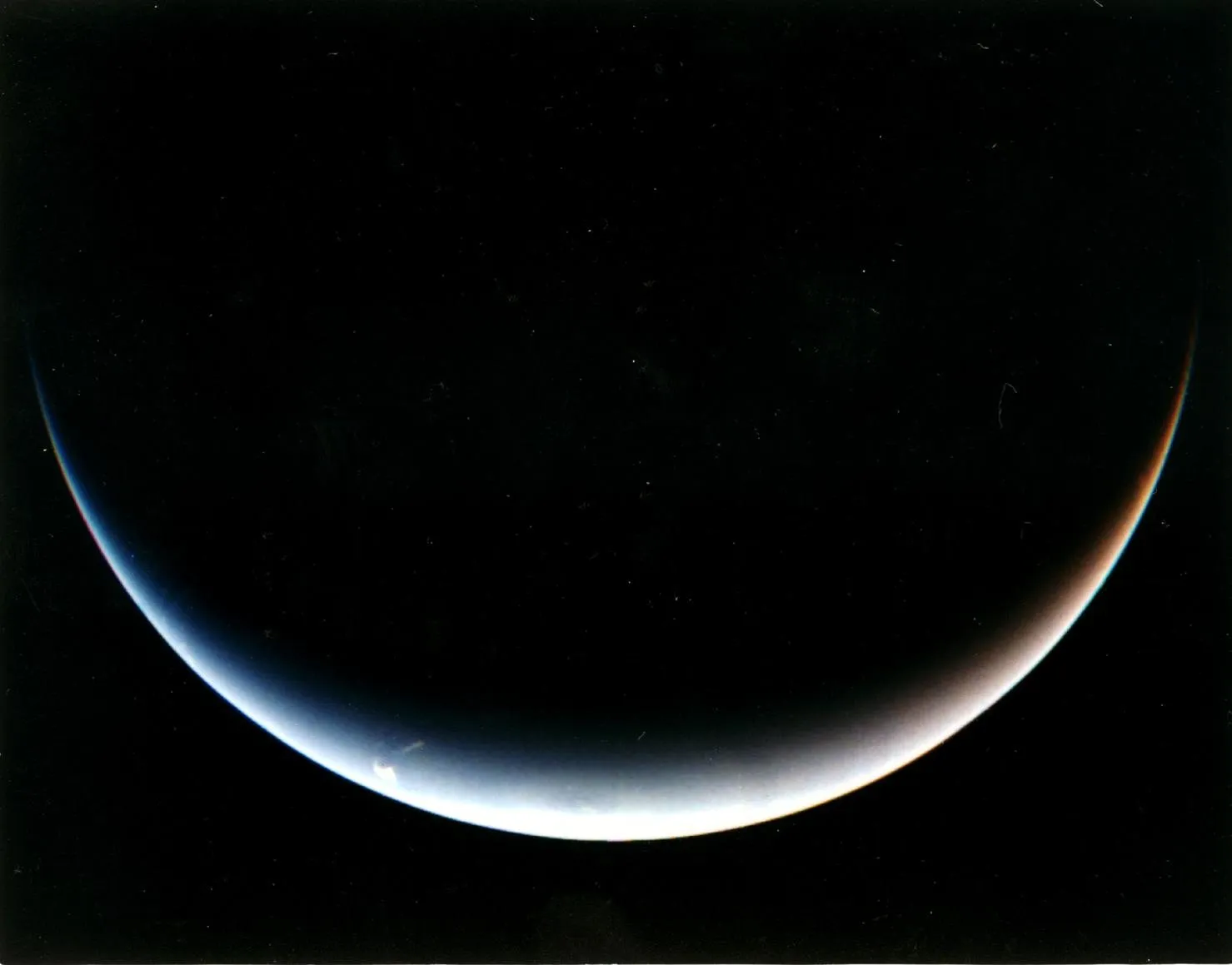
The solar system is mostly empty space, and that emptiness is the whole story.
Look
Most pictures of the solar system squeeze the planets together like beads on a string, and draw them far too big. They have to: at true scale, a page would be almost completely empty.
Guess first: if the Sun were a beach ball, how far away would Earth be? A step? A room? A street?
A street. With the Sun as a 1-metre ball, Earth is a 9 mm pea about 107 metres away: roughly the length of a football pitch. Keep that picture in mind as you travel.
The Scale Walk above is drawn at true scale: sizes and distances in the same proportion. Every pixel you scroll carries you 3,000 km. Scroll inside the frame, press Next world, or tap a planet on the journey map at the top.
- The journey map is to scale too. The white marker is you. Notice how the Sun and the four inner planets crowd together at the far left.
- The odometer counts kilometres and the time sunlight has needed to get where you are.
- When you stop near a world, the camera locks on and leans in (the zoom is shown next to the scale bar), and a card tells you where you are.
- Earth, a globe 12,742 km across, is almost 50,000 scrolled pixels from the Sun. Neptune is about 1.5 million pixels away.
Notice how much of the trip is just black, with only a few lines of narration drifting past. That is the real solar system: tiny worlds separated by enormous emptiness.
Understand
A scale model divides every length by the same number. Here the number is 3,000: 3,000 km of real space becomes 1 pixel.
| World | Real diameter | Diameter at 1 px = 3,000 km | Distance from Sun | At this scale |
|---|---|---|---|---|
| Sun | 1,391,400 km | 464 px | 0 | 0 |
| Earth | 12,742 km | 4 px | 149.6 million km | 49,866 px |
| Jupiter | 139,822 km | 47 px | 778.3 million km | 259,437 px |
| Neptune | 49,244 km | 16 px | 4,498 million km | 1,499,000 px |
A handy comparison uses the Sun as a 1-metre ball. Divide everything by the Sun’s diameter (1.39 million km):
- Earth is a 9 mm pea, 107 m away.
- Jupiter is a 10 cm grapefruit, 560 m away.
- Neptune is a 3.5 cm marble, 3.2 km away.
- The nearest star, Proxima Centauri, would be another ball about 29,000 km away: more than two thirds of the way around the real Earth.
Try the autopilot at 1×, the real speed of light. You move 100 pixels per second, which feels slow on screen. Real sunlight really does need 8 minutes to reach Earth and more than 4 hours to reach Neptune. The faster settings compress time, not distance: the autopilot still brakes and pauses at every world.
Guess first: scrolling with a mouse wheel, are you moving faster or slower than light?
Much faster. A brisk scroll carries you millions of kilometres per second, often ten or more times the speed of light; the speed readout under the odometer shows it. Even so, the outer planets take a long time to reach. That is how big the distances are.
Master
Two separate compressions distort normal diagrams: the size scale and the distance scale. The ratio of the Sun-Neptune distance (4.5 × 10⁹ km) to Earth’s diameter (1.27 × 10⁴ km) is about 350,000. A screen 1,000 pixels tall can resolve a range of about 1,000, so no single static image can show both the planets and their spacing. Interactive zoom, logarithmic axes or a scroll-length model like this one are the only honest options.
This is also why the orrery on this site offers two modes. Readable scale compresses distance with a square root (r_screen ∝ √r) and draws planets at fixed legible sizes. True scale is linear in both size and distance, so the planets shrink to sub-pixel dots.
The emptiness has consequences for spaceflight. Travelling between planets is not like driving between cities: the planets move, the distances are huge, and the energy cost depends far more on changes of speed than on distance. That idea, delta-v, is at the heart of the Navigator path.
A last scale fact: the asteroid belt, often drawn as a crowded field of rocks, is so sparse that spacecraft cross it without any special manoeuvres. The Kuiper belt beyond Neptune is emptier still.
Ku day
Set the autopilot speed to 1× and press 'Travel at the speed of light'. Watch the light-time clock as you reach Earth: about 8 minutes 20 seconds. Before you look at the table, guess how long the same trip takes to Neptune, then check.
Wayn. Dhibaatooyinka waa halka waxbarashada ku shubto.
Imtixaan degdeg ah
3 su'aalo degdeg ah. Dooro jawaab si aad u aragto haddii aad xaq tahay.
-
If the Sun were a ball 1 metre wide, about how big would Earth be?
- A A football
- B A grapefruit
- C About 9 millimetres, like a pea
- D About 1 millimetre
Tuso jawaabta
C. About 9 millimetres, like a pea The Sun is about 109 times wider than Earth, so 1 m ÷ 109 ≈ 9 mm.
-
At that same scale, how far away would Earth be from the 1-metre Sun?
- A About 1 metre
- B About 10 metres
- C About 107 metres
- D About 1 kilometre
Tuso jawaabta
C. About 107 metres 1 au is about 107.5 Sun diameters, so Earth would be a pea about the length of a football pitch away.
-
Why do most drawings of the solar system show the planets close together?
- A Because they really are close
- B Because at true scale the planets would be too small to see on the page
- C Because the drawings show the planets at their closest approach
- D Because of light pollution
Tuso jawaabta
B. Because at true scale the planets would be too small to see on the page
Jidka dhamaadka
- La ciyaaray la interactive
- Akhri akhriska
- Ma dhibco
- Ku qaatay imtixaankan
Mark fasalka dhamaystiran si aad u badbaadiso in horumarka aad ku qalabkan.
Waxbarasho dhamaatay. Wanaagsan!
Kor u qaad Days and years on each worldErayada akhriskaan
Isha
- NASA NSSDCA Planetary Fact Sheet (diameters, distances)
- JPL SSD: Approximate Positions of the Planets (semi-major axes)
- NASA NSSDCA: Schoolyard Solar System scale model
Waxbarashadani waa la siiyay CC BY-SA 4.0.