
Бұл сабақ Local Solar System Foundation тобының мүшесімен жазылған және білікті тексеруші арқылы жақсартылуы мүмкін. Сіз осы тақырып бойынша біліктісіз бе? Өзгертуді ұсыныңыз
Масштабтау
Толық бетті ашуМұнда барлығы шын масштабта: өлшемдер мен қашықтықтар тең пропорцияда. Жүргізген әрбір пиксел 3 000 км- ге дейін созылады.
Жүргізіп тұрыңыз. Күн жүйесінің көрген әрбір суреті осы бос орынды толтырады.
Меркурий алдыңғы орында, онда күн сәулесі Жердегіден жеті есе күшті.
Ештеңе жоқ. 16,8 миллион km дегеннен бастап Меркурий дегенге дейін өттіңіз.
Күн сәулесі сізге жақындап, 5 мин 5 с бұрын Күннен шықты.
Жер алдыда.
Қаңтар әлі 58,8 миллион km алдыңғы.
Жерден жіберілген радио хабардың Марсқа жетуі екі планетаның орналасуына байланысты 3-22 минутты алады.
Сіз қатарға тұруға болады 4 611 Жерді бір- біріне жақын жерден өткеннен кейін Жер.
Сіз 14% жолынан Қаңтар екі Церераobject name (optional).
Ештеңе жоқ. 53,1 миллион km дегеннен бастап Қаңтар дегенге дейін өттіңіз.
Күн сәулесі сізге жақындап, 17 мин 6 с бұрын Күннен шықты.
Церераobject name (optional) әлі 79,6 миллион km алдыңғы.
Сіз астероид белдеуінің ішіндесіз. Сіз бірдеңеге соқтығысып қалдыңыз ба? Орташа алғанда, астероидтер арасындағы қашықтық шамамен миллион шақырым.
Сіз қатарға тұруға болады 12 497 Жерді бір- біріне жақын жерден өткеннен кейін Қаңтар.
Сіз 17% жолынан Церераobject name (optional) екі Юпитер.
Ештеңе жоқ. 122 миллион km дегеннен бастап Церераobject name (optional) дегенге дейін өттіңіз.
Күн сәулесі сізге жақындап, 33 мин 8 с бұрын Күннен шықты.
Юпитер әлі 122 миллион km алдыңғы.
Сіз қатарға тұруға болады 23 846 Жерді бір- біріне жақын жерден өткеннен кейін Церераobject name (optional).
Сіз 10% жолынан Юпитер екі Сатурн.
Ештеңе жоқ. 130 миллион km дегеннен бастап Юпитер дегенге дейін өттіңіз.
Күн сәулесі сізге жақындап, 54 мин 5 с бұрын Күннен шықты.
Сатурн әлі 389 миллион km алдыңғы.
«Вояджер-1» Юпитерден Сатурнға дейінгі жолда 20 ай жүрді.
Сіз қатарға тұруға болады 30 529 Жерді бір- біріне жақын жерден өткеннен кейін Юпитер.
Сіз 70% жолынан Юпитер екі Сатурн.
Ештеңе жоқ. 519 миллион km дегеннен бастап Юпитер дегенге дейін өттіңіз.
Күн сәулесі сізге жақындап, 1 сағ 16 мин бұрын Күннен шықты.
Уран әлі 1,31 миллиард km алдыңғы.
Сіз қатарға тұруға болады 20 605 Жерді бір- біріне жақын жерден өткеннен кейін Сатурн.
Сіз 27% жолынан Сатурн екі Уран.
Ештеңе жоқ. 525 миллион km дегеннен бастап Сатурн дегенге дейін өттіңіз.
Уран Сатурнан екі есе алыс. Неғұрлым алыс болса, соғұрлым бос болады.
Күн сәулесі сізге жақындап, 2 сағ 3 мин бұрын Күннен шықты.
Уран әлі 525 миллион km алдыңғы.
Сіз қатарға тұруға болады 82 418 Жерді бір- біріне жақын жерден өткеннен кейін Сатурн.
Сіз 82% жолынан Сатурн екі Уран.
Ештеңе жоқ. 1,31 миллиард km дегеннен бастап Сатурн дегенге дейін өттіңіз.
Күн сәулесі сізге жақындап, 2 сағ 48 мин бұрын Күннен шықты.
Нептун әлі 1,33 миллиард km алдыңғы.
Сіз қатарға тұруға болады 34 840 Жерді бір- біріне жақын жерден өткеннен кейін Уран.
Сіз 36% жолынан Уран екі Нептун.
Ештеңе жоқ. 740 миллион km дегеннен бастап Уран дегенге дейін өттіңіз.
«Вояджер-2» бұл арақашықтықты 1986 жылы Ураннан 1989 жылы Нептунға дейін үш жыл жарты уақыт ішінде басып өтті.
Күн сәулесі сізге жақындап, 3 сағ 37 мин бұрын Күннен шықты.
Нептун әлі 444 миллион km алдыңғы.
Сіз қатарға тұруға болады 104 519 Жерді бір- біріне жақын жерден өткеннен кейін Уран.
Сіз 91% жолынан Уран екі Нептун.
Ештеңе жоқ. 129 миллион km дегеннен бастап Нептун дегенге дейін өттіңіз.
Күн сәулесі сізге жақындап, 4 сағ 24 мин бұрын Күннен шықты.
Кейбір ғалымдар Плутонның айналасында ірі планеталар бар деп есептейді, ал кейбіреулері оның айналасында үлкен планеталар бар деп санайды.
Плутон әлі 906 миллион km алдыңғы.
Сіз қатарға тұруға болады 50 798 Жерді бір- біріне жақын жерден өткеннен кейін Нептун.
Сіз 55% жолынан Нептун екі Плутон.
Ештеңе жоқ. 906 миллион km дегеннен бастап Нептун дегенге дейін өттіңіз.
Жалпы шығарылған ең жылдам ғарыш аппараттарының бірі - New Horizons, Плутонға жету үшін тоғыз жыл жарты уақыт жұмсады. Күн сәулесі Плутонның орташа қашықтығына шамамен бес сағат жарты уақытта жетеді.
Күн сәулесі сізге жақындап, 5 сағ 15 мин бұрын Күннен шықты.
Плутон әлі 129 миллион km алдыңғы.
Шегіну үшін фреймнің ішіндегі жолды төмен жүгіртіңіз, немесе төмендегі автопилотты жегу.
Жолдың соңы
Артқа қара. Бұл жарқын жұлдыз - Күн.
Деректер кестесінің (мәтіндік) орны
| Дүниежүзілік | Диаметрі | Күннен қашықтық | Күннен жарық уақыты | px |
|---|---|---|---|---|
| Меркурий | 4 879 km | 0,387 au | 3 мин 13 с | 19 303 |
| Венера | 12 104 km | 0,723 au | 6 мин 1 с | 36 070 |
| Жер | 12 742 km | 1 au | 8 мин 19 с | 49 866 |
| Қаңтар | 6 779 km | 1,52 au | 12 мин 40 с | 75 981 |
| Церераobject name (optional) | 939 km | 2,77 au | 23 мин 0 с | 137 907 |
| Юпитер | 139 822 km | 5,2 au | 43 мин 16 с | 259 447 |
| Сатурн | 116 464 km | 9,54 au | 1 сағ 19 мин | 475 555 |
| Уран | 50 724 km | 19,2 au | 2 сағ 40 мин | 956 886 |
| Нептун | 49 244 km | 30,1 au | 4 сағ 10 мин | 1 499 465 |
| Плутон | 2 377 km | 39,6 au | 5 сағ 29 мин | 1 974 125 |
Almost every picture of the solar system lies. To fit on a page, the planets are squeezed together and blown up in size. Walk it at true scale and you discover the real star of the show: empty space.
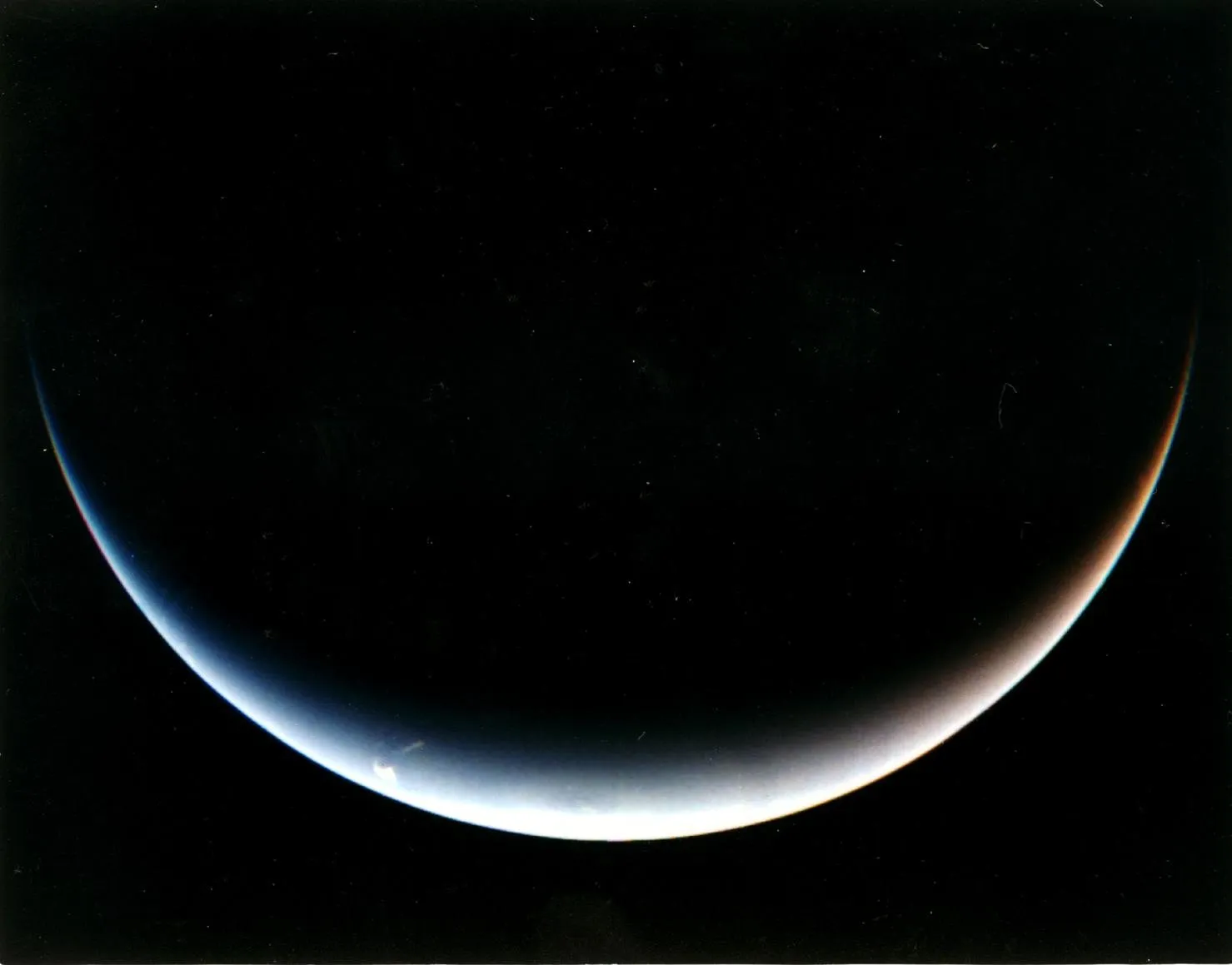
The solar system is mostly empty space, and that emptiness is the whole story.
Look
Most pictures of the solar system squeeze the planets together like beads on a string, and draw them far too big. They have to: at true scale, a page would be almost completely empty.
Guess first: if the Sun were a beach ball, how far away would Earth be? A step? A room? A street?
A street. With the Sun as a 1-metre ball, Earth is a 9 mm pea about 107 metres away: roughly the length of a football pitch. Keep that picture in mind as you travel.
The Scale Walk above is drawn at true scale: sizes and distances in the same proportion. Every pixel you scroll carries you 3,000 km. Scroll inside the frame, press Next world, or tap a planet on the journey map at the top.
- The journey map is to scale too. The white marker is you. Notice how the Sun and the four inner planets crowd together at the far left.
- The odometer counts kilometres and the time sunlight has needed to get where you are.
- When you stop near a world, the camera locks on and leans in (the zoom is shown next to the scale bar), and a card tells you where you are.
- Earth, a globe 12,742 km across, is almost 50,000 scrolled pixels from the Sun. Neptune is about 1.5 million pixels away.
Notice how much of the trip is just black, with only a few lines of narration drifting past. That is the real solar system: tiny worlds separated by enormous emptiness.
Understand
A scale model divides every length by the same number. Here the number is 3,000: 3,000 km of real space becomes 1 pixel.
| World | Real diameter | Diameter at 1 px = 3,000 km | Distance from Sun | At this scale |
|---|---|---|---|---|
| Sun | 1,391,400 km | 464 px | 0 | 0 |
| Earth | 12,742 km | 4 px | 149.6 million km | 49,866 px |
| Jupiter | 139,822 km | 47 px | 778.3 million km | 259,437 px |
| Neptune | 49,244 km | 16 px | 4,498 million km | 1,499,000 px |
A handy comparison uses the Sun as a 1-metre ball. Divide everything by the Sun’s diameter (1.39 million km):
- Earth is a 9 mm pea, 107 m away.
- Jupiter is a 10 cm grapefruit, 560 m away.
- Neptune is a 3.5 cm marble, 3.2 km away.
- The nearest star, Proxima Centauri, would be another ball about 29,000 km away: more than two thirds of the way around the real Earth.
Try the autopilot at 1×, the real speed of light. You move 100 pixels per second, which feels slow on screen. Real sunlight really does need 8 minutes to reach Earth and more than 4 hours to reach Neptune. The faster settings compress time, not distance: the autopilot still brakes and pauses at every world.
Guess first: scrolling with a mouse wheel, are you moving faster or slower than light?
Much faster. A brisk scroll carries you millions of kilometres per second, often ten or more times the speed of light; the speed readout under the odometer shows it. Even so, the outer planets take a long time to reach. That is how big the distances are.
Master
Two separate compressions distort normal diagrams: the size scale and the distance scale. The ratio of the Sun-Neptune distance (4.5 × 10⁹ km) to Earth’s diameter (1.27 × 10⁴ km) is about 350,000. A screen 1,000 pixels tall can resolve a range of about 1,000, so no single static image can show both the planets and their spacing. Interactive zoom, logarithmic axes or a scroll-length model like this one are the only honest options.
This is also why the orrery on this site offers two modes. Readable scale compresses distance with a square root (r_screen ∝ √r) and draws planets at fixed legible sizes. True scale is linear in both size and distance, so the planets shrink to sub-pixel dots.
The emptiness has consequences for spaceflight. Travelling between planets is not like driving between cities: the planets move, the distances are huge, and the energy cost depends far more on changes of speed than on distance. That idea, delta-v, is at the heart of the Navigator path.
A last scale fact: the asteroid belt, often drawn as a crowded field of rocks, is so sparse that spacecraft cross it without any special manoeuvres. The Kuiper belt beyond Neptune is emptier still.
Сынап көру
Set the autopilot speed to 1× and press 'Travel at the speed of light'. Watch the light-time clock as you reach Earth: about 8 minutes 20 seconds. Before you look at the table, guess how long the same trip takes to Neptune, then check.
Жақсы.
Жылдам тест
3 жылдам сұрақтар. Дұрыс жауап бергеніңізді тексеру үшін біреуін таңдаңыз.
-
If the Sun were a ball 1 metre wide, about how big would Earth be?
- A A football
- B A grapefruit
- C About 9 millimetres, like a pea
- D About 1 millimetre
Жауап көрсетілсін
C. About 9 millimetres, like a pea The Sun is about 109 times wider than Earth, so 1 m ÷ 109 ≈ 9 mm.
-
At that same scale, how far away would Earth be from the 1-metre Sun?
- A About 1 metre
- B About 10 metres
- C About 107 metres
- D About 1 kilometre
Жауап көрсетілсін
C. About 107 metres 1 au is about 107.5 Sun diameters, so Earth would be a pea about the length of a football pitch away.
-
Why do most drawings of the solar system show the planets close together?
- A Because they really are close
- B Because at true scale the planets would be too small to see on the page
- C Because the drawings show the planets at their closest approach
- D Because of light pollution
Жауап көрсетілсін
B. Because at true scale the planets would be too small to see on the page
Аяқтау жолы
- Интерактивті ойнау
- Урокты оқу
- Мақсатты орындады
- Тестті тапсырды
Бұл құрылғыдағы орындалуын сақтау үшін сабақты біткен деп белгілеңіз.
Урок бітті. Жақсы жұмыс!
Келесіге Days and years on each worldБұл сабақтағы сөздер
Көздері
- NASA NSSDCA Planetary Fact Sheet (diameters, distances)
- JPL SSD: Approximate Positions of the Planets (semi-major axes)
- NASA NSSDCA: Schoolyard Solar System scale model
Бұл сабақ CC BY-SA 4.0 лицензиясымен таратылады.