Scientific publications
Seventeen peer-reviewed studies, all free to read, on what artificial light at night is doing to our skies, our wildlife and our bodies. Chosen by the Light Initiative.
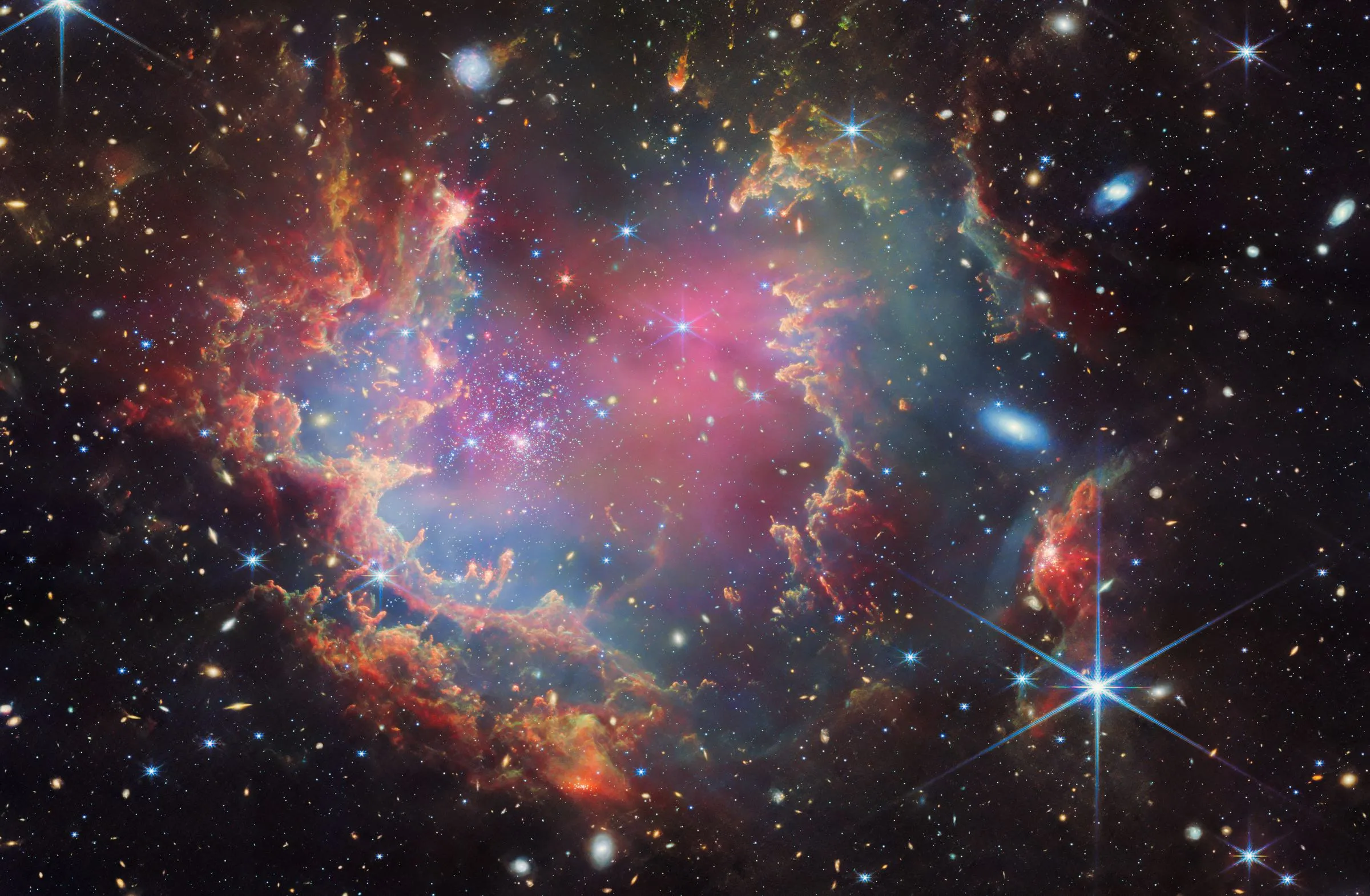
ESA/Webb, NASA & CSA, P. Zeidler, E. Sabbi, A. Nota, M. Zamani (ESA/Webb) (CC BY 4.0)
These papers are by independent researchers, not by Local Solar System. All were published open access in Scientific Reports, so anyone can read them in full. The short summaries are ours; please read the papers themselves before citing them.
Science is how we know the night is disappearing. It is also how we will know when it comes back.
Measuring the sky
Using all-sky differential photometry to investigate how nocturnal clouds darken the night sky in rural areas
Andreas Jechow, Franz Hölker & Christopher C. M. Kyba. Scientific Reports 9, 1391 (2019).
All-sky photometry with a consumer camera shows how clouds darken the sky at unpolluted rural sites, setting a reference point for natural darkness.
Imaging and mapping the impact of clouds on skyglow with all-sky photometry
Andreas Jechow, Zoltán Kolláth, Salvador J. Ribas, Henk Spoelstra, Franz Hölker & Christopher C. M. Kyba. Scientific Reports 7, 6741 (2017).
Maps how clouds amplify skyglow near cities, using all-sky photometry at several sites.
Variation of outdoor illumination as a function of solar elevation and light pollution
Manuel Spitschan, Geoffrey K. Aguirre, David H. Brainard & Alison M. Sweeney. Scientific Reports 6, 26756 (2016).
Measures how outdoor light changes with the Sun’s elevation at a dark park and in Philadelphia, extending the standard daylight model into twilight and night.
Contrasting trends in light pollution across Europe based on satellite observed night time lights
Jonathan Bennie, Thomas W. Davies, James P. Duffy, Richard Inger & Kevin J. Gaston. Scientific Reports 4, 3789 (2014).
Satellite images over 15 years show Europe getting brighter overall, while some developed regions are getting darker: reduction is possible.
Citizen Science Provides Valuable Data for Monitoring Global Night Sky Luminance
Christopher C. M. Kyba, Janna M. Wagner, Helga U. Kuechly, Constance E. Walker, Christopher D. Elvidge, Fabio Falchi, Thomas Ruhtz, Jürgen Fischer & Franz Hölker. Scientific Reports 3, 1835 (2013).
Naked-eye star counts from the GLOBE at Night citizen-science project track artificial skyglow closely and can monitor lighting changes worldwide.
Artificial light alters natural regimes of night-time sky brightness
Thomas W. Davies, Jonathan Bennie, Richard Inger & Kevin J. Gaston. Scientific Reports 3, 1722 (2013).
Artificial light changes the natural cycles of night-sky brightness, including the monthly lunar cycle, with consequences for ecosystems.
Birds
Light pollution is greatest within migration passage areas for nocturnally-migrating birds around the world
Sergio A. Cabrera-Cruz, Jaclyn A. Smolinsky & Jeffrey J. Buler. Scientific Reports 8, 3261 (2018).
Light pollution is strongest in the regions that nocturnally migrating birds cross during migration, the most critical stage of their year.
GPS tracking for mapping seabird mortality induced by light pollution
Airam Rodríguez, Beneharo Rodríguez & Juan J. Negro. Scientific Reports 5, 10670 (2015).
GPS tracking of Cory’s shearwater fledglings on Tenerife shows that young seabirds are grounded by artificial light on their first flight.
Wildlife
Artificial Light at Night Promotes Activity Throughout the Night in Nesting Common Swifts (Apus apus)
Eran Amichai & Noga Kronfeld-Schor. Scientific Reports 9, 11052 (2019).
Artificial light at night kept nesting common swifts active throughout the night.
White LED Light Exposure Inhibits the Development and Xanthophore Pigmentation of Zebrafish Embryo
Ünsal Veli Üstündağ, E. Çalıskan-Ak, Perihan Seda Ateş, İsmail Ünal, Gizem Eğilmezer, Türkan Yiğitbaşı, A. Ata Alturfan & Ebru Emekli-Alturfan. Scientific Reports 9, 10810 (2019).
White LED light slowed development and pigmentation in zebrafish embryos.
Ambient anthropogenic noise but not light is associated with the ecophysiology of free-living songbird nestlings
Thomas Raap, Rianne Pinxten, Giulia Casasole, Nina Dehnhard & Marcel Eens. Scientific Reports 7, 2754 (2017).
In great tit nestlings, traffic noise but not light was linked to physiological stress. A useful counterpoint: not every effect is caused by light.
Light pollution disrupts sleep in free-living animals
Thomas Raap, Rianne Pinxten & Marcel Eens. Scientific Reports 5, 13557 (2015).
Great tits exposed to LED light at night woke earlier and slept less: direct evidence that light pollution disrupts sleep in wild animals.
Oceans
The spectral and spatial distribution of light pollution in the waters of the northern Gulf of Aqaba (Eilat)
Raz Tamir, Amit Lerner, Carynelisa Haspel, Zvy Dubinsky & David Iluz. Scientific Reports 7, 42329 (2017).
First measurements of artificial light under water near a city, detected down to 30 m in the coral reefs of the Gulf of Aqaba.
Health
Several biological benefits of the low color temperature light-emitting diodes based normal indoor lighting source
Jiaqi Lin, Xingwei Ding, Can Hong, Yulian Pang, Liming Chen, Quanwen Liu, Xu Zhang, Hongbo Xin & Xiaolei Wang. Scientific Reports 9, 7560 (2019).
Reports biological benefits of low colour temperature LED lighting indoors, compared with cooler light.
Cycles of circadian illuminance are sufficient to entrain and maintain circadian locomotor rhythms in Drosophila
Eunjoo Cho, Ji Hye Oh, Euna Lee, Young Rag Do & Eun Young Kim. Scientific Reports 6, 37784 (2016).
Using a measure called circadian illuminance, shows in fruit flies that specially designed LEDs can light the night with far less disruption to the body clock.
Parkinson’s Disease, Lights and Melanocytes: Looking Beyond the Retina
Gregory L. Willis, Cleo Moore & Stuart Maxwell Armstrong. Scientific Reports 4, 3921 (2014).
A paper proposing links between light, skin melanocytes and Parkinson’s disease beyond the eye. A hypothesis rather than an established result.
Bright light exposure reduces TH-positive dopamine neurons: implications of light pollution in Parkinson’s disease epidemiology
Stefania Romeo, Cristina Viaggi, Daniela Di Camillo, Allison W. Willis, Luca Lozzi, Cristina Rocchi, Marta Capannolo, Gabriella Aloisi, Francesca Vaglini, Rita Maccarone, Matteo Caleo, Cristina Missale, Brad A. Racette, Giovanni U. Corsini & Roberto Maggio. Scientific Reports 3, 1395 (2013).
In rats, continuous bright light reduced dopamine neurons; the authors report a preliminary correlation between sky brightness and Parkinson’s disease prevalence.
Know a study that belongs here? Suggest it through the contribution board.