
Ову лекцију је направио члан Local Solar System фондационог тима и може бити побољшана од стране квалификованог рецензента. Да ли сте квалификовани за ову тему? Предложите измену
Ноћно небо и светлосно загађење
Отвори целу страницуПозиције и сјај звезда из Јејловог каталога светлих звезда. Ваша локација се никада не сачувава.
Табела података (текст алтернатива)
| Класификација по класама | Најсјајније звезде | Видљиве звезде (цело небо, чиста ноћ) |
|---|---|---|
| 1 | 7.8 | 9.093+ |
| 2 | 7.3 | 9.082+ |
| 3 | 6.8 | 9.002+ |
| 4 | 6.3 | 7.008 |
| 5 | 5.8 | 4.103 |
| 6 | 5.3 | 2.319 |
| 7 | 4.8 | 1.267 |
| 8 | 4.3 | 718 |
| 9 | 3.8 | 409 |
For all of human history people looked up and saw the galaxy we live in. Today one person in three on Earth can no longer see the Milky Way from home. This lesson teaches you to read the sky, and to understand what we are losing.
The sky is the oldest book there is. Light pollution is closing it.
Look
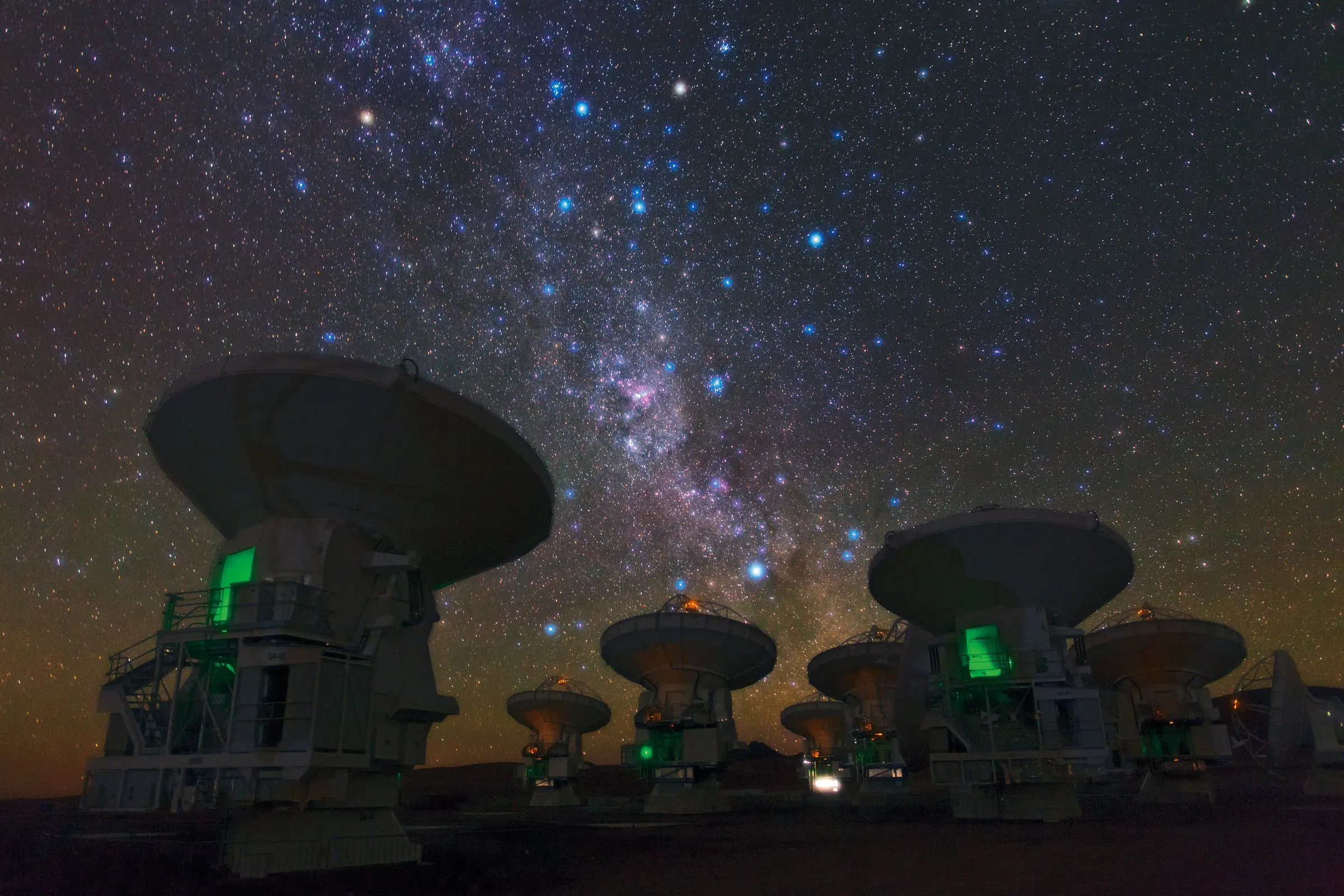
Look at the sky from a city and you might see a few dozen stars. From a truly dark place, far from any town, you can see thousands, and the Milky Way stretches across the sky like a cloud.
The difference is light pollution: artificial light that escapes upwards and makes the sky glow. That glow washes out the faint stars.
Drag the slider in the tool from 1 (a truly dark site) to 9 (inner city). The stars are real: they come from a catalogue of the 9,000 or so brightest stars in the sky. Watch how many disappear.
This is not only about stargazing. Night-time light also affects animals that navigate or hunt in the dark, and it wastes energy by lighting the sky instead of the ground. This connects to our Red Initiative and its Light Initiative for night-sky preservation.
Understand
Astronomers measure brightness with magnitudes. It is a backwards scale: bright stars have small numbers.
- Sirius, the brightest star at night, is about −1.5.
- The faintest stars most people can see from a dark site are about magnitude 6 to 7.
- In a city, the limit may be magnitude 4 or brighter.
The Bortle scale, published by the amateur astronomer John Bortle in 2001, sorts skies into nine classes. Each class comes with a typical faintest visible magnitude:
| Bortle class | Description | Faintest stars |
|---|---|---|
| 1 | Excellent dark site | 7.6 to 8.0 |
| 3 | Rural sky | 6.6 to 7.0 |
| 5 | Suburban sky | 5.6 to 6.0 |
| 7 | Suburban/urban transition | 4.6 to 5.0 |
| 9 | Inner-city sky | 4.0 at best |
Because there are many more faint stars than bright ones, each magnitude you lose hides a lot of them. In the Yale catalogue, about 5,000 stars are brighter than magnitude 6, but only about 500 are brighter than magnitude 4.
A 2016 world atlas found that more than 80% of people, and more than 99% of people in the United States and Europe, live under light-polluted skies.
Master
Magnitude is logarithmic. For two stars with fluxes F₁ and F₂:
m₁ − m₂ = −2.5 · log₁₀(F₁ / F₂)
A difference of 5 magnitudes is exactly a factor of 100 in flux, so one magnitude is a factor of 100^(1/5) ≈ 2.512.
Why do star counts rise so steeply? If stars were spread uniformly through space, all with the same luminosity, the number brighter than magnitude m would grow as 10^(0.6 m): about four times more stars for each fainter magnitude. The real Galaxy is not uniform, so the observed growth is smaller, around three times per magnitude near the naked-eye limit. You can check it with the catalogue counts in the tool’s data table.
Sky glow adds a background of its own brightness. A star is visible only if it stands out enough against that background, so a brighter sky raises the limiting magnitude. The Bortle limits are rough observer-based ranges, not a physical law, and your own result depends on your eyes, dark adaptation and the weather.
What works against light pollution, according to DarkSky International’s lighting principles: light only what needs light, only when it needs it, no brighter than necessary, pointing downwards with full shielding, and in warm colours (less blue light, which scatters more in the atmosphere).
Пробај.
Find your own home on the Bortle scale: go outside on a clear moonless night, let your eyes adapt for 20 minutes, and count how many stars you can see inside the rectangle of Orion (or the Southern Cross). Set the slider to match what you saw.
Извођење је оно што учење држи.
Брзи тест
3 Брза питања. Изаберите одговор да бисте видели да ли сте у праву.
-
On the magnitude scale, which star is brighter?
- A A star of magnitude 1
- B A star of magnitude 6
- C They look the same
- D It depends on the colour
Прикажи одговор
A. A star of magnitude 1 Smaller magnitudes are brighter. Each step of 5 magnitudes is a factor of 100 in brightness.
-
In a big city (Bortle class 8 or 9), roughly how many stars can you see in the whole sky?
- A Several hundred at most
- B About 5,000
- C About 10,000
- D Millions
Прикажи одговор
A. Several hundred at most
-
Which of these helps reduce light pollution?
- A Brighter bulbs
- B Lights that point upwards
- C Shielded lights that point down, warm colours and timers
- D Blue-white lighting
Прикажи одговор
C. Shielded lights that point down, warm colours and timers
Завршна линија
- Играо се са интерактивним
- Прочитај лекцију
- Урадио изазов
- Положио сам тест.
Означи лекцију као завршену да бисте је сачували у напредак на овом уређају.
Лекција завршена.
То је била последња лекција на овом путу. Твој напредак
Речи у овој лекцији
Извор
- J. E. Bortle, 'Introducing the Bortle Dark-Sky Scale', Sky & Telescope, February 2001
- Yale Bright Star Catalogue, 5th revised ed. (Hoffleit & Warren 1991), CDS catalogue V/50
- F. Falchi et al., 'The new world atlas of artificial night sky brightness', Science Advances 2 (2016)
- DarkSky International: lighting principles
Ова лекција је лиценцирана као CC BY-SA 4.0.