
Navigator
Schwerkraft, Keplers Gesetze, Umlaufbahnen, Geschwindigkeiten, Flucht, die Raketengleichung und wie Raumfahrzeuge zwischen Welten reisen.
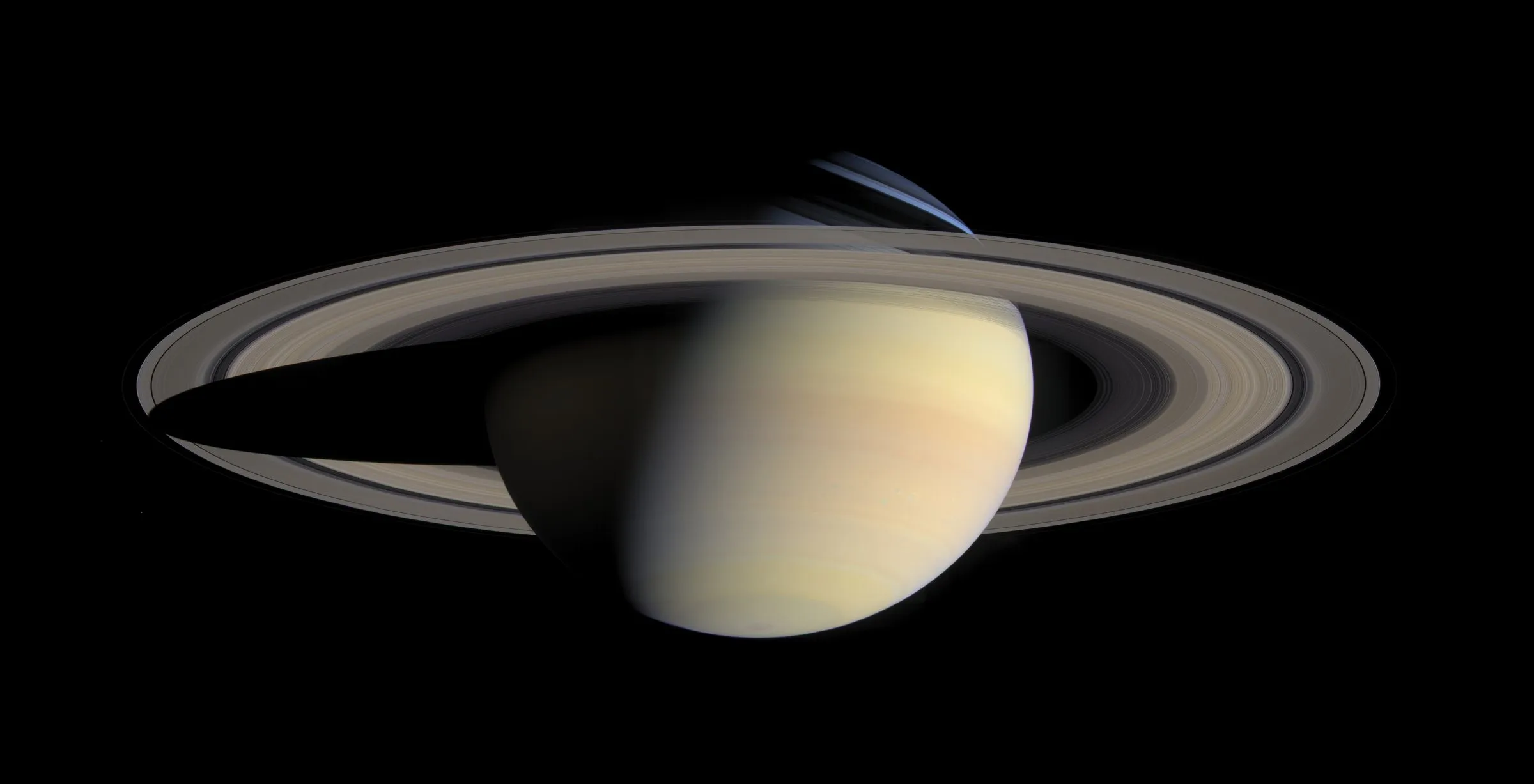
NASA/JPL/Space Science Institute
-
Newtonsche Schwerkraft
- Newton's gravity · 12 min Abgeschlossen
One law explains falling apples, the Moon's orbit and the path of every planet. Fire Newton's cannon and find out how.
- Newton's gravity · 12 min Abgeschlossen
-
Keplersche Gesetze
- Kepler's laws · 14 min Abgeschlossen
Three rules found from careful observations in the early 1600s still describe every orbit, from moons to exoplanets.
- Kepler's laws · 14 min Abgeschlossen
-
Orbitalelement
- Orbital elements · 14 min Abgeschlossen
Six numbers pin down any orbit in space: its size, shape, tilt, orientation and where the body is on it.
- Orbital elements · 14 min Abgeschlossen
-
Umlaufgeschwindigkeit: die Vis-Viva-Gleichung
- Orbital speed: the vis-viva equation · 12 min Abgeschlossen
One short equation gives the speed of anything in orbit at any point, if you know how far it is and the size of its orbit.
- Orbital speed: the vis-viva equation · 12 min Abgeschlossen
-
Fluchtgeschwindigkeit
- Escape velocity · 12 min Abgeschlossen
How fast do you need to go to leave a world for good? And why rockets do not actually need to reach it at the surface.
- Escape velocity · 12 min Abgeschlossen
-
Warum eine Umlaufbahn ein Sturz ist
- Why an orbit is a fall · 10 min Abgeschlossen
Astronauts float not because there is no gravity up there, but because they are falling all the time, and missing.
- Why an orbit is a fall · 10 min Abgeschlossen
-
Erreichen der Umlaufbahn: die Schwerkraftdrehung
- Reaching orbit · 12 min Abgeschlossen
Why rockets go up for only a few seconds, then spend ten minutes going sideways: the gravity turn, staging and orbital insertion.
- Reaching orbit · 12 min Abgeschlossen
-
Die Raketengleichung und Delta-v
- The rocket equation and delta-v · 12 min Abgeschlossen
Why rockets are mostly fuel, why they come in stages, and the one equation behind every mission's budget.
- The rocket equation and delta-v · 12 min Abgeschlossen
-
Navigationsleiste Hohmann Transfers
- Hohmann transfers: changing orbits · 12 min Abgeschlossen
To go higher you speed up, and then you arrive slower. The two-burn manoeuvre that moves satellites from low orbit to geostationary orbit.
- Hohmann transfers: changing orbits · 12 min Abgeschlossen
-
Startfenster
- Launch windows: the road to Mars · 12 min Abgeschlossen
You cannot aim at Mars, only at where Mars will be in eight months. Why Mars missions leave every 26 months, all at once.
- Launch windows: the road to Mars · 12 min Abgeschlossen
-
Orbit-Einfügung: eingefangen werden
- Orbital insertion: getting captured · 12 min Abgeschlossen
Arriving at a planet is the most dangerous minute of a mission: one burn decides whether you stay or fly past forever.
- Orbital insertion: getting captured · 12 min Abgeschlossen
-
Gravity Assists
- Gravity assists: the free slingshot · 12 min Abgeschlossen
How Voyager, Cassini and New Horizons stole speed from planets, and why it never breaks the conservation of energy.
- Gravity assists: the free slingshot · 12 min Abgeschlossen
-
Lagrange-Punkt
- Lagrange points: balance in the sky · 11 min Abgeschlossen
Five places around every pair of worlds where a spacecraft can ride along for free, and why the James Webb Space Telescope lives at one of them.
- Lagrange points: balance in the sky · 11 min Abgeschlossen
-
Rendezvous und Andocken
- Rendezvous: catching the space station · 11 min Abgeschlossen
To catch something ahead of you in orbit, you drop lower and go slower-looking but faster. The counter-intuitive art of meeting in space.
- Rendezvous: catching the space station · 11 min Abgeschlossen
-
Nach Hause kommen: Wiedereintritt
- Coming home: reentry · 11 min Abgeschlossen
A small push slows a spacecraft by a hundred metres per second, and the air takes care of the other 7.8 kilometres per second, as a fireball.
- Coming home: reentry · 11 min Abgeschlossen
-
Schweinefleischparzellen
Kommen Sie bald wieder
-
Asteroiden und Kometen
Kommen Sie bald wieder
Die Tools und Lektionen verwenden vereinfachte Modelle nur zum Lernen, sie dürfen nicht für die Navigation, Missionsplanung oder andere operative Entscheidungen verwendet werden. Zertifikate sind kostenlos und nicht akkreditiert. Lesen Sie den Haftungsausschluss für Bildungsinhalte