
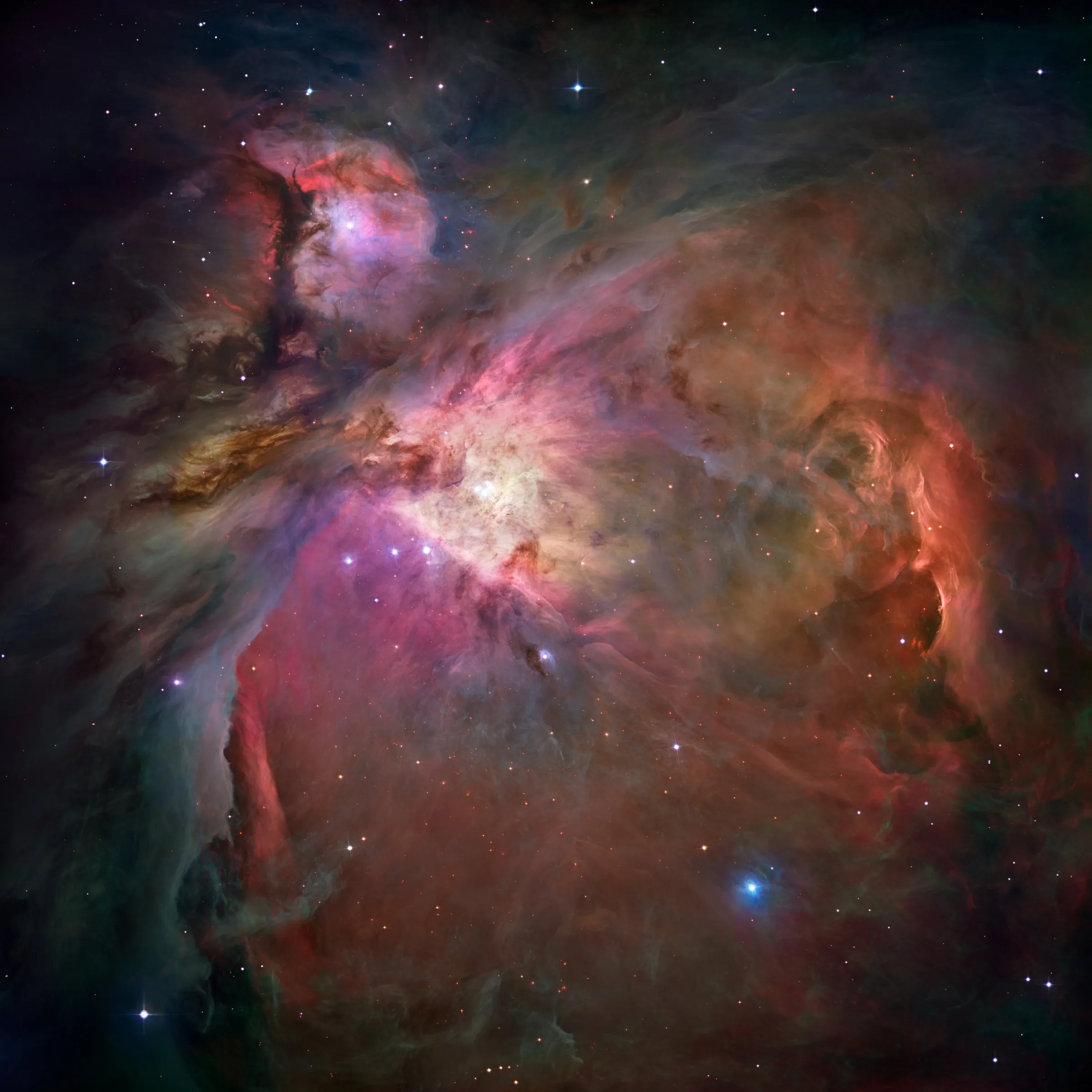
NASA, ESA, M. Robberto ( Space Telescope Science Institute/ESA) and the Hubble Space Telescope Orion Treasury Project Team (CC BY 4.0)
- Apoapsis
-
The point of an orbit farthest from the central body, at distance a(1 + e). Around the Sun it is called aphelion, around Earth apogee.
Formelr_a = a (1 + e)Siehe auch: Periapsis
- Argument of periapsis (ω)
-
The angle, measured in the orbital plane from the ascending node, to the periapsis.
Formelϖ = Ω + ωWhere:
ϖlongitude of periapsis;Ωlongitude of the ascending nodeSiehe auch: Longitude of the ascending node (Ω), Periapsis
- Astronomical unit (au)
-
A unit of length defined as exactly 149,597,870,700 metres, roughly the average distance between Earth and the Sun. Defined by IAU 2012 Resolution B2.
Siehe auch: Light-time, Light-year
- Axial tilt (obliquity)
-
The angle between a body’s spin axis and the perpendicular to its orbital plane. Earth’s is about 23.44°, which causes the seasons. Uranus’s is about 98°.
Siehe auch: Declination, Solstice, Equinox
- Bortle scale
-
A nine-class scale of night-sky darkness introduced by John E. Bortle in Sky & Telescope (2001), from class 1 (excellent dark site, stars to magnitude 7.6 to 8.0) to class 9 (inner city, magnitude 4.0 at best).
Siehe auch: Magnitude, Light pollution
- Circular orbital speed
-
The speed needed for a circular orbit at distance r. Just above Earth’s surface it is about 7.9 km/s.
Formelv_c = √(μ / r)Where:
μgravitational parameter;rdistance from the centreSiehe auch: Escape velocity, Vis-viva equation
- Constellation
-
One of 88 officially defined regions of the sky (IAU, 1922 to 1930), named after a traditional star pattern such as Orion. Stars in a constellation are usually at very different distances.
Siehe auch: Magnitude
- Declination
-
The angle of a point in the sky north (+) or south (−) of the celestial equator, the sky’s equivalent of latitude. The Sun’s declination swings between +23.44° and −23.44° over the year.
Formelsin δ = sin ε · sin λWhere:
δSun's declination;εobliquity of the ecliptic;λSun's ecliptic longitudeSiehe auch: Axial tilt (obliquity), Solstice
- Delta-v
-
Change in velocity, in km/s. It is the currency of spaceflight: every manoeuvre costs delta-v, and a rocket’s propellant sets how much it has.
FormelΔv = v_e ln(m₀ / m_f)Where:
v_eeffective exhaust speed;m₀, m_finitial and final massSiehe auch: Hohmann transfer, Oberth effect
- Dwarf planet
-
A body that orbits the Sun and is nearly round, but has not cleared its orbital neighbourhood and is not a moon (IAU 2006). Examples: Ceres, Pluto, Eris, Haumea, Makemake.
Siehe auch: Planet, Kuiper belt
- Eccentricity (e)
-
How stretched an orbit is: 0 for a circle, between 0 and 1 for an ellipse, 1 for a parabola and above 1 for a hyperbola.
- Eclipse
-
When one body passes into the shadow of another. Solar eclipse: the Moon’s shadow falls on Earth (at new Moon). Lunar eclipse: the Moon passes through Earth’s shadow (at full Moon).
Siehe auch: Node, Umbra and penumbra
- Ecliptic
-
The plane of Earth’s orbit around the Sun, and the Sun’s apparent yearly path across the sky. It is the usual reference plane for orbits of solar-system bodies. It is tilted about 23.44° to Earth’s equator.
Siehe auch: Axial tilt (obliquity), Inclination (i), Node
- Ellipse
-
A closed curve, the set of points whose distances to two fixed points (foci) add up to a constant. Bound orbits are ellipses with the central body at one focus (Kepler’s first law).
Formelr = a(1 − e²) / (1 + e cos ν)Where:
asemi-major axis;eeccentricity;νtrue anomalySiehe auch: Eccentricity (e), Semi-major axis (a)
- Equinox
-
The moment when the Sun crosses the celestial equator (declination 0°), around 20 March and 22 September. Day and night are about equal everywhere.
Siehe auch: Solstice, Declination
- Escape velocity
-
The minimum speed at which an unpowered body leaves a gravitating body for good. It is √2 times the circular speed at the same distance. Earth’s surface: 11.2 km/s.
Formelv_esc = √(2μ / r)Siehe auch: Circular orbital speed, Specific orbital energy
- Free fall
-
Motion under gravity alone. Astronauts in orbit feel weightless because they and their spacecraft are in free fall together, not because gravity is absent.
- Gravitational parameter (μ)
-
The product of the gravitational constant and a body’s mass, μ = GM. It is measured far more precisely than G or M alone. Earth: 398,600.4 km³/s²; Sun: 1.32712 × 10¹¹ km³/s².
Formelμ = G MSiehe auch: Gravity, Vis-viva equation
- Gravity
-
The attraction between masses. In Newton’s description the force is proportional to both masses and inversely proportional to the square of their distance.
FormelF = G M m / r²Where:
G6.67430 × 10⁻¹¹ m³ kg⁻¹ s⁻² (CODATA 2018);M, mthe two masses;rdistance between centresSiehe auch: Gravitational parameter (μ), Free fall
- Hohmann transfer
-
The minimum-energy two-burn transfer between two circular, coplanar orbits, along half of an ellipse touching both.
Formela_t = (r₁ + r₂) / 2Siehe auch: Delta-v, Vis-viva equation
- Inclination (i)
-
The tilt of an orbital plane relative to a reference plane (the ecliptic for planets, the equator for satellites). Above 90° the orbit is retrograde.
Siehe auch: Longitude of the ascending node (Ω), Retrograde
- Kepler's third law
-
The square of the orbital period is proportional to the cube of the semi-major axis. Around the Sun, with T in years and a in au, T² = a³.
FormelT² / a³ = 4π² / μWhere:
Torbital period;asemi-major axis;μG(M + m)Siehe auch: Orbital period, Semi-major axis (a)
- Kuiper belt
-
A region of icy bodies beyond Neptune, from about 30 to 50 au from the Sun. Pluto, Haumea and Makemake orbit there.
Siehe auch: Main asteroid belt, Dwarf planet
- Light pollution
-
Excessive or misdirected artificial light, especially sky glow that hides stars. It also affects wildlife and wastes energy.
Siehe auch: Bortle scale
- Light-time
-
The time light needs to travel a given distance. Sunlight takes about 8 minutes 19 seconds to reach Earth. Commands to spacecraft are delayed by the light-time.
Formelt = d / cWhere:
ddistance;cspeed of light, 299,792.458 km/sSiehe auch: Astronomical unit (au)
- Light-year
-
The distance light travels in vacuum in one Julian year (365.25 days): about 9.46 trillion km, or 63,241 au. It is a distance, not a time.
Formel1 ly = c × 365.25 × 86,400 sWhere:
cspeed of light, 299,792.458 km/sSiehe auch: Astronomical unit (au), Light-time
- Longitude of the ascending node (Ω)
-
The angle, measured in the reference plane from the reference direction, to the point where the orbit crosses the plane going north.
Siehe auch: Node, Inclination (i), Argument of periapsis (ω)
- Magnitude
-
A logarithmic scale of brightness, where smaller numbers are brighter. Five magnitudes are exactly a factor of 100 in brightness.
Formelm₁ − m₂ = −2.5 log₁₀(F₁ / F₂)Where:
mmagnitude;Fobserved fluxSiehe auch: Bortle scale
- Main asteroid belt
-
The region between the orbits of Mars and Jupiter, roughly 2.2 to 3.3 au from the Sun, where most known asteroids orbit. Despite its reputation it is mostly empty space; its largest body is the dwarf planet Ceres.
Siehe auch: Kuiper belt, Dwarf planet
- Mean anomaly (M)
-
An angle that increases uniformly with time, 360° per orbit. The actual position follows from Kepler’s equation.
FormelM = E − e sin EWhere:
Eeccentric anomaly;eeccentricitySiehe auch: Eccentricity (e)
- Node
-
One of the two points where an orbit crosses a reference plane. The Moon’s nodes lie on the ecliptic; eclipses happen only when a new or full Moon occurs near a node.
Siehe auch: Longitude of the ascending node (Ω), Eclipse
- Oberth effect
-
A burn made where a spacecraft moves fastest (deep in a gravity well) changes its orbital energy the most. Departing from low orbit therefore costs less than the leftover speed you want far away.
FormelΔv = √(v∞² + v_esc²) − v_cWhere:
v∞hyperbolic excess speed;v_escescape speed at the burn;v_ccircular speed at the burnSiehe auch: Delta-v, Escape velocity
- Orbit
-
The path of a body moving under the gravity of another. In the two-body case it is a conic section: an ellipse (closed), a parabola or a hyperbola (open).
Siehe auch: Ellipse, Kepler's third law, Free fall
- Orbital period
-
The time taken to complete one orbit. The sidereal period is measured against the stars; the synodic period is measured relative to another moving body, such as the Sun seen from Earth.
FormelT = 2π √(a³/μ)Where:
asemi-major axis;μgravitational parameter of the central bodySiehe auch: Kepler's third law, Synodic month
- Periapsis
-
The point of an orbit closest to the central body, at distance a(1 − e). Around the Sun it is called perihelion, around Earth perigee.
Formelr_p = a (1 − e)Siehe auch: Apoapsis, Perihelion
- Perihelion
-
The point of an orbit around the Sun closest to the Sun. Earth passes it in early January at about 147.1 million km. The farthest point is aphelion.
- Planet
-
By the 2006 IAU definition, a body that orbits the Sun, is massive enough to be nearly round under its own gravity, and has cleared the neighbourhood around its orbit. The solar system has eight.
Siehe auch: Dwarf planet, Orbit
- Retrograde
-
Moving or rotating in the opposite direction to most bodies in the system. Venus rotates retrograde; Triton and Halley’s Comet orbit retrograde (inclination above 90°).
Siehe auch: Inclination (i), Solar day
- Semi-major axis (a)
-
Half of the longest diameter of an ellipse. It sets the orbit’s size, its energy and its period.
Formela = (r_p + r_a) / 2Where:
r_pperiapsis distance;r_aapoapsis distanceSiehe auch: Kepler's third law, Ellipse
- Sidereal day
-
The time a body takes to rotate once relative to the distant stars. For Earth: 23 h 56 min 4.09 s.
Siehe auch: Solar day
- Sidereal month
-
The time the Moon takes to orbit Earth once relative to the stars: 27.322 days.
Siehe auch: Synodic month
- Solar day
-
The time from one noon to the next, i.e. one rotation relative to the Sun. It differs from the sidereal day because the body also moves along its orbit.
Formel1/P_solar = 1/P_rot − 1/P_orbWhere:
P_rotsidereal rotation period (negative if retrograde);P_orborbital periodSiehe auch: Sidereal day, Retrograde
- Solstice
-
The moment when the Sun reaches its farthest north (around 21 June) or south (around 21 December) declination. It gives the longest and shortest days.
Siehe auch: Equinox, Declination
- Specific orbital energy
-
Orbital energy per unit mass. Negative for bound (elliptical) orbits, zero for parabolic escape, positive for hyperbolic.
Formelε = v²/2 − μ/r = −μ / (2a)Siehe auch: Vis-viva equation, Escape velocity
- Synodic month
-
The time between two identical Moon phases, e.g. new Moon to new Moon: 29.531 days on average.
Formel1/P_syn = 1/P_sid − 1/P_yearWhere:
P_sidsidereal month, 27.322 days;P_yearsidereal year, 365.256 daysSiehe auch: Sidereal month
- Umbra and penumbra
-
The umbra is the dark central part of a shadow where the light source is completely hidden; the penumbra is the outer part where it is only partly hidden.
Siehe auch: Eclipse
- Vis-viva equation
-
Gives the orbital speed at any distance from the orbit’s size alone. It expresses conservation of energy.
Formelv = √(μ (2/r − 1/a))Where:
μgravitational parameter;rcurrent distance;asemi-major axisSiehe auch: Specific orbital energy, Circular orbital speed
Die Tools und Lektionen verwenden vereinfachte Modelle nur zum Lernen, sie dürfen nicht für die Navigation, Missionsplanung oder andere operative Entscheidungen verwendet werden. Zertifikate sind kostenlos und nicht akkreditiert. Lesen Sie den Haftungsausschluss für Bildungsinhalte