
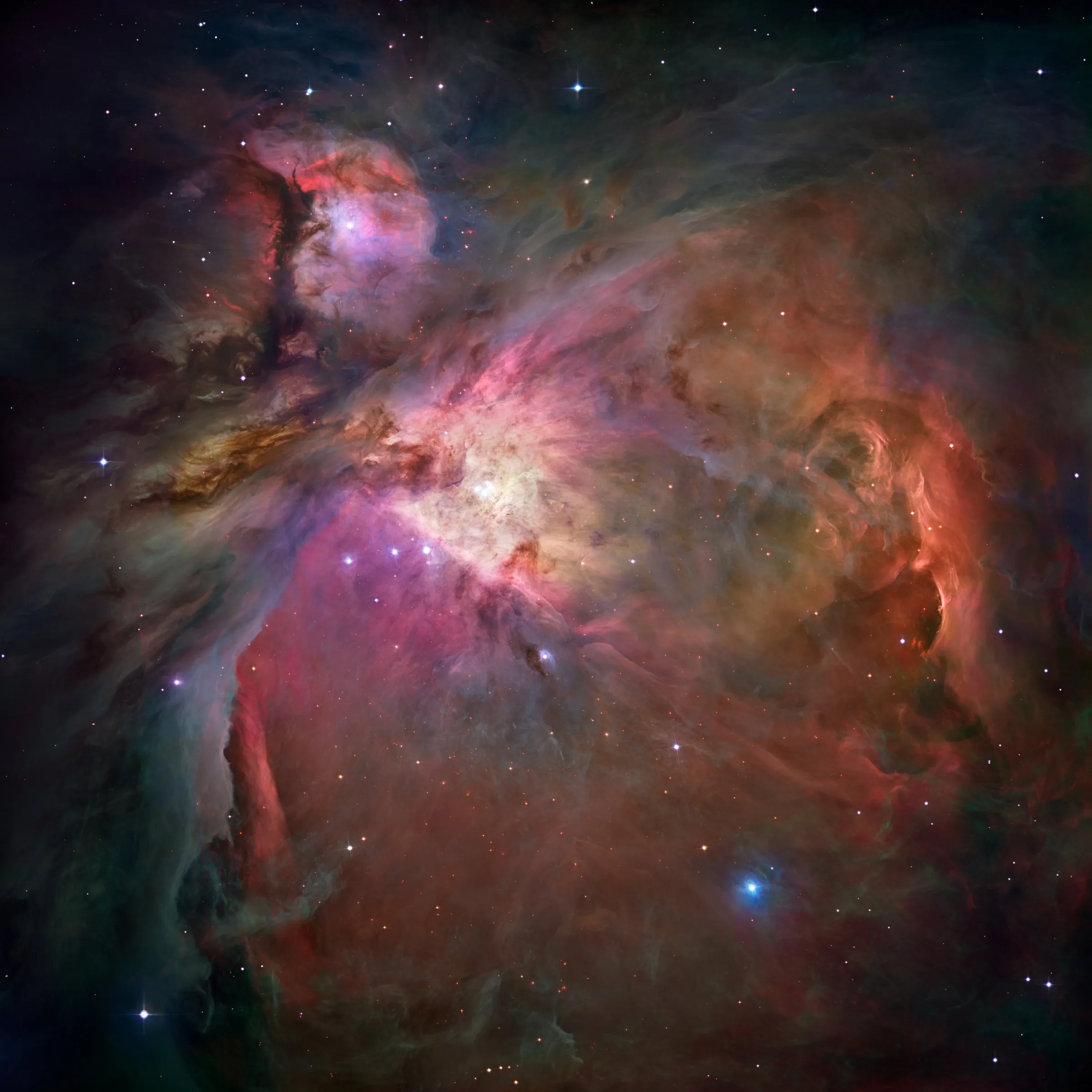
NASA, ESA, M. Robberto ( Space Telescope Science Institute/ESA) and the Hubble Space Telescope Orion Treasury Project Team (CC BY 4.0)
- Apoapsis
-
The point of an orbit farthest from the central body, at distance a(1 + e). Around the Sun it is called aphelion, around Earth apogee.
فارمولاr_a = a (1 + e)ڏسو: Periapsis
- Argument of periapsis (ω)
-
The angle, measured in the orbital plane from the ascending node, to the periapsis.
فارمولاϖ = Ω + ωجتي:
ϖlongitude of periapsis;Ωlongitude of the ascending node - Astronomical unit (au)
-
A unit of length defined as exactly 149,597,870,700 metres, roughly the average distance between Earth and the Sun. Defined by IAU 2012 Resolution B2.
ڏسو: Light-time, Light-year
- Axial tilt (obliquity)
-
The angle between a body’s spin axis and the perpendicular to its orbital plane. Earth’s is about 23.44°, which causes the seasons. Uranus’s is about 98°.
ڏسو: Declination, Solstice, Equinox
- Bortle scale
-
A nine-class scale of night-sky darkness introduced by John E. Bortle in Sky & Telescope (2001), from class 1 (excellent dark site, stars to magnitude 7.6 to 8.0) to class 9 (inner city, magnitude 4.0 at best).
ڏسو: Magnitude, Light pollution
- Circular orbital speed
-
The speed needed for a circular orbit at distance r. Just above Earth’s surface it is about 7.9 km/s.
فارمولاv_c = √(μ / r)جتي:
μgravitational parameter;rdistance from the centre - Constellation
-
One of 88 officially defined regions of the sky (IAU, 1922 to 1930), named after a traditional star pattern such as Orion. Stars in a constellation are usually at very different distances.
ڏسو: Magnitude
- Declination
-
The angle of a point in the sky north (+) or south (−) of the celestial equator, the sky’s equivalent of latitude. The Sun’s declination swings between +23.44° and −23.44° over the year.
فارمولاsin δ = sin ε · sin λجتي:
δSun's declination;εobliquity of the ecliptic;λSun's ecliptic longitude - Delta-v
-
Change in velocity, in km/s. It is the currency of spaceflight: every manoeuvre costs delta-v, and a rocket’s propellant sets how much it has.
فارمولاΔv = v_e ln(m₀ / m_f)جتي:
v_eeffective exhaust speed;m₀, m_finitial and final mass - Dwarf planet
-
A body that orbits the Sun and is nearly round, but has not cleared its orbital neighbourhood and is not a moon (IAU 2006). Examples: Ceres, Pluto, Eris, Haumea, Makemake.
ڏسو: Planet, Kuiper belt
- Eccentricity (e)
-
How stretched an orbit is: 0 for a circle, between 0 and 1 for an ellipse, 1 for a parabola and above 1 for a hyperbola.
- Eclipse
-
When one body passes into the shadow of another. Solar eclipse: the Moon’s shadow falls on Earth (at new Moon). Lunar eclipse: the Moon passes through Earth’s shadow (at full Moon).
ڏسو: Node, Umbra and penumbra
- Ecliptic
-
The plane of Earth’s orbit around the Sun, and the Sun’s apparent yearly path across the sky. It is the usual reference plane for orbits of solar-system bodies. It is tilted about 23.44° to Earth’s equator.
- Ellipse
-
A closed curve, the set of points whose distances to two fixed points (foci) add up to a constant. Bound orbits are ellipses with the central body at one focus (Kepler’s first law).
فارمولاr = a(1 − e²) / (1 + e cos ν)جتي:
asemi-major axis;eeccentricity;νtrue anomaly - Equinox
-
The moment when the Sun crosses the celestial equator (declination 0°), around 20 March and 22 September. Day and night are about equal everywhere.
ڏسو: Solstice, Declination
- Escape velocity
-
The minimum speed at which an unpowered body leaves a gravitating body for good. It is √2 times the circular speed at the same distance. Earth’s surface: 11.2 km/s.
فارمولاv_esc = √(2μ / r) - Free fall
-
Motion under gravity alone. Astronauts in orbit feel weightless because they and their spacecraft are in free fall together, not because gravity is absent.
- Gravitational parameter (μ)
-
The product of the gravitational constant and a body’s mass, μ = GM. It is measured far more precisely than G or M alone. Earth: 398,600.4 km³/s²; Sun: 1.32712 × 10¹¹ km³/s².
فارمولاμ = G Mڏسو: Gravity, Vis-viva equation
- Gravity
-
The attraction between masses. In Newton’s description the force is proportional to both masses and inversely proportional to the square of their distance.
فارمولاF = G M m / r²جتي:
G6.67430 × 10⁻¹¹ m³ kg⁻¹ s⁻² (CODATA 2018);M, mthe two masses;rdistance between centres - Hohmann transfer
-
The minimum-energy two-burn transfer between two circular, coplanar orbits, along half of an ellipse touching both.
فارمولاa_t = (r₁ + r₂) / 2ڏسو: Delta-v, Vis-viva equation
- Inclination (i)
-
The tilt of an orbital plane relative to a reference plane (the ecliptic for planets, the equator for satellites). Above 90° the orbit is retrograde.
- Kepler's third law
-
The square of the orbital period is proportional to the cube of the semi-major axis. Around the Sun, with T in years and a in au, T² = a³.
فارمولاT² / a³ = 4π² / μجتي:
Torbital period;asemi-major axis;μG(M + m) - Kuiper belt
-
A region of icy bodies beyond Neptune, from about 30 to 50 au from the Sun. Pluto, Haumea and Makemake orbit there.
- Light pollution
-
Excessive or misdirected artificial light, especially sky glow that hides stars. It also affects wildlife and wastes energy.
ڏسو: Bortle scale
- Light-time
-
The time light needs to travel a given distance. Sunlight takes about 8 minutes 19 seconds to reach Earth. Commands to spacecraft are delayed by the light-time.
فارمولاt = d / cجتي:
ddistance;cspeed of light, 299,792.458 km/s - Light-year
-
The distance light travels in vacuum in one Julian year (365.25 days): about 9.46 trillion km, or 63,241 au. It is a distance, not a time.
فارمولا1 ly = c × 365.25 × 86,400 sجتي:
cspeed of light, 299,792.458 km/s - Longitude of the ascending node (Ω)
-
The angle, measured in the reference plane from the reference direction, to the point where the orbit crosses the plane going north.
- Magnitude
-
A logarithmic scale of brightness, where smaller numbers are brighter. Five magnitudes are exactly a factor of 100 in brightness.
فارمولاm₁ − m₂ = −2.5 log₁₀(F₁ / F₂)جتي:
mmagnitude;Fobserved fluxڏسو: Bortle scale
- Main asteroid belt
-
The region between the orbits of Mars and Jupiter, roughly 2.2 to 3.3 au from the Sun, where most known asteroids orbit. Despite its reputation it is mostly empty space; its largest body is the dwarf planet Ceres.
ڏسو: Kuiper belt, Dwarf planet
- Mean anomaly (M)
-
An angle that increases uniformly with time, 360° per orbit. The actual position follows from Kepler’s equation.
فارمولاM = E − e sin Eجتي:
Eeccentric anomaly;eeccentricityڏسو: Eccentricity (e)
- Node
-
One of the two points where an orbit crosses a reference plane. The Moon’s nodes lie on the ecliptic; eclipses happen only when a new or full Moon occurs near a node.
- Oberth effect
-
A burn made where a spacecraft moves fastest (deep in a gravity well) changes its orbital energy the most. Departing from low orbit therefore costs less than the leftover speed you want far away.
فارمولاΔv = √(v∞² + v_esc²) − v_cجتي:
v∞hyperbolic excess speed;v_escescape speed at the burn;v_ccircular speed at the burnڏسو: Delta-v, Escape velocity
- Orbit
-
The path of a body moving under the gravity of another. In the two-body case it is a conic section: an ellipse (closed), a parabola or a hyperbola (open).
ڏسو: Ellipse, Kepler's third law, Free fall
- Orbital period
-
The time taken to complete one orbit. The sidereal period is measured against the stars; the synodic period is measured relative to another moving body, such as the Sun seen from Earth.
فارمولاT = 2π √(a³/μ)جتي:
asemi-major axis;μgravitational parameter of the central body - Periapsis
-
The point of an orbit closest to the central body, at distance a(1 − e). Around the Sun it is called perihelion, around Earth perigee.
فارمولاr_p = a (1 − e)ڏسو: Apoapsis, Perihelion
- Perihelion
-
The point of an orbit around the Sun closest to the Sun. Earth passes it in early January at about 147.1 million km. The farthest point is aphelion.
- Planet
-
By the 2006 IAU definition, a body that orbits the Sun, is massive enough to be nearly round under its own gravity, and has cleared the neighbourhood around its orbit. The solar system has eight.
ڏسو: Dwarf planet, Orbit
- Retrograde
-
Moving or rotating in the opposite direction to most bodies in the system. Venus rotates retrograde; Triton and Halley’s Comet orbit retrograde (inclination above 90°).
ڏسو: Inclination (i), Solar day
- Semi-major axis (a)
-
Half of the longest diameter of an ellipse. It sets the orbit’s size, its energy and its period.
فارمولاa = (r_p + r_a) / 2جتي:
r_pperiapsis distance;r_aapoapsis distanceڏسو: Kepler's third law, Ellipse
- Sidereal day
-
The time a body takes to rotate once relative to the distant stars. For Earth: 23 h 56 min 4.09 s.
ڏسو: Solar day
- Sidereal month
-
The time the Moon takes to orbit Earth once relative to the stars: 27.322 days.
ڏسو: Synodic month
- Solar day
-
The time from one noon to the next, i.e. one rotation relative to the Sun. It differs from the sidereal day because the body also moves along its orbit.
فارمولا1/P_solar = 1/P_rot − 1/P_orbجتي:
P_rotsidereal rotation period (negative if retrograde);P_orborbital periodڏسو: Sidereal day, Retrograde
- Solstice
-
The moment when the Sun reaches its farthest north (around 21 June) or south (around 21 December) declination. It gives the longest and shortest days.
ڏسو: Equinox, Declination
- Specific orbital energy
-
Orbital energy per unit mass. Negative for bound (elliptical) orbits, zero for parabolic escape, positive for hyperbolic.
فارمولاε = v²/2 − μ/r = −μ / (2a) - Synodic month
-
The time between two identical Moon phases, e.g. new Moon to new Moon: 29.531 days on average.
فارمولا1/P_syn = 1/P_sid − 1/P_yearجتي:
P_sidsidereal month, 27.322 days;P_yearsidereal year, 365.256 daysڏسو: Sidereal month
- Umbra and penumbra
-
The umbra is the dark central part of a shadow where the light source is completely hidden; the penumbra is the outer part where it is only partly hidden.
ڏسو: Eclipse
- Vis-viva equation
-
Gives the orbital speed at any distance from the orbit’s size alone. It expresses conservation of energy.
فارمولاv = √(μ (2/r − 1/a))جتي:
μgravitational parameter;rcurrent distance;asemi-major axis
اوزار ۽ سکيا صرف سکڻ لاءِ آسان ماڊل استعمال ڪندا آھن. انھن کي ھلائڻ، ميشن منصوبابندي يا ڪنھن به آپريشنل فيصلي لاءِ استعمال نه ڪجي. سرٽيفڪيٽ مفت آھن ۽ غير تصديق ٿيل آھن. تعليمي مواد جي ذميواري کان انڪار پڙهو