
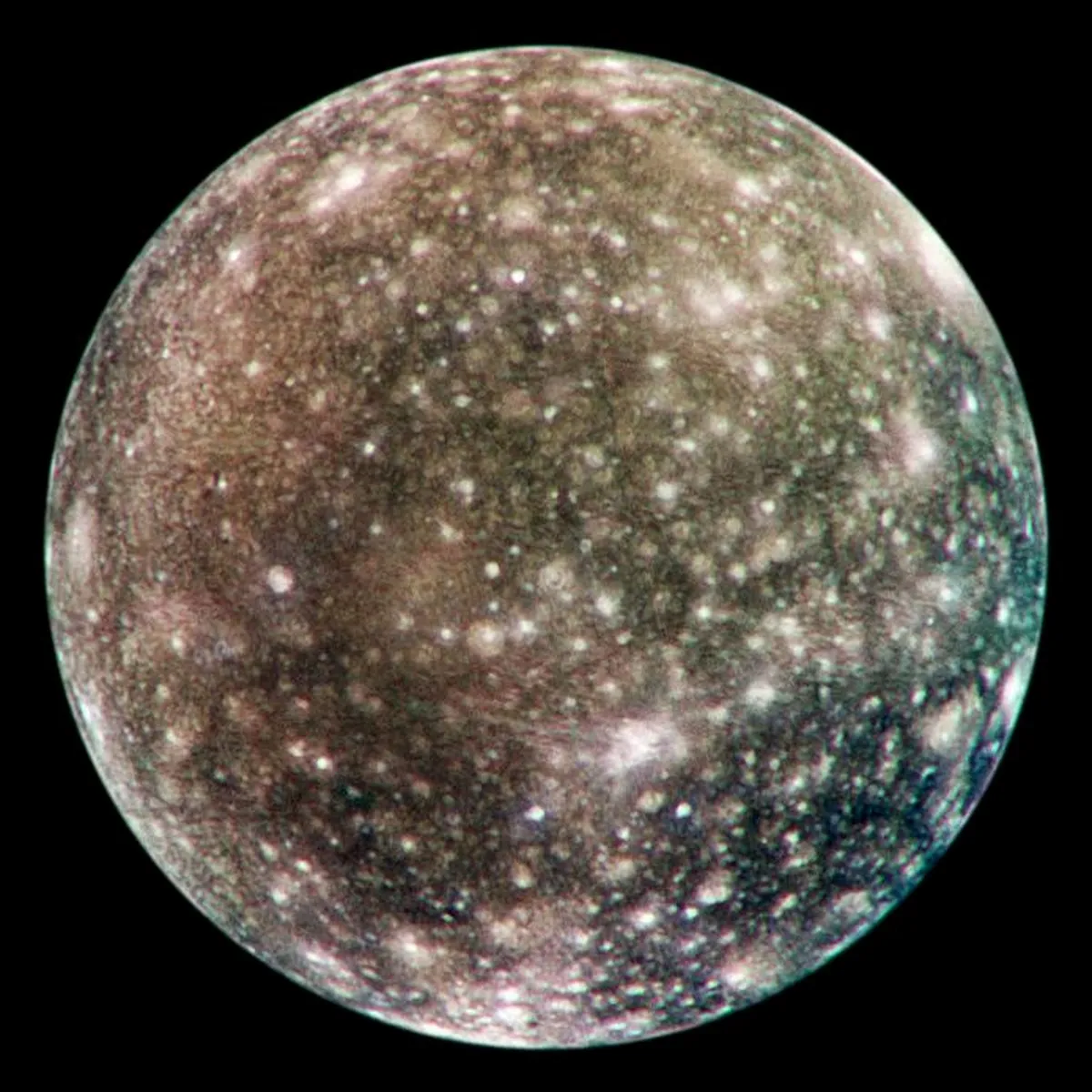
Callisto
Callisto, Jupiter's outermost large moon, is nearly as wide as Mercury and covered in ancient craters. Its size, orbit, possible ocean and missions.
NASA/JPL/DLR
One of the most heavily cratered surfaces in the solar system: a face that has barely changed for about four billion years.
Callisto is the outermost of Jupiter’s four Galilean moons and the third largest moon in the solar system. Its dark, icy surface is packed with impact craters, a record of the early solar system that has hardly been touched by geology. Beneath it there may be a salty ocean.
How big is Callisto?
Callisto is about 4,821 km across, almost exactly as wide as the planet Mercury (4,879 km) and about 1.4 times the width of Earth’s Moon. Only Ganymede and Saturn’s moon Titan are larger.
Its mass is about 1.08 × 10²³ kg, roughly 1.5 times the Moon’s but only about a third of Mercury’s. With an average density of about 1.83 g/cm³, the lowest of the Galilean moons, Callisto is a mixture of roughly equal parts rock and ice.
How far is Callisto from Jupiter?
Callisto orbits about 1,882,700 km from Jupiter’s centre, almost five times the Moon’s distance from Earth. It takes about 16.7 days to complete one orbit and is tidally locked, so one side always faces Jupiter and a Callisto day lasts as long as its orbit.
Unlike Io, Europa and Ganymede, Callisto is not part of the 1:2:4 orbital resonance. It therefore gets almost no tidal heating, which helps explain why its interior has stayed relatively cool and its surface so old. See Kepler’s laws for why its orbit is the slowest of the four.
Why is Callisto covered in craters?
Callisto’s surface is saturated with craters: new impacts mostly land on old ones, and there is almost no smooth ground left. With no volcanoes, tectonic plates or strong tides to renew it, the surface has kept a record of impacts going back about four billion years.
The largest feature is Valhalla, an impact basin with a bright centre about 600 km wide surrounded by rings of ridges and troughs that spread to about 3,800 km across. A second ringed basin, Asgard, is about 1,600 km across. Close up, NASA’s Galileo spacecraft found that the smallest craters are rarer than expected, probably because a dark dusty layer has filled them in as surface ice slowly evaporates.
Is there an ocean inside Callisto?
Possibly. Galileo measured a magnetic signal that changes with Jupiter’s field, the same sign that points to oceans in Europa and Ganymede. One explanation is a salty liquid layer more than 100 km below the surface. Callisto’s interior also seems only partly separated into rock and ice layers, which surprised scientists. Both points are still debated, and some researchers think the signal could come from Callisto’s thin upper atmosphere instead.
Does Callisto have an atmosphere?
Only a very thin one. Galileo detected a trace of carbon dioxide in 1999, and later observations found oxygen too. The air is so thin that it is far closer to a vacuum than to Earth’s atmosphere. The surface temperature averages about -139 °C.
Callisto lies outside Jupiter’s most intense radiation belts, so it receives far less radiation than the inner moons. For that reason NASA studies in 2003 suggested it as a possible site for a future human base in the Jupiter system. Such a mission is a concept only, with no plans or dates.
Which missions have explored Callisto?
Galileo Galilei discovered Callisto in January 1610, along with the other three large moons. Pioneer 10 and 11 passed through the Jupiter system in 1973 and 1974, and Voyager 1 and 2 photographed Callisto’s cratered face in 1979. The Galileo orbiter made eight close flybys between 1996 and 2001, some within about 140 km of the surface. Cassini and New Horizons also took images while passing Jupiter in 2000 and 2007.
ESA’s JUICE mission, launched in 2023, is planned to reach Jupiter in 2031 and fly past Callisto many times before entering orbit around Ganymede in 2034. It will use these encounters as gravity assists to shape its path, and its radar and cameras will look for signs of the possible ocean.
Can you see Callisto from Earth?
Yes, with binoculars. Callisto shines at about magnitude 5.7, the faintest of the four Galilean moons, but because it can appear well away from Jupiter it is often the easiest to pick out from the planet’s glare. Look for up to four small points of light in a line on either side of Jupiter; Callisto is usually the one farthest out. Over a few nights you can watch it creep from one side to the other.
A small telescope shows its shadow crossing Jupiter’s cloud tops only during some years, because its orbit is wide enough that the shadow often misses the planet. The orrery and the night sky guide help you find Jupiter first.
Data sources
Tools and lessons use simplified models for learning only. They must not be used for navigation, mission planning or any operational decision. Certificates are free and non-accredited. Read the educational content disclaimer