
Jupiter
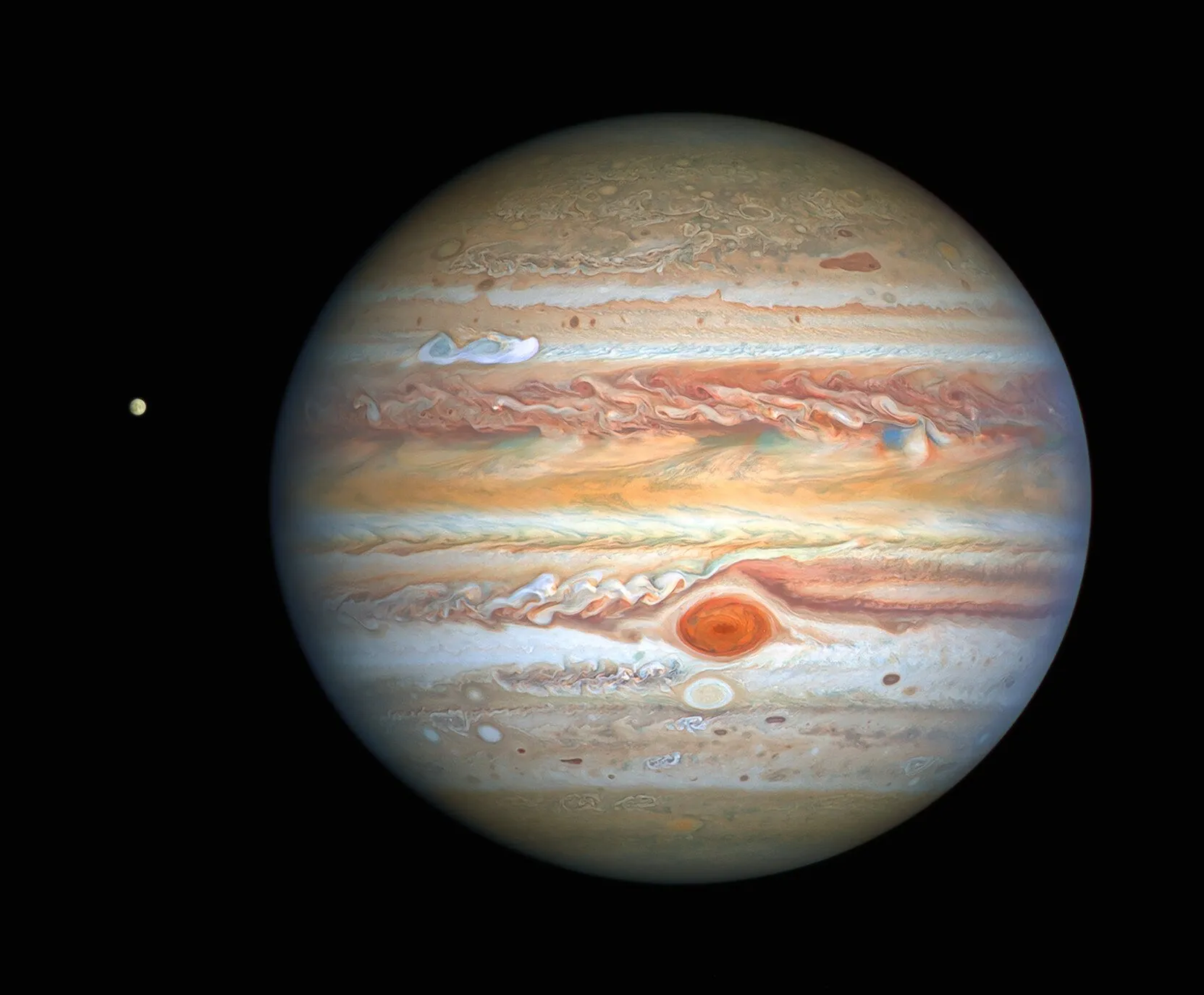
Jupiter is the largest planet, 11 times Earth's width and 318 times its mass, with a 10-hour day, the Great Red Spot and at least 95 moons.
NASA, ESA, A. Simon (Goddard Space Flight Center), and M. H. Wong (University of California, Berkeley) and the OPAL team (CC BY 4.0)
A planet so big that its storm, the Great Red Spot, is larger than the whole Earth.
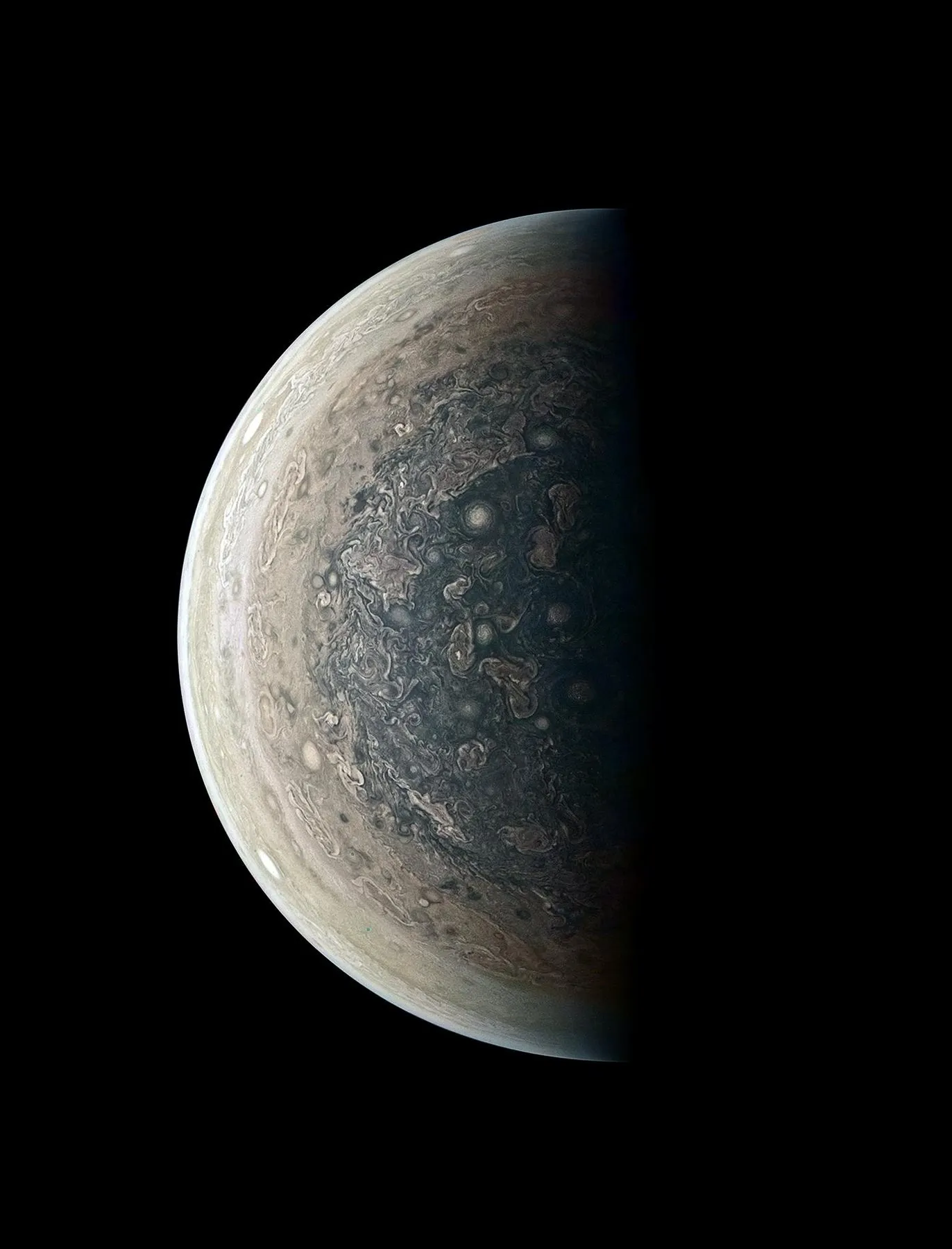
Jupiter is the fifth planet from the Sun and by far the largest. It is a gas giant made mostly of hydrogen and helium, with no solid surface to stand on, and it has more mass than all the other planets put together.
How big is Jupiter?
Jupiter’s equatorial radius is 71,492 km, so it is about 143,000 km wide at the equator, roughly 11 times Earth’s diameter. About 1,300 Earths would fit inside it. Its fast spin makes it bulge: the polar diameter is about 7% smaller than the equatorial one.
Its mass is about 1.90 × 1027 kg, 318 times Earth’s and about two and a half times the mass of all the other planets combined. Its density is only 1.33 g/cm³, a little more than water, because it is mostly light gas.
How far is Jupiter from the Sun?
Jupiter orbits at an average of about 778.5 million km (5.2 AU), ranging from about 740.6 to 816.4 million km. Sunlight takes about 43 minutes to reach it. It moves at an average of 13.1 km/s and takes 11.86 Earth years to complete one orbit.
Its gravity shapes much of the solar system. It keeps the asteroid belt from forming a planet, herds two large groups of Trojan asteroids at its Lagrange points, and pulls many comets into new orbits.
How long is a day on Jupiter?
Jupiter spins faster than any other planet. Its interior turns once every 9 hours 55 minutes 30 seconds, so a day there is less than 10 hours long. The cloud bands at the equator rotate a few minutes faster than those near the poles.
Its axis is tilted only about 3°, so Jupiter has almost no seasons.
What is Jupiter made of?
By number of molecules, Jupiter’s atmosphere is about 90% hydrogen and 10% helium, close to the mix in the Sun. The visible clouds sit in layers: ammonia ice at the top, ammonium hydrosulphide below and water clouds deeper still. These form the light zones and dark belts that circle the planet. The temperature at the cloud tops is about -110 °C.
Deeper down, the pressure squeezes hydrogen into a liquid and then into a metal-like state that conducts electricity. Measurements by NASA’s Juno spacecraft suggest the core is not a compact ball but a large, “fuzzy” region where heavy elements mix with hydrogen. Exactly how this formed is still being worked out.
The Great Red Spot
The Great Red Spot is a giant high-pressure storm south of the equator. Today it is about 1.3 times as wide as Earth, and it has been shrinking for over a century. It has been watched continuously since at least 1831, and it may be the same feature astronomers saw in the 1660s, though that link is uncertain.
Magnetic field and rings
Jupiter’s magnetic field is the strongest of any planet, 16 to 54 times as powerful as Earth’s at the cloud tops, and it traps intense radiation belts. Jupiter also has faint, dusty rings, discovered by Voyager 1 in 1979.
How many moons does Jupiter have?
NASA lists 95 officially recognised moons, and astronomers continue to find small ones, so the total is expected to grow. Most are only a few kilometres across.
The four largest, the Galilean moons, were found by Galileo Galilei in January 1610:
- Io: the most volcanically active world in the solar system.
- Europa: an icy shell over a salty ocean, one of the best places to search for life.
- Ganymede: the largest moon in the solar system, wider than Mercury.
- Callisto: an ancient, heavily cratered ice-and-rock world.
Which missions have explored Jupiter?
- Pioneer 10 and 11 (NASA, 1973 and 1974): the first flybys.
- Voyager 1 and 2 (NASA, 1979): found the rings and Io’s volcanoes.
- Galileo (NASA, 1995 to 2003): the first orbiter. It also dropped a probe into the atmosphere in 1995.
- Juno (NASA): entered a polar orbit in July 2016 and studied the interior, the poles and the moons through an extended mission that ran until at least 2025.
- Juice (ESA): launched in April 2023 and due to reach Jupiter in 2031, focusing on Ganymede.
- Europa Clipper (NASA): launched in October 2024 and due to arrive in 2030 to study Europa.
Cassini and New Horizons also flew past on their way to Saturn and Pluto, using Jupiter for gravity assists. In 1994 spacecraft and telescopes watched the fragments of comet Shoemaker-Levy 9 crash into the planet.
Can you see Jupiter from Earth?
Yes. Jupiter is usually the brightest object in the night sky after the Moon and Venus, reaching about magnitude -2.9. It looks like a steady, creamy-white star.
It is best placed around opposition, when it rises at sunset and is visible all night. Oppositions come about every 13 months: one was in January 2026, and the next is in early 2027. Even ordinary binoculars held steady show the four Galilean moons as tiny points of light beside the planet, changing position from night to night. A small telescope reveals the cloud belts. See the night sky guide and the orrery to find Jupiter now.
Moons in the knowledge base
Data sources
Tools and lessons use simplified models for learning only. They must not be used for navigation, mission planning or any operational decision. Certificates are free and non-accredited. Read the educational content disclaimer