
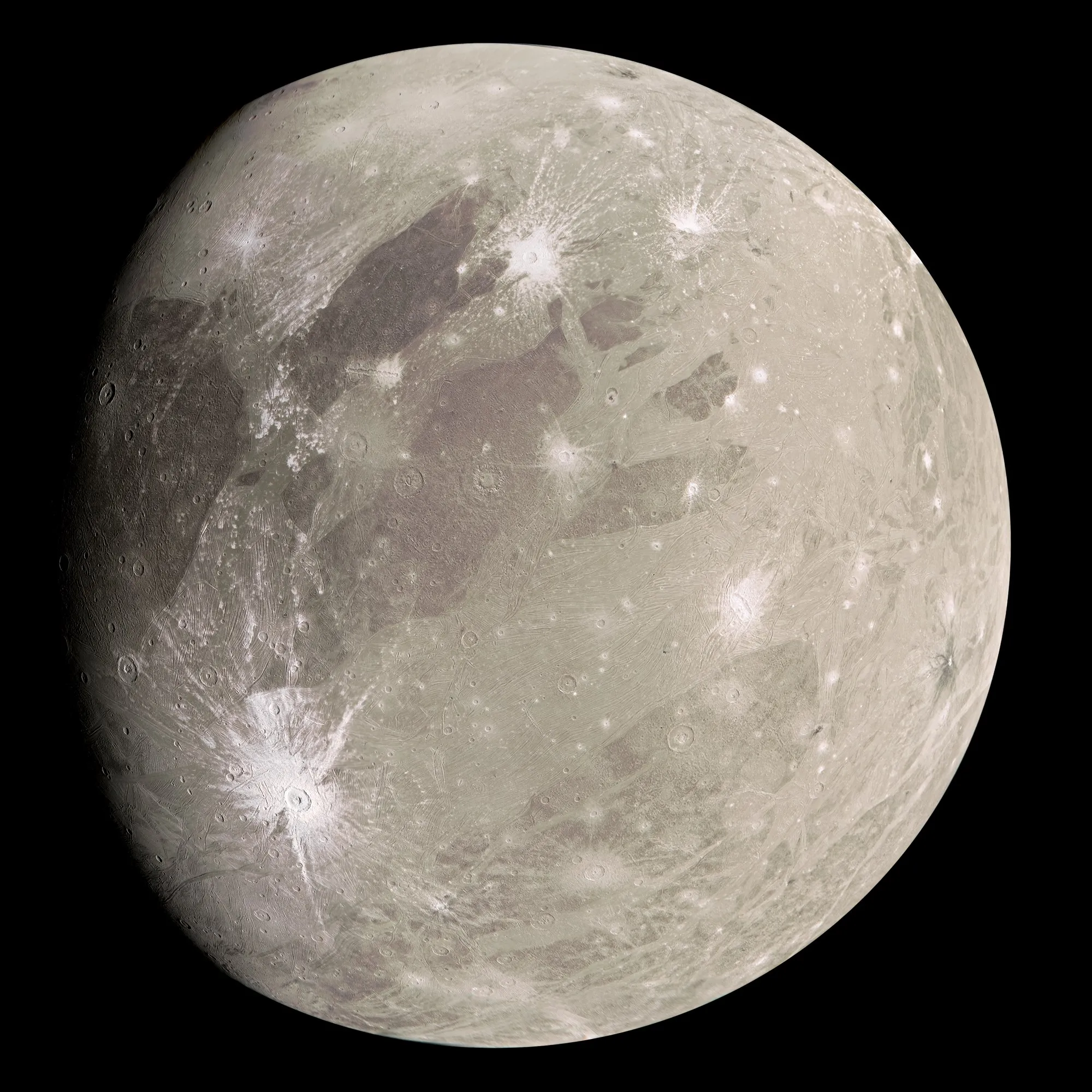
Ganymede
Ganymede is the largest moon in the solar system, wider than Mercury, with its own magnetic field and a hidden ocean. Size, orbit and JUICE.
NASA/JPL-Caltech/SwRI/MSSS, processed by Kevin M. Gill (CC BY 2.0)
The largest moon in the solar system, bigger than the planet Mercury, and the only moon with its own magnetic field.
Ganymede is the third of Jupiter’s four Galilean moons counting outward from the planet, and the largest moon of any planet. It is a world of ice and rock, with a metal core that generates its own magnetic field and, most likely, a salty ocean buried deep beneath its crust. ESA’s JUICE spacecraft is on its way to become the first to orbit it.
How big is Ganymede?
Ganymede is about 5,268 km across, wider than the planet Mercury (4,879 km) and about 1.5 times the width of Earth’s Moon. It is also slightly larger than Saturn’s moon Titan, the second largest moon.
Its mass is about 1.48 × 10²³ kg, about twice the Moon’s but only about 45% of Mercury’s. The reason is density: at about 1.94 g/cm³, Ganymede is roughly half ice and half rock, while Mercury is mostly rock and iron. If Ganymede orbited the Sun instead of Jupiter, it would easily count as a planet.
How far is Ganymede from Jupiter?
Ganymede orbits about 1,070,400 km from Jupiter’s centre, nearly three times the Moon’s distance from Earth. It takes about 7.15 days to go round once and is tidally locked, so the same side always faces Jupiter.
It is the outer partner in a 1:2:4 orbital resonance: for every orbit Ganymede makes, Europa makes two and Io makes four. Because Ganymede lies farther out, the tidal flexing from Jupiter is much weaker than on Io or Europa, but it may have been stronger in the past. See Kepler’s laws for how orbital period grows with distance.
Why does Ganymede have a magnetic field?
In 1996 NASA’s Galileo spacecraft found that Ganymede has its own magnetic field, the only moon known to have one. It is probably generated, as on Earth, by liquid iron moving in a molten core. The field carves out a small bubble, a mini-magnetosphere, inside Jupiter’s much larger one.
The field also produces aurorae: glowing belts of light around Ganymede’s north and south poles. Those aurorae became the key to finding its ocean.
Does Ganymede have an ocean?
Very probably. In 2015 scientists used the Hubble Space Telescope to watch how Ganymede’s aurorae rock back and forth as Jupiter’s magnetic field sweeps past. A salty, electrically conducting ocean under the surface should damp that rocking, and Hubble saw it damped, matching Galileo’s earlier magnetic hints.
The ocean is thought to lie under about 150 km of ice and may be around 100 km deep, possibly with more water than all of Earth’s oceans. Some models suggest several layers of ocean and high-pressure ice stacked like a club sandwich. These depths are estimates and remain uncertain.
What is the surface like?
About a third of Ganymede is old, dark, heavily cratered terrain, such as the region Galileo Regio, about 3,200 km across. The rest is younger and lighter, crossed by long bands of ridges and grooves where the icy crust was pulled apart and refrozen. Surface temperatures are very cold, roughly -180 to -110 °C depending on latitude and time of day. A very thin oxygen atmosphere is formed as radiation splits surface ice.
Which missions have explored Ganymede?
Galileo Galilei discovered Ganymede in January 1610 along with the other three large moons. Pioneer 10 and 11 passed in 1973 and 1974, and Voyager 1 and 2 photographed it in 1979. The Galileo orbiter made six close flybys between 1996 and 2000. NASA’s Juno passed about 1,038 km above the surface on 7 June 2021, the closest approach in over two decades.
JUICE
ESA’s Jupiter Icy Moons Explorer, JUICE, launched on 14 April 2023 on an Ariane 5. It is using gravity assists from the Earth and Moon, Venus, and Earth again to reach Jupiter in 2031. After flybys of Europa, Ganymede and Callisto, it is planned to enter orbit around Ganymede in late 2034, the first spacecraft to orbit a moon other than our own. See orbital insertion for how a spacecraft is captured into orbit.
Can you see Ganymede from Earth?
Yes. At about magnitude 4.6, Ganymede is the brightest of Jupiter’s moons and would be visible to the naked eye if Jupiter’s glare did not hide it. A few people with sharp eyesight report seeing it under dark skies when it is far from the planet. Through binoculars it is easy: look for up to four small points of light in a line beside Jupiter. Use the orrery to find Jupiter in tonight’s sky.
Data sources
Tools and lessons use simplified models for learning only. They must not be used for navigation, mission planning or any operational decision. Certificates are free and non-accredited. Read the educational content disclaimer