
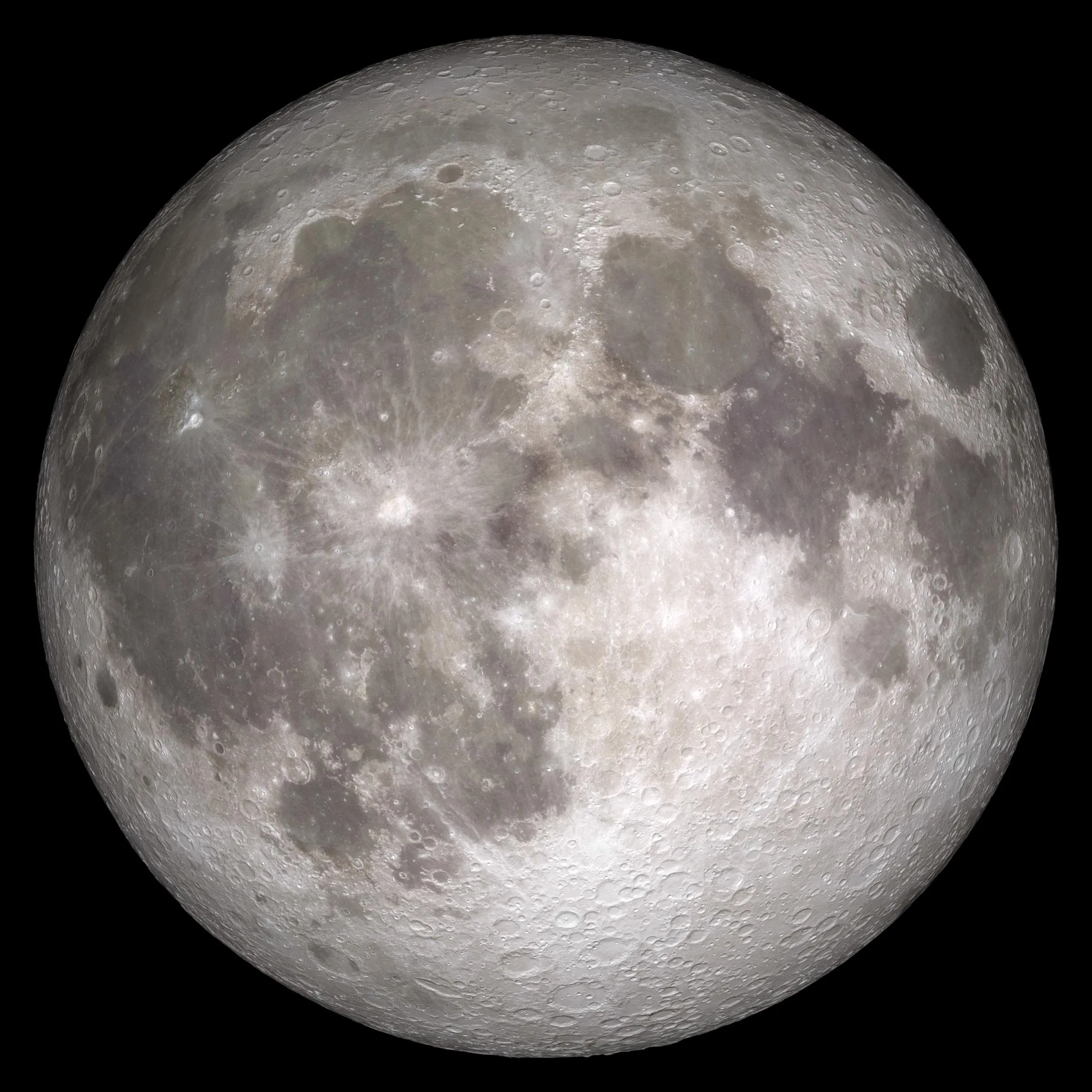
Moon
The Moon is Earth's only natural satellite, 3,475 km wide and 384,400 km away. Its phases, origin, ice, Apollo landings and new missions.
NASA
Our only natural satellite, and the only other world where humans have walked.
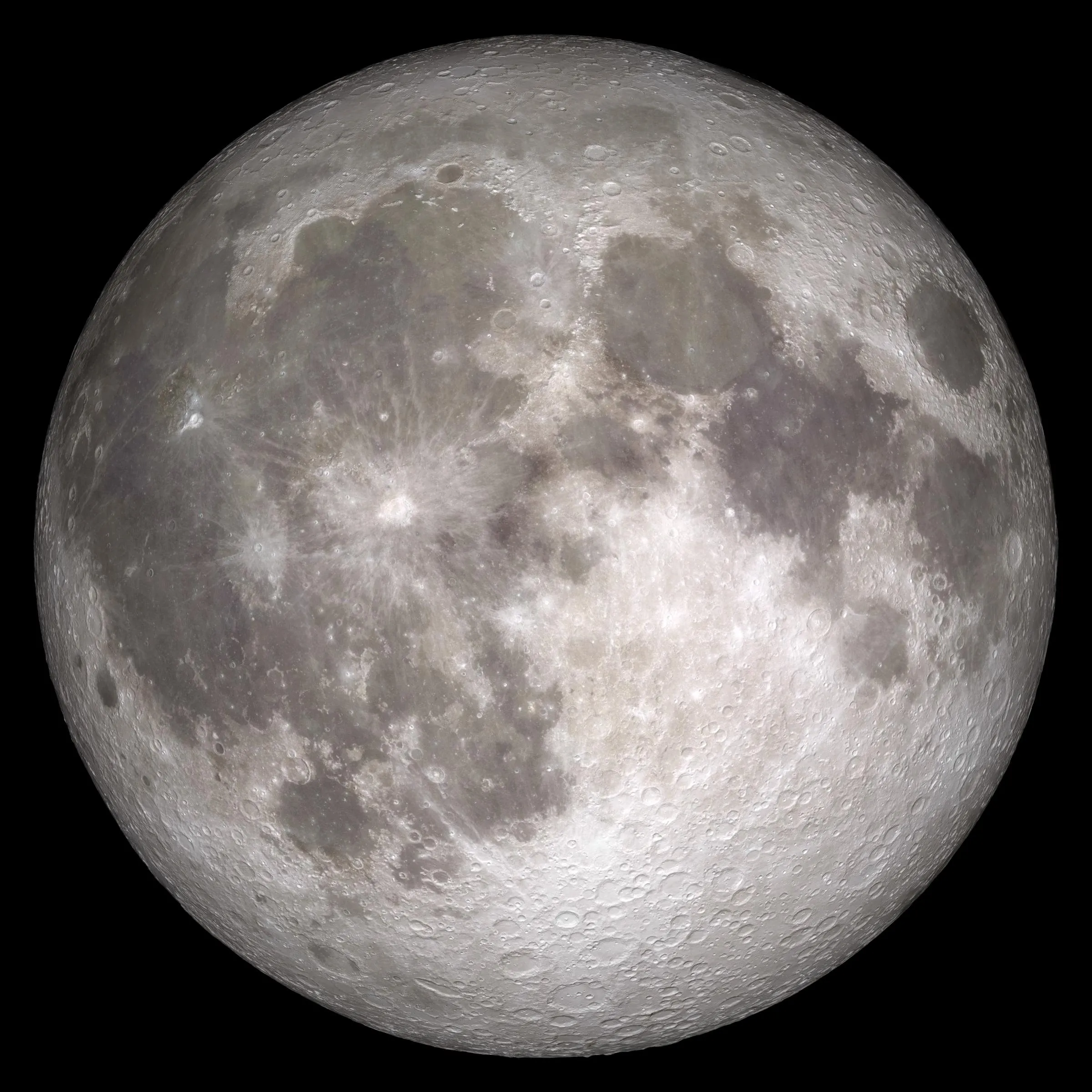
The Moon is Earth’s only natural satellite and the fifth-largest moon in the solar system. It steadies Earth’s tilt, raises the ocean tides and is the only place beyond Earth where people have set foot.
How big is the Moon?
The Moon has a mean radius of 1,737.4 km, so its diameter is about 3,475 km, roughly 27% of Earth’s. Its mass is about 7.35 × 10²² kg, only 1.2% of Earth’s, and its density is 3.34 g/cm³.
Surface gravity is 1.62 m/s², about one sixth of Earth’s, which is why astronauts could bound across the surface. Only Ganymede, Titan, Callisto and Io are larger moons. Compared with the planet it orbits, though, our Moon is unusually large.
How far away is the Moon?
The Moon orbits at an average distance of 384,400 km, about 30 Earth diameters. The orbit is slightly oval, ranging from about 363,300 km at perigee to 405,500 km at apogee. A full Moon near perigee, often called a supermoon, looks about 14% wider than one near apogee.
Light takes about 1.3 seconds to cross the gap. Laser beams bounced off reflectors left by Apollo crews show that the Moon is drifting away by about 3.8 cm a year, as Earth’s tides slowly transfer energy to it.
How long is a day on the Moon?
The Moon orbits Earth once every 27.3 days, and it spins once in the same time. Because of this tidal locking it always keeps the same face towards Earth. A slight wobble called libration lets you see about 59% of the surface over time.
From one new Moon to the next takes 29.5 days, because Earth moves along its orbit while the Moon goes round. That is also the length of a lunar day: any spot on the Moon gets about two weeks of sunlight followed by two weeks of night. The far side is not dark; it simply faces away from us.
What is the Moon’s surface like?
The Moon has two main kinds of terrain. The bright highlands are old, heavily cratered crust made of pale rock called anorthosite. The dark patches, the maria, are huge basins flooded by basalt lava more than 3 billion years ago. Early astronomers mistook them for seas, which is why “mare” means sea.
The largest impact basin, South Pole-Aitken, is about 2,500 km across. The whole surface is blanketed in regolith, a layer of fine dust and broken rock churned up by billions of years of impacts.
Temperature and ice
The Moon has no real atmosphere, only a very thin exosphere, so its temperatures swing widely. Near the equator, daytime reaches about 120 °C and night falls to about -130 °C. Inside some permanently shadowed craters near the poles, NASA’s Lunar Reconnaissance Orbiter has measured temperatures below -240 °C. Several missions have found evidence of water ice in these cold traps, which makes the south pole a target for future landings.
How did the Moon form?
The leading explanation is the giant-impact hypothesis. About 4.5 billion years ago a Mars-sized body, often called Theia, struck the young Earth. Debris thrown into orbit gathered to form the Moon. This fits the Moon’s small iron core and the close chemical match between lunar and Earth rocks, although the details are still debated.
The Moon’s gravity raises tides in Earth’s oceans and helps keep Earth’s axial tilt stable over long periods. When the Moon lines up with the Sun and Earth, it causes eclipses. See Phases and eclipses.
Which missions have explored the Moon?
- Luna 2 and Luna 3 (USSR, 1959): the first spacecraft to hit the Moon, then the first photos of the far side.
- Luna 9 (USSR, 1966): the first soft landing.
- Apollo 8 (NASA, 1968): the first crew to orbit the Moon.
- Apollo 11 (NASA, 1969): Neil Armstrong and Buzz Aldrin landed on 20 July 1969. Between 1969 and 1972, twelve astronauts walked on the Moon and brought back about 382 kg of rock and soil.
- Lunar Reconnaissance Orbiter (NASA, 2009): still mapping the surface in fine detail.
- Chang’e 4 (China, 2019) made the first landing on the far side, and Chang’e 6 (2024) returned the first far-side samples.
- Chandrayaan-3 (India, 2023): the first landing near the south pole region.
- IM-1 (Intuitive Machines, 2024): the first commercial lander on the Moon, though it tipped onto its side. Blue Ghost (Firefly, 2025) made the first fully successful commercial landing.
NASA’s Artemis programme sent an uncrewed Orion capsule around the Moon in 2022 and aims to land astronauts near the south pole. Hohmann transfers and Orbital insertion explain how spacecraft get there.
How can you see the Moon?
The Moon is the brightest object in the night sky and easy to see, often in daylight too. Its phases follow a 29.5-day cycle from new Moon through first quarter, full Moon and last quarter. The best time to look with binoculars is near first or last quarter, when shadows along the line between day and night make craters and mountains stand out.
During a total lunar eclipse, Earth’s shadow turns the full Moon a coppery red. Lunar eclipses are safe to watch with the naked eye. The night sky guide has more tips for observing.
Data sources
Tools and lessons use simplified models for learning only. They must not be used for navigation, mission planning or any operational decision. Certificates are free and non-accredited. Read the educational content disclaimer