
Io
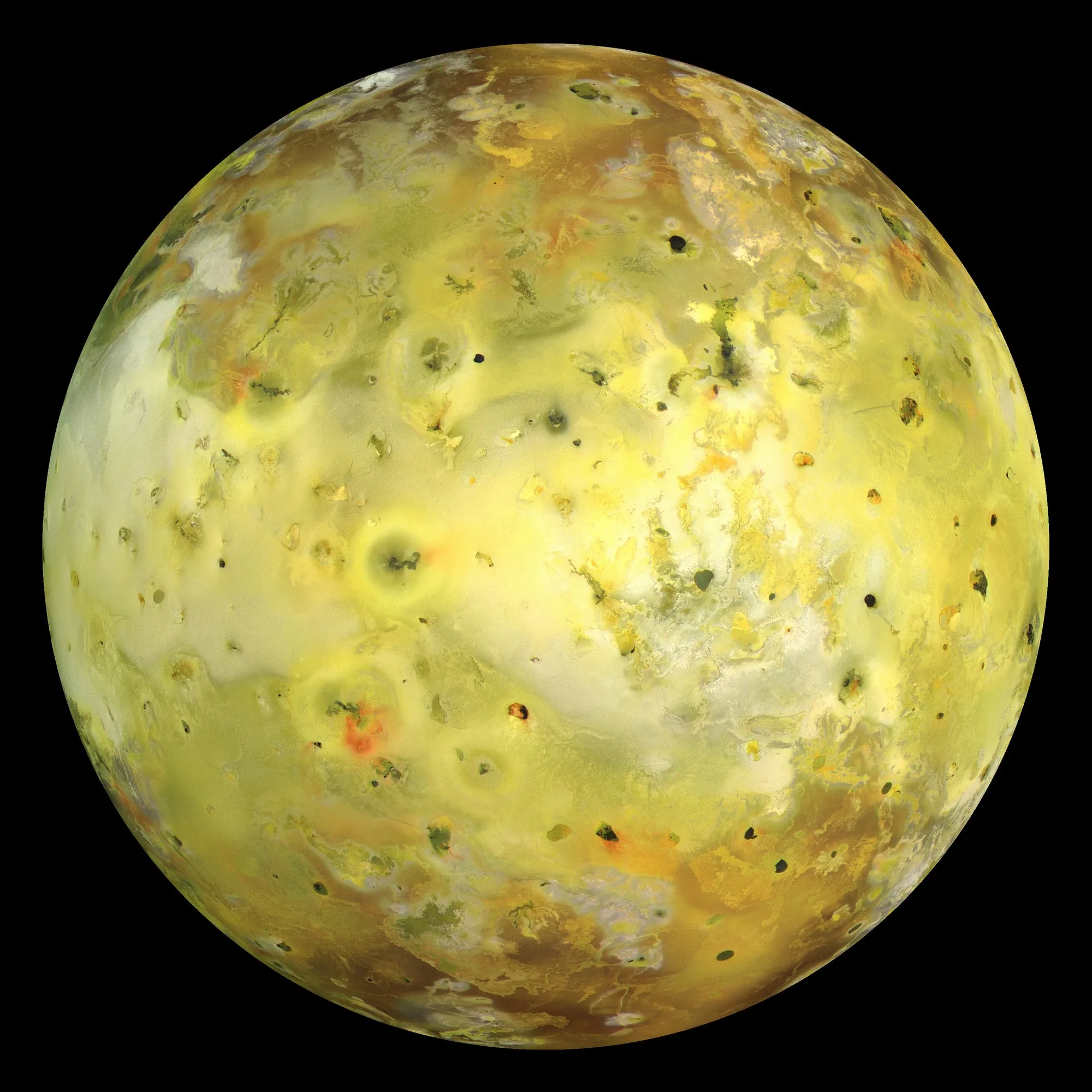
Io, Jupiter's innermost large moon, has over 400 active volcanoes heated by tides. Its size, orbit, lava, sulphur surface and missions.
NASA/JPL/University of Arizona
The most volcanic place in the solar system, squeezed and heated by Jupiter’s gravity.
Io is the innermost of Jupiter’s four large Galilean moons and the most volcanically active body known. More than 400 active volcanoes cover its surface, some throwing plumes hundreds of kilometres into space. Its colours of yellow, orange, red and white come from sulphur and sulphur dioxide.
How big is Io?
Io is about 3,643 km across, slightly larger than Earth’s Moon (3,475 km) and about 29% of Earth’s width. Its mass is about 8.9 × 10²² kg, roughly 1.2 times the Moon’s and 1.5% of Earth’s.
With an average density of about 3.53 g/cm³, Io is the densest of the Galilean moons. Unlike its icy neighbours it is made almost entirely of rock around an iron or iron sulphide core, with very little water. That is probably because it formed closest to young Jupiter, where heat drove off ice.
How far is Io from Jupiter?
Io orbits about 421,800 km from Jupiter’s centre, a little farther than our Moon is from Earth. It goes round once every 1.77 days (42.5 hours), and like most large moons it is tidally locked, so the same side always faces Jupiter. One Io day therefore equals one orbit.
The resonance that heats Io
Io is in a 1:2:4 orbital resonance with Europa and Ganymede: for every orbit Ganymede makes, Europa makes two and Io makes four. The regular tugs from its neighbours keep Io’s orbit slightly oval. As Io’s distance from Jupiter changes, the planet’s gravity stretches and squeezes it, and the solid surface rises and falls by up to about 100 metres. That flexing generates heat inside the moon, called tidal heating. See Kepler’s laws and Newton’s gravity for the physics behind it.
What are Io’s volcanoes like?
Io gives off around 100 trillion watts of heat from its interior, far more per square metre than Earth. Its lavas can be hotter than 1,200 °C, suggesting silicate rock rich in magnesium, similar to lavas Earth produced billions of years ago.
Loki Patera, the most powerful volcano, holds a lava lake about 200 km across that brightens and fades in a regular cycle. Plumes from vents such as Pele and Tvashtar reach 300 to 400 km high and fall back as rings of sulphur frost. Eruptions resurface Io so quickly that no impact craters have been found on it.
Io also has mountains taller than Everest. Boösaule Montes rises about 17 km, pushed up by the crust breaking under the weight of piled lava rather than by volcanic eruptions.
Does Io have a magma ocean?
For years scientists debated whether a global ocean of molten rock lay under the crust. In 2024, gravity measurements from NASA’s Juno spacecraft suggested it does not: Io’s interior appears mostly solid, with magma held in more local chambers. This is a new result and may be refined.
Does Io have an atmosphere?
Io has a very thin atmosphere, mostly sulphur dioxide from volcanoes and frost. When Io passes into Jupiter’s shadow, it cools and much of the gas freezes onto the ground. The average surface temperature is about -130 °C, while active lava spots are more than 1,000 °C hotter.
Every second Jupiter’s magnetic field strips about one tonne of material from Io. These charged particles form a doughnut-shaped ring around Jupiter, the Io plasma torus, and electric currents linking Io to Jupiter’s poles create bright spots in Jupiter’s aurorae. The radiation near Io is intense enough to damage spacecraft electronics in days.
How was Io discovered and explored?
Galileo Galilei discovered Io in January 1610, together with Europa, Ganymede and Callisto. The German astronomer Simon Marius gave the moons their mythological names; Io was one of Zeus’s lovers.
Pioneer 10 and 11 passed in 1973 and 1974. In March 1979, engineer Linda Morabito spotted a plume on a Voyager 1 image, the first active volcano seen beyond Earth. Scientists had predicted tidal heating just days before. NASA’s Galileo orbiter studied Io from 1995 to 2003, and Cassini (2000) and New Horizons (2007) observed it on their way to other targets.
Juno flew within about 1,500 km of Io in December 2023 and February 2024, the closest passes in more than 20 years, and returned detailed images of lava lakes and the north polar region.
Can you see Io from Earth?
Yes, with binoculars. Io shines at about magnitude 5, but Jupiter’s glare hides it from the naked eye. Hold binoculars steady and you will see up to four small points of light in a line beside Jupiter; Io is the one closest to the planet, and its position changes noticeably from night to night.
A small telescope lets you watch Io pass in front of Jupiter, casting a black shadow on the cloud tops, or vanish into Jupiter’s shadow. The night sky guide and the orrery help you find Jupiter first.
Data sources
Tools and lessons use simplified models for learning only. They must not be used for navigation, mission planning or any operational decision. Certificates are free and non-accredited. Read the educational content disclaimer