
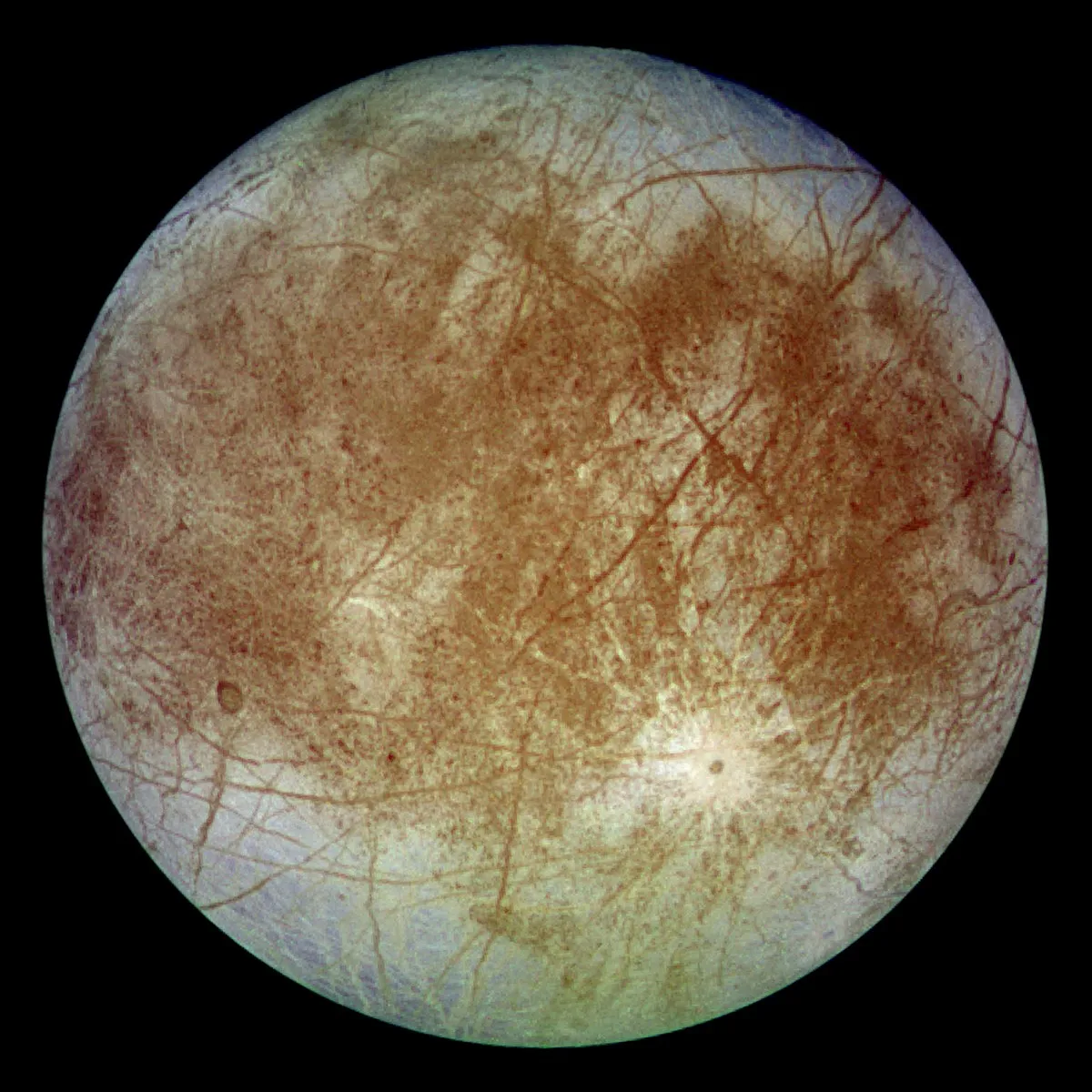
Europa
Europa, Jupiter's icy moon, hides a salty ocean with more water than Earth's seas. Its size, ice shell, chance of life and Europa Clipper.
NASA/JPL/DLR
Under a shell of cracked ice lies a salty ocean: one of the best places to look for life beyond Earth.
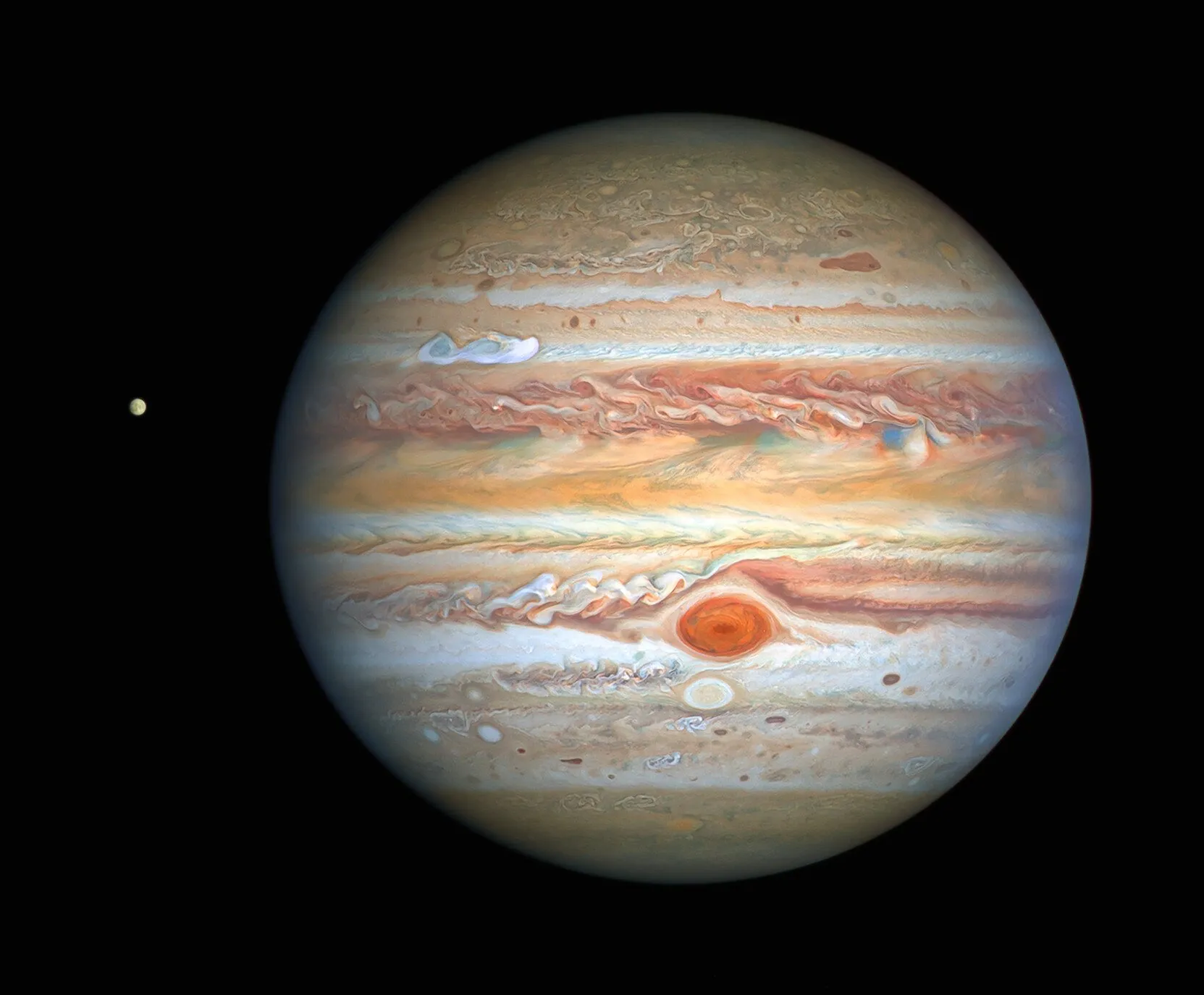
Europa is the smallest of Jupiter’s four Galilean moons and the second closest to the planet. Its bright surface of water ice is crossed by long cracks and ridges, and beneath it lies a global ocean of salty water. Water, chemistry and energy are the basic needs of life as we know it, and Europa may have all three.
How big is Europa?
Europa is about 3,122 km across, slightly smaller than Earth’s Moon (3,475 km) and about a quarter of Earth’s width. Its mass is about 4.8 × 10²² kg, roughly 65% of the Moon’s.
Its average density of about 3.01 g/cm³ tells scientists it is mostly rock, with an iron core at the centre. The outer layer of water and ice is thin compared with the whole moon, but still deeper than any ocean on Earth.
How far is Europa from Jupiter?
Europa orbits about 671,100 km from Jupiter’s centre, taking 3.55 days to go round once. It is tidally locked, so one side always faces Jupiter, and one Europa day equals one orbit.
It sits in a 1:2:4 resonance with Io and Ganymede: Europa makes two orbits for every four of Io and one of Ganymede. These regular tugs keep its orbit slightly oval, so Jupiter’s gravity flexes the moon as it goes round. That tidal heating is weaker than on Io, but enough to keep the ocean liquid.
Does Europa have an ocean?
Almost certainly. In the late 1990s NASA’s Galileo spacecraft found that Europa disturbs Jupiter’s magnetic field in a way best explained by a layer of electrically conducting, salty water. Combined with gravity data, this points to a global ocean beneath the ice.
Estimates put the ice shell at about 15 to 25 km thick and the ocean at 60 to 150 km deep. Even though Europa is small, that could add up to about twice the water in all of Earth’s oceans. The thickness of the shell is still debated, and measuring it is one of the main goals of new missions.
Could there be life on Europa?
Nobody knows. The ocean is thought to touch a rocky seafloor, where reactions between water and rock could release chemical energy, as at deep-sea vents on Earth. In 2023 the James Webb Space Telescope found carbon dioxide on the surface, concentrated in a young region called Tara Regio, which suggests carbon may come up from the ocean. These are ingredients and conditions, not evidence of life.
What is Europa’s surface like?
Europa is one of the smoothest solid bodies in the solar system, with few large craters. That means its surface is young, probably 40 to 90 million years old, compared with billions of years for Callisto. The ice is constantly reshaped.
Long dark lines called lineae run for thousands of kilometres, often as double ridges. In chaos terrain, blocks of ice have broken apart, drifted and refrozen, possibly over pockets of water inside the shell. The reddish-brown colour along cracks may come from salts and sulphur compounds, some of them carried over from Io.
The surface temperature is about -160 °C at the equator and colder near the poles. Jupiter’s radiation splits water ice into hydrogen and oxygen, giving Europa a very thin oxygen atmosphere. Hubble has reported possible water vapour plumes, but those sightings remain unconfirmed.
Which missions have explored Europa?
Galileo Galilei discovered Europa on 8 January 1610, the night after he first noticed Jupiter’s moons. Pioneer 10 and 11 passed in 1973 and 1974, and Voyager 1 and 2 photographed the cracked surface in 1979. The Galileo orbiter made 11 close flybys between 1995 and 2003. NASA’s Juno flew about 352 km above the surface in September 2022.
Europa Clipper and JUICE
NASA’s Europa Clipper launched on 14 October 2024 on a Falcon Heavy rocket. It is using gravity assists from Mars (2025) and Earth (2026) and should reach Jupiter in 2030. It will not orbit Europa itself, where radiation is too strong, but will orbit Jupiter and make 49 close flybys, measuring the ice shell, the ocean’s saltiness and the chemistry of the surface.
ESA’s JUICE mission, launched in 2023, is set to make two Europa flybys in the early 2030s on its way to orbit Ganymede.
Can you see Europa from Earth?
Yes, with binoculars. Europa shines at about magnitude 5.3 but is lost in Jupiter’s glare to the naked eye. Steady binoculars show it as one of up to four points of light lined up beside the planet, its position changing from night to night. A small telescope lets you watch it cross Jupiter’s face or slip into the planet’s shadow. Use the orrery to find Jupiter in tonight’s sky.
Data sources
Tools and lessons use simplified models for learning only. They must not be used for navigation, mission planning or any operational decision. Certificates are free and non-accredited. Read the educational content disclaimer