
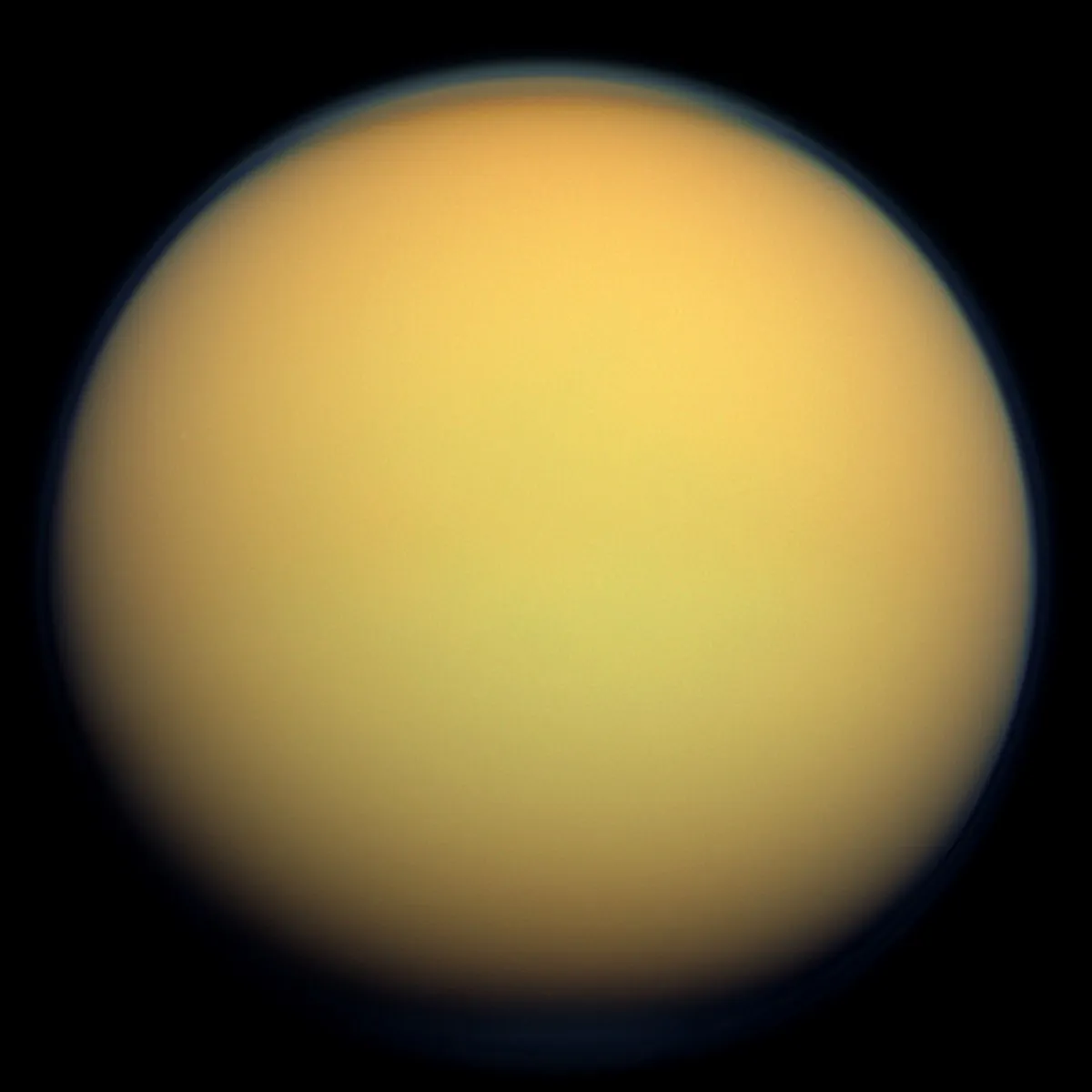
Titan
Titan is Saturn's largest moon: bigger than Mercury, wrapped in thick nitrogen air, with methane rain, rivers and seas at −179 °C.
NASA/JPL-Caltech/Space Science Institute
A moon with rain, rivers and seas, all made of methane instead of water.
Titan is Saturn’s largest moon and the second largest moon in the solar system, after Jupiter’s Ganymede. It is the only moon with a thick atmosphere, and the only world apart from Earth known to have stable bodies of liquid on its surface. Those seas are not water but liquid methane and ethane, at about −179 °C.
How big is Titan?
Titan is about 5,150 km across, roughly 40% of Earth’s diameter and about 5% wider than the planet Mercury. It is not as heavy as Mercury, though. Its mass is about 1.35 × 10²³ kg, only around 2.3% of Earth’s mass and less than half of Mercury’s, because Titan is made of roughly equal parts rock and water ice.
That mix gives it a density of 1.88 g/cm³, much lower than rocky worlds. Surface gravity is about 1.35 m/s², around 14% of Earth’s and a little less than the Moon’s. If you stood on Titan you would weigh about one seventh of what you weigh at home.
Titan’s orbit, day and seasons
Titan orbits Saturn at an average distance of about 1.22 million km, taking 15.95 Earth days per lap. Like our Moon, it is tidally locked: the same face always points towards Saturn, so one Titan day also lasts 15.95 Earth days.
Titan shares Saturn’s axial tilt and its 29.5-year trip around the Sun. Each season on Titan therefore lasts about 7 Earth years. Cassini watched clouds and lakes change as northern spring arrived in 2009 and turned towards summer in 2017. You can compare these cycles in our lesson on days and years.
What is Titan’s atmosphere like?
Titan’s air is about 95% nitrogen and around 5% methane near the surface, with traces of other hydrocarbons. The surface pressure is about 1.5 bar, roughly 50% higher than at sea level on Earth. Because gravity is weak and the air is dense, a person could in principle fly by flapping wings strapped to their arms.
Sunlight breaks methane apart high in the atmosphere. The fragments recombine into more complex organic molecules that form a thick orange haze, which hides the surface from ordinary cameras. Those particles slowly settle onto the ground, coating Titan in organic material.
Methane on Titan behaves much like water on Earth. It evaporates, forms clouds, falls as rain and carves river channels. Without a steady supply the methane would be destroyed by sunlight within tens of millions of years, so scientists think it is replenished from the interior, though how is still debated.
What is on Titan’s surface?
Radar on Cassini mapped seas and lakes near the poles, mostly in the north. The largest, Kraken Mare, covers about 400,000 km², more than the Caspian Sea. Ligeia Mare and Punga Mare are the next largest. Their depths reach more than 100 metres in places.
Around the equator, long dunes of dark organic grains run for hundreds of kilometres and stand up to about 100 metres tall. There are also mountains of water ice, which is as hard as rock at these temperatures, and only a few impact craters, a sign that the surface is geologically young.
Under the crust, measurements of how Titan flexes in Saturn’s gravity point to a global ocean of salty liquid water, probably tens to hundreds of kilometres below the surface. Its exact depth and thickness are still uncertain.
Exploring Titan: Huygens and Dragonfly
Christiaan Huygens discovered Titan on 25 March 1655. Pioneer 11 flew past Saturn in 1979, and Voyager 1 passed Titan in 1980 but could not see through the haze.
The joint NASA and ESA Cassini-Huygens mission, launched in 1997, reached Saturn in 2004. Cassini made 127 targeted flybys of Titan before its mission ended in 2017, using radar and infrared cameras to see the surface. ESA’s Huygens probe parachuted down on 14 January 2005, the first landing on a world in the outer solar system. It found rounded pebbles of ice on damp ground and kept transmitting for about 72 minutes after touchdown.
NASA’s Dragonfly is a nuclear-powered rotorcraft lander, planned to launch no earlier than July 2028 and arrive in 2034. It will fly from site to site in the Shangri-La dune field and towards Selk crater, studying the chemistry that comes before biology.
Can you see Titan from Earth?
Yes, with a small telescope. Titan shines at about magnitude 8.4, too faint for the naked eye but easy in a 60 mm to 80 mm telescope on a steady night. It looks like a faint star near Saturn, usually the brightest of the planet’s moons.
Over about 16 days you can watch it move from one side of Saturn to the other. Saturn is best placed around opposition, when it rises at sunset; see our night sky guide or try the orrery to find where Saturn is now.
Data sources
Tools and lessons use simplified models for learning only. They must not be used for navigation, mission planning or any operational decision. Certificates are free and non-accredited. Read the educational content disclaimer