
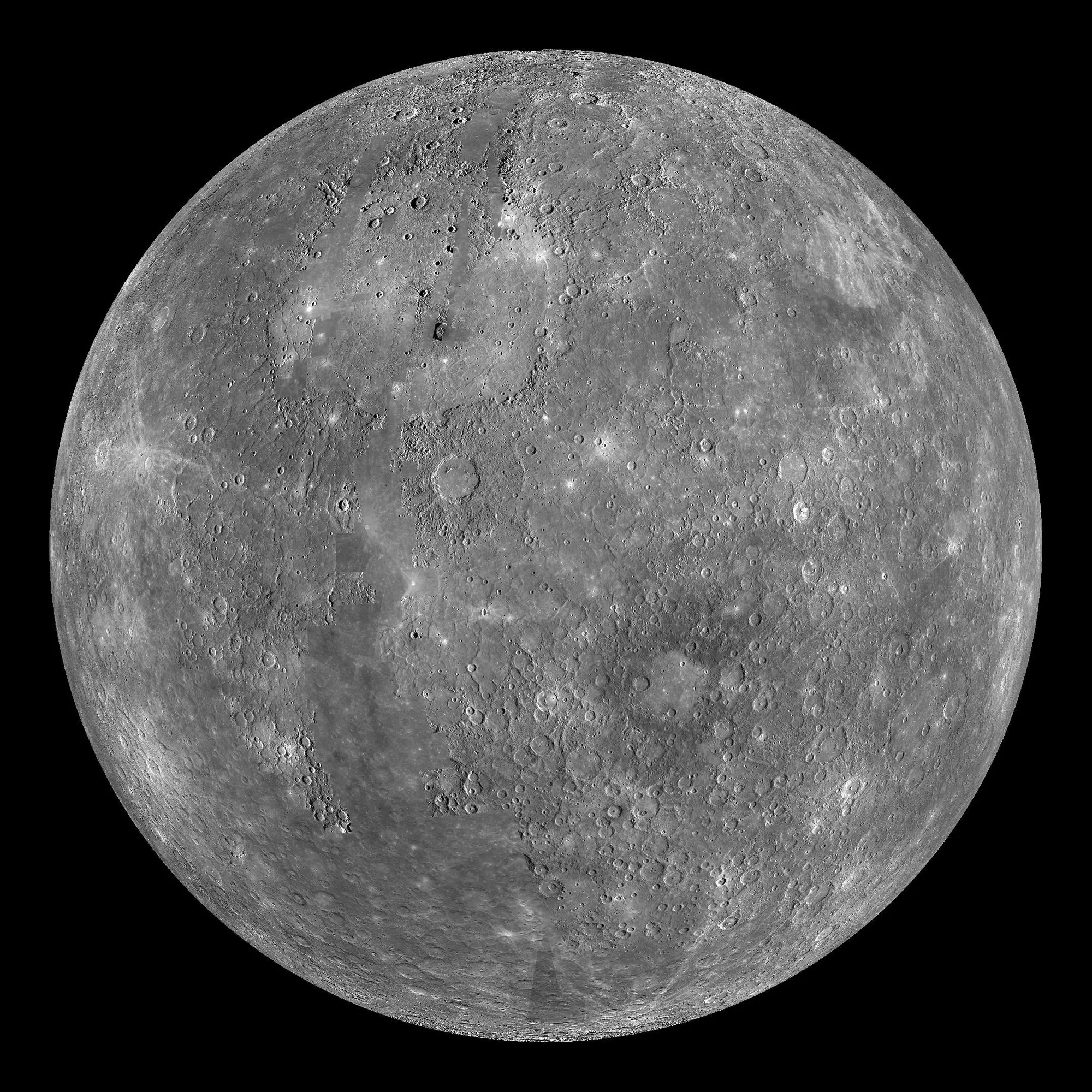
Mercury
Mercury is the smallest planet and closest to the Sun: an 88-day year, 430 °C days, -180 °C nights and a huge iron core. How to spot it.
NASA/Johns Hopkins University Applied Physics Laboratory/Carnegie Institution of Washington
The smallest planet, where one day from sunrise to sunrise lasts two whole Mercury years.
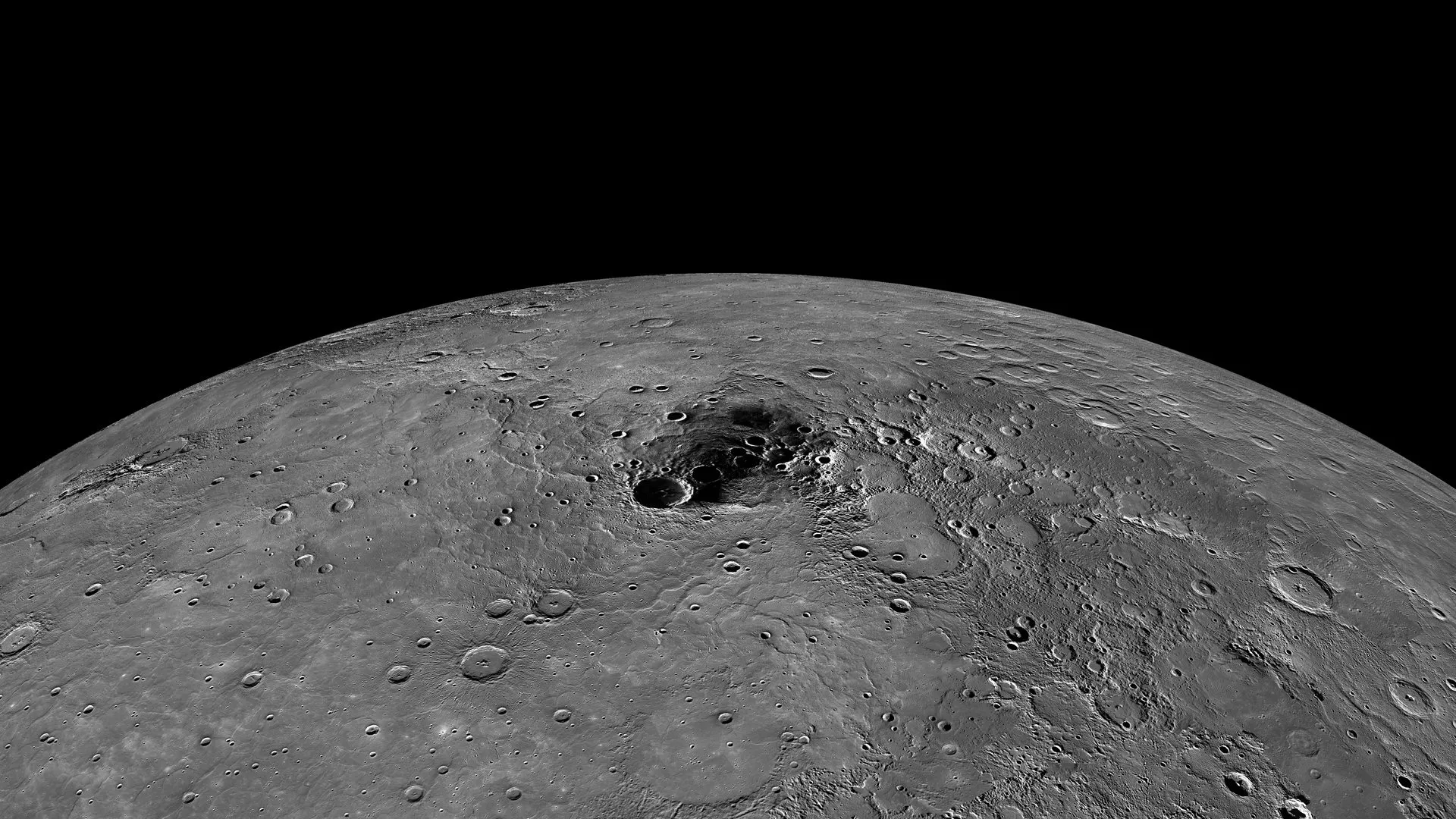
Mercury is the smallest planet and the one closest to the Sun. It is a rocky world only slightly larger than our Moon, with almost no atmosphere, so its surface swings between scorching days and freezing nights.
How big is Mercury?
Mercury has a diameter of about 4,879 km, around 38% of Earth’s and only about 1,400 km wider than the Moon. Two of the largest moons in the solar system, Ganymede and Titan, are bigger than it, though both have less mass.
Its mass is about 3.30 × 10²³ kg, roughly 5.5% of Earth’s. Surface gravity is 3.7 m/s², about 38% of Earth’s, so a person weighing 60 kg on Earth would feel like 23 kg there.
Mercury is very dense for its size: 5.43 g/cm³, second only to Earth. That is because a metallic core fills about 85% of its radius, a far larger share than any other rocky planet.
How far is Mercury from the Sun?
Mercury orbits at an average of about 57.9 million km (0.39 AU). Its orbit is the most stretched of any planet, with an eccentricity of 0.21. At its closest it comes within 46.0 million km of the Sun and at its farthest it is 69.8 million km away.
It is also the fastest planet, averaging about 47.4 km/s. Kepler’s laws explain why: the closer a planet is to the Sun, the faster it must move. Its orbit also shifts slowly in a way Newton’s gravity could not fully explain. Einstein’s general relativity accounted for the difference in 1915.
How long is a day on Mercury?
A Mercury year lasts 88 Earth days. The planet spins once every 58.6 Earth days, exactly three turns for every two orbits. Because it is moving around the Sun as it spins, the time from one sunrise to the next is 176 Earth days, two full Mercury years.
Its axis is almost upright, tilted only about 0.03°, so Mercury has no seasons. See Days and years for how solar days and sidereal days differ.
What is the surface of Mercury like?
Mercury’s grey surface is covered in craters and looks a lot like the Moon. Its largest impact feature, the Caloris Basin, is about 1,550 km across. The blow that formed it sent shock waves through the planet and jumbled the ground on the far side.
Long cliffs called lobate scarps run across the surface for hundreds of kilometres. They formed as the planet’s interior cooled and Mercury shrank, wrinkling its crust. Scientists estimate its radius has shrunk by several kilometres.
Temperature and ice
With no thick air to hold heat, daytime temperatures reach about 430 °C, hot enough to melt lead, while nights fall to about -180 °C. Even so, the floors of some craters near the poles never see sunlight. Radar from Earth and data from MESSENGER show that they hold water ice.
Atmosphere and magnetic field
Mercury has only a very thin exosphere of atoms such as oxygen, sodium, hydrogen, helium and potassium, knocked off the surface by sunlight and the solar wind. It has a global magnetic field about 1% as strong as Earth’s, a sign that part of its core is still molten.
Which missions have visited Mercury?
Mercury is hard to reach. A spacecraft falling towards the Sun speeds up, so it must shed a great deal of energy to slow down and enter orbit, usually by several gravity assists.
- Mariner 10 (NASA): flew past three times in 1974 and 1975, mapping just under half the surface.
- MESSENGER (NASA): launched in 2004, became the first spacecraft to orbit Mercury in 2011 and mapped the whole planet. It ended its mission by crashing into the surface on 30 April 2015.
- BepiColombo (ESA and JAXA): launched in 2018 with two orbiters. After six Mercury flybys it is scheduled to enter orbit in late 2026.
Can you see Mercury from Earth?
Yes, with the naked eye, but it takes some planning. Mercury never strays more than about 28° from the Sun in the sky, so you only see it low on the horizon in twilight: in the west after sunset or in the east before sunrise.
The best chances come around its greatest elongations, which happen several times a year, when it stands farthest from the Sun. At its brightest it can reach about magnitude -2, brighter than almost every star. A pair of binoculars helps you find it, but never sweep them near the Sun before it has set.
Occasionally Mercury crosses the face of the Sun as a tiny black dot. The last transit was on 11 November 2019 and the next is on 13 November 2032. The night sky guide and the orrery can help you find where Mercury is now.
Data sources
Tools and lessons use simplified models for learning only. They must not be used for navigation, mission planning or any operational decision. Certificates are free and non-accredited. Read the educational content disclaimer