Saturn
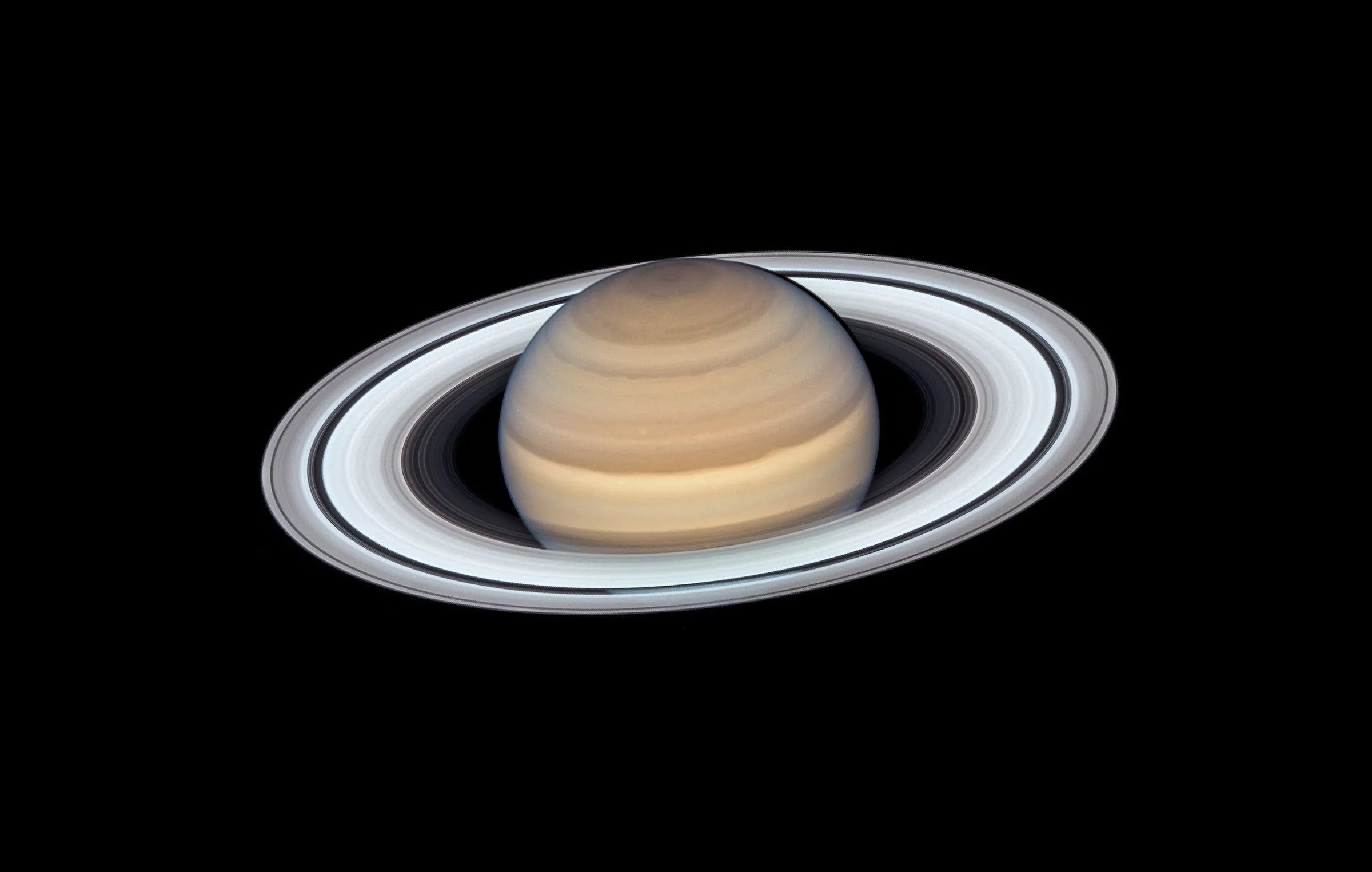
Saturn is 9.5 times wider than Earth yet less dense than water. Its size, rings, 274 moons, 10.7-hour day and how to see it.
NASA, ESA, A. Simon (Goddard Space Flight Center), and M.H. Wong (University of California, Berkeley) (CC BY 4.0)
A giant light enough to float in water, if you could find a bathtub big enough, wearing the brightest rings in the solar system.
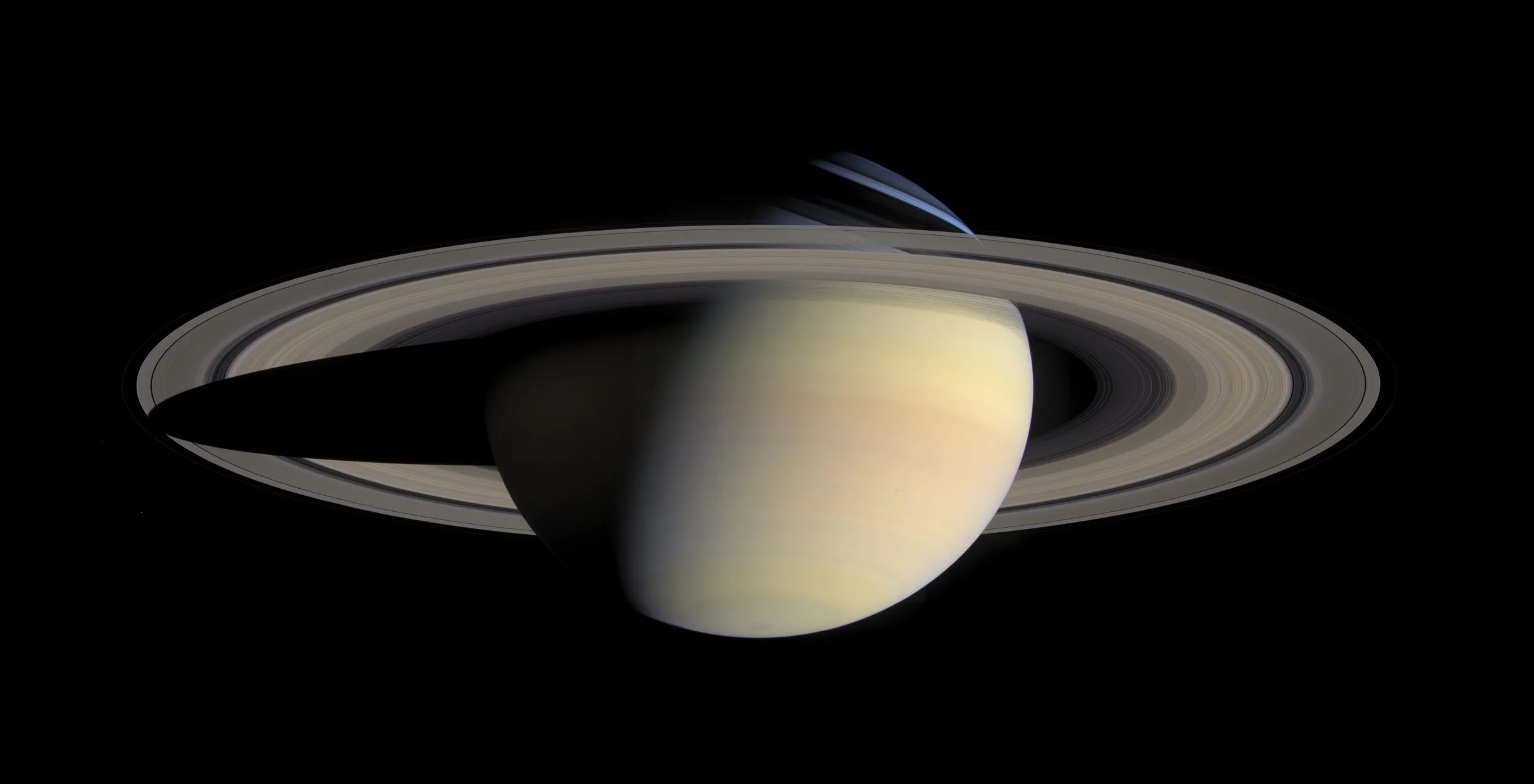
Saturn is the sixth planet from the Sun and the second largest, a gas giant made mostly of hydrogen and helium. Its rings are made of countless pieces of water ice and rock, and its family of moons is the largest known around any planet. On a clear night you can see it without a telescope.
How big is Saturn compared with Earth?
Saturn measures 120,536 km across at the equator, about 9.5 times the width of Earth. You could line up nine Earths across its face, and about 760 would fit inside it by volume. Its fast spin flattens it: the polar diameter is roughly 10% smaller than the equatorial one, the most of any planet.
Despite that size, Saturn holds only about 95 Earth masses. Its average density is about 0.69 g/cm³, lower than the 1 g/cm³ of water, which makes it the least dense planet. That is where the bathtub line comes from, although Saturn has no solid surface and would not hold together as a floating ball.
How far is Saturn from the Sun?
Saturn orbits at an average of about 1.43 billion km, or 9.5 times Earth’s distance from the Sun (9.5 AU). Its slightly elliptical path takes it from about 1.36 billion km at its closest to 1.51 billion km at its farthest. Sunlight takes around 80 minutes to reach it.
How long is a day and a year on Saturn?
A year on Saturn lasts about 29.4 Earth years, and the planet travels at an average of 9.7 km/s. A day is short: Saturn turns once in about 10 hours 33 minutes, a value Cassini scientists pinned down in 2019 by timing waves in the rings, because the planet has no fixed surface features to watch. Its axis is tilted 26.7°, so it has seasons, each lasting about seven years. See days and years and Kepler’s laws for why the outer planets move so slowly.
What is Saturn made of?
Saturn’s upper atmosphere is about 96% hydrogen and 3% helium by volume. Deeper down, rising pressure squeezes hydrogen into a liquid and then into a metal that conducts electricity, which generates the planet’s magnetic field. At the centre there is probably a core of rock, ice and metal, though Cassini data suggest it is diffuse rather than sharply bounded.
The visible cloud tops sit at around -140 °C at the 1-bar level, the pressure of Earth’s air at sea level. Winds at the equator reach about 1,800 km/h. A six-sided jet stream, the hexagon, circles the north pole, with each side longer than Earth’s diameter. Saturn also gives off more heat than it receives from the Sun, partly because helium droplets sink through the interior like rain.
What are Saturn’s rings made of?
The main rings stretch to about 137,000 km from the planet’s centre, yet they are mostly only about 10 metres thick. They are more than 95% water ice, in pieces from dust grains to house-sized blocks. Gaps such as the Cassini Division, about 4,800 km wide, are kept clear by the gravity of moons.
How old the rings are is still debated. Cassini’s measurements of their mass and cleanliness pointed to an age of a few hundred million years, much younger than Saturn, but some researchers argue that old rings could stay clean. The rings are also slowly losing material to the planet.
How many moons does Saturn have?
Saturn has 274 confirmed moons, more than any other planet, after 128 new ones were announced in 2025. Titan, wider than Mercury, has a thick nitrogen atmosphere and lakes of liquid methane. Enceladus sprays water ice from an underground ocean through cracks near its south pole.
Which missions have visited Saturn?
Four spacecraft have reached Saturn. Pioneer 11 flew past in 1979, followed by Voyager 1 in 1980 and Voyager 2 in 1981. The Cassini orbiter arrived in 2004 and studied the system for 13 years. Its Huygens probe landed on Titan in January 2005, and Cassini ended its mission by diving into Saturn’s atmosphere on 15 September 2017.
NASA’s Dragonfly, a rotorcraft lander for Titan, is planned to launch in 2028 and arrive in the mid-2030s.
Can you see Saturn from Earth?
Yes. Saturn shines as a steady, pale yellow point, about as bright as the brightest stars, and people have watched it since ancient times. It is best placed around opposition, when Earth passes between it and the Sun, which happens about every 378 days. Use the orrery to see where it is tonight, and the night sky guide for tips on finding planets.
A small telescope magnifying 25 times or more shows the rings, and binoculars may reveal Titan. Galileo saw odd shapes beside the planet in 1610, and Christiaan Huygens explained them as a ring in 1655. Every 13 to 16 years the rings turn edge-on to Earth and almost vanish, as they did in March 2025; they are now opening again.
Moons in the knowledge base
Data sources
Tools and lessons use simplified models for learning only. They must not be used for navigation, mission planning or any operational decision. Certificates are free and non-accredited. Read the educational content disclaimer