
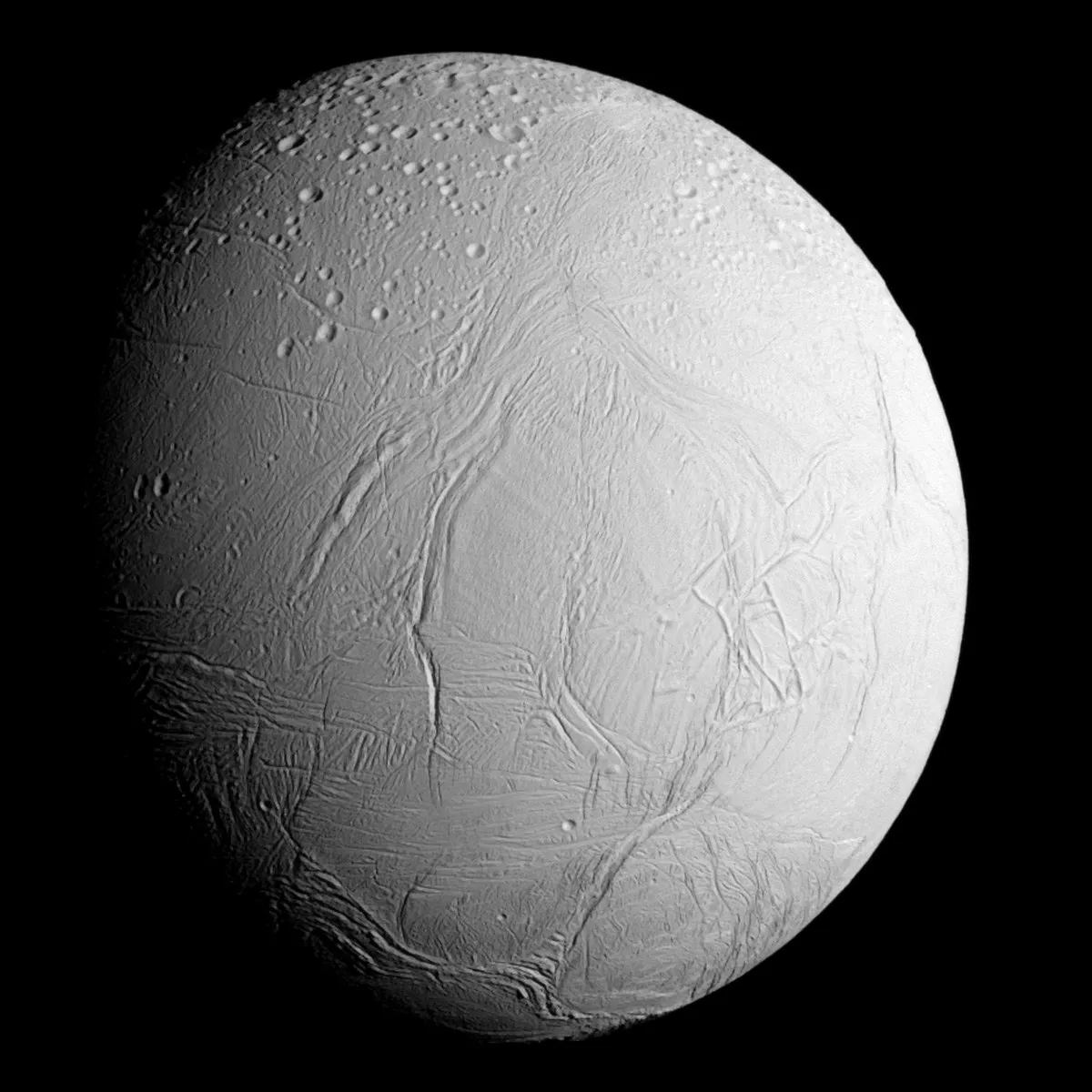
Enceladus
Enceladus is a 504 km icy moon of Saturn whose south-pole jets spray water from a hidden salty ocean into space, feeding Saturn's E ring.
NASA/JPL-Caltech/Space Science Institute
Barely 500 km across, and yet it sprays water into space from an ocean hidden under its ice.
Enceladus is a small, bright moon of Saturn, only about 504 km across. Near its south pole, jets of water vapour and ice grains erupt through long cracks in the ice and feed Saturn’s E ring. Those jets come from a global ocean of salty water beneath the surface, which makes Enceladus one of the best places in the solar system to look for conditions suitable for life.
How big is Enceladus?
Enceladus is about 504 km in diameter, small enough to fit inside the United Kingdom from end to end. Its mass is about 1.08 × 10²⁰ kg, which is only around 0.15% of the Moon’s mass and less than one fifty-thousandth of Earth’s.
Its density of 1.61 g/cm³ tells you it is a mix of rock and water ice, with a rocky core and an icy shell. Surface gravity is about 0.11 m/s², roughly 1% of Earth’s. A firm jump would carry you a long way, though not quite fast enough to escape (escape velocity is about 240 m/s; see our lesson on escape velocity).
Orbit and day length
Enceladus orbits Saturn at about 238,000 km from the planet’s centre, inside the broad, faint E ring. One orbit takes about 32.9 hours (1.37 Earth days). It is tidally locked, so its day lasts the same 32.9 hours and one side always faces Saturn.
Every time Enceladus goes around Saturn twice, the larger moon Dione goes around once. This 2:1 resonance keeps Enceladus’s orbit slightly oval. As its distance from Saturn changes, the planet’s gravity squeezes and relaxes the moon, and that flexing produces the heat that keeps its ocean liquid.
Why is Enceladus so bright and cold?
Enceladus is covered in fresh, clean ice and reflects about 80% of the sunlight that reaches it, more than any other large body in the solar system. Because it absorbs so little sunlight, its surface stays at about −201 °C.
Much of the surface is smooth and lightly cratered, and some regions have almost no craters at all. That shows the ice has been resurfaced recently in geological terms, partly by material falling back from the jets.
The south-pole jets and the hidden ocean
In 2005, NASA’s Cassini spacecraft found plumes erupting from the south pole. They come from four parallel fractures nicknamed the “tiger stripes”, each about 130 km long and spaced about 35 km apart. Scientists have identified more than 100 individual jets along them. Water vapour and ice particles leave at about 400 metres per second, faster than the moon’s escape speed, so much of the material reaches orbit around Saturn and builds the E ring.
In 2015, measurements of a slight wobble in Enceladus’s rotation showed that the ice shell is not attached to the core. That requires a global ocean between them. The ice is thought to be around 20 to 25 km thick on average and much thinner near the south pole, although estimates vary.
What did Cassini find in the plumes?
Cassini flew through the plumes several times, getting as close as 49 km above the surface in October 2015. Its instruments detected:
- Salts, including sodium chloride, showing the water has been in contact with rock.
- Tiny silica grains, which form where hot water above about 90 °C reacts with rock, a strong sign of hydrothermal activity on the sea floor.
- Molecular hydrogen, reported in 2017, a possible energy source for microbes on Earth.
- Organic molecules, from simple to fairly complex ones.
- Phosphates, reported in 2023 from E ring grains, a key ingredient for life as we know it.
None of this is evidence of life. It shows that Enceladus has liquid water, chemical energy and many of the needed ingredients, which is why it ranks high on lists for future missions.
Discovery and exploration
William Herschel discovered Enceladus on 28 August 1789, using a new 1.2 metre telescope. Voyager 1 (1980) and Voyager 2 (1981) took the first close images and saw its bright, smooth surface.
Cassini arrived at Saturn in 2004 and made 23 targeted flybys of Enceladus before its mission ended in 2017. In 2023 the James Webb Space Telescope imaged a water plume stretching nearly 10,000 km from the moon, many times its own size. Mission concepts such as an orbiter and lander have been studied by NASA and ESA, but none has been approved for flight yet.
Can you see Enceladus from Earth?
Only with a fairly large telescope. Enceladus shines at about magnitude 11.7 and sits close to Saturn’s bright glare, so you will want at least a 200 mm telescope, steady air and a time when it is near its greatest distance from the planet. It is far easier to find Titan, which is about 20 times brighter. Check where Saturn is in the orrery.
Data sources
Tools and lessons use simplified models for learning only. They must not be used for navigation, mission planning or any operational decision. Certificates are free and non-accredited. Read the educational content disclaimer