
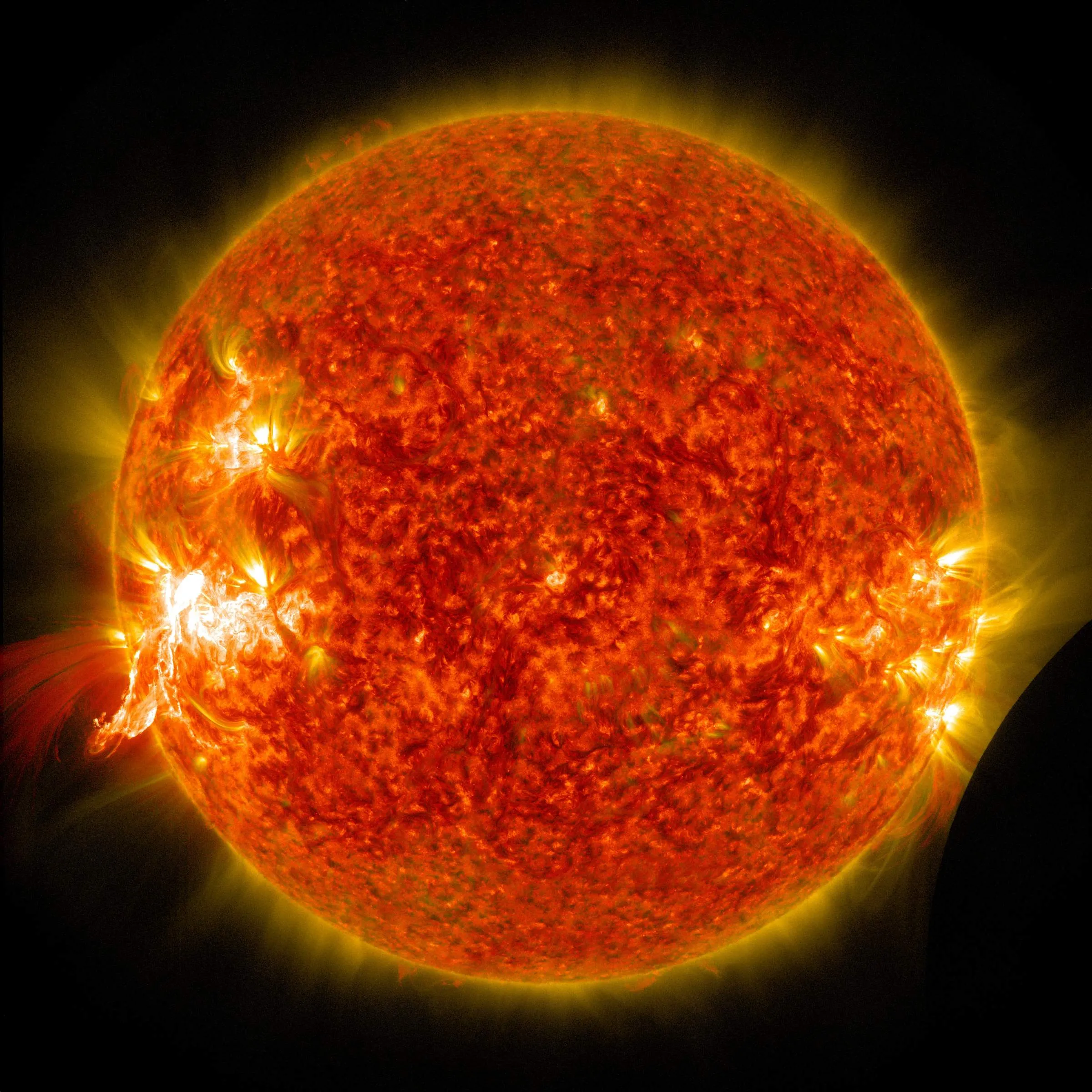
Sun
The Sun is a 4.6-billion-year-old star 109 times wider than Earth, holding 99.86% of the solar system's mass. How it shines and how to view it.
NASA
Our star: the source of almost all the energy on Earth, and the anchor that holds every planet in its orbit.
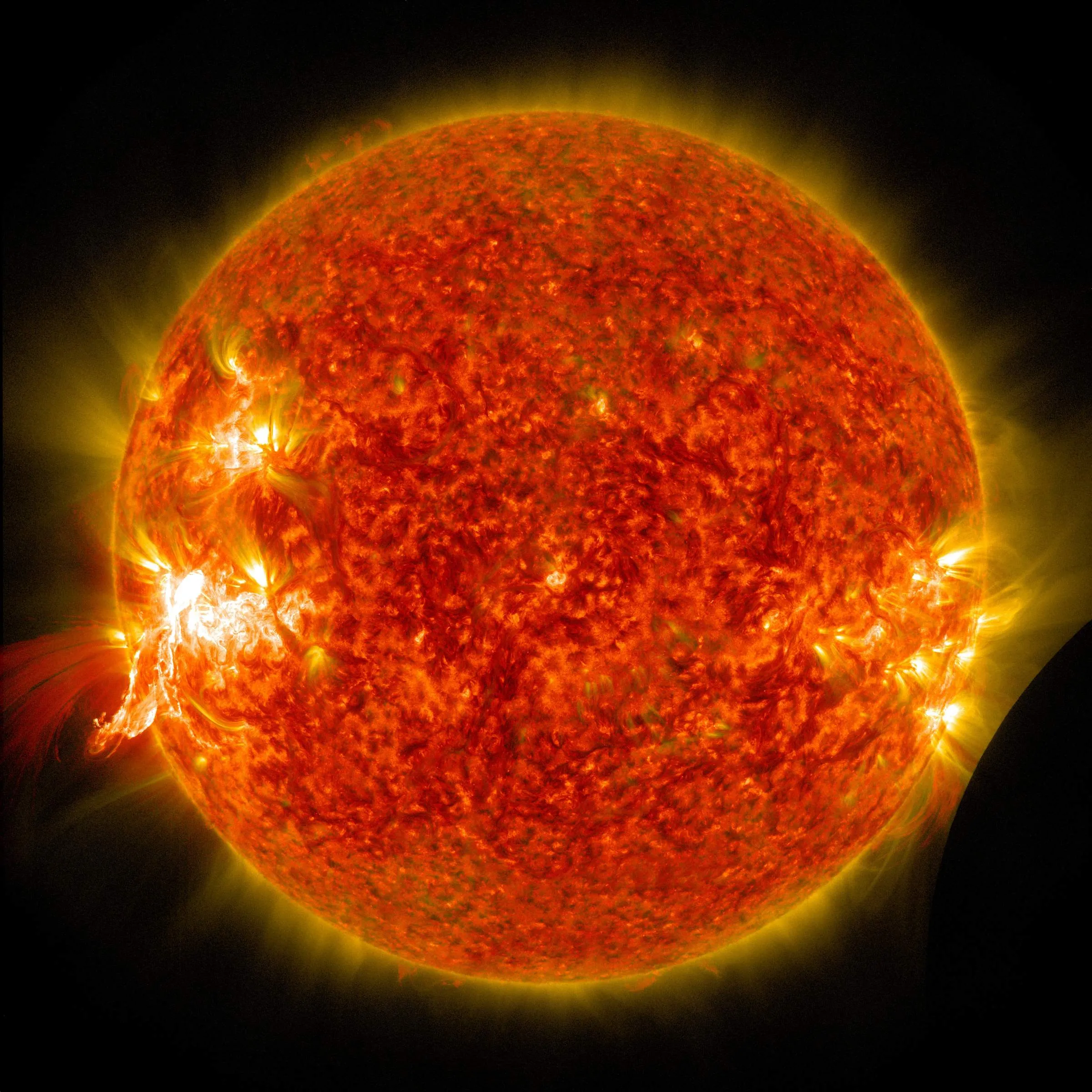
The Sun is an ordinary yellow dwarf star about 4.6 billion years old, and it sits at the centre of the solar system. It shines by fusing hydrogen into helium in its core. Every planet, dwarf planet, asteroid and comet in the solar system orbits it.
How big is the Sun?
The Sun has a radius of about 695,700 km, so its diameter is roughly 1.39 million km, about 109 times Earth’s. You could fit around 1.3 million Earths inside it by volume. Its mass is about 1.989 × 1030 kg, which is roughly 333,000 times the mass of Earth.
That mass is about 99.86% of everything in the solar system. Even so, it is a middle-sized star (type G2 V), and many stars you see at night are bigger.
How far away is the Sun?
Earth orbits the Sun at an average distance of about 149.6 million km. Astronomers call this distance one astronomical unit (AU) and use it to measure the rest of the solar system. Light covers it in about 8 minutes 20 seconds, so you always see the Sun as it was a little over eight minutes ago.
Because Earth’s orbit is slightly oval, the distance changes through the year: about 147.1 million km in early January and 152.1 million km in early July. The seasons come from Earth’s tilt, not from this change. See Seasons for why.
The Sun itself orbits the centre of the Milky Way about 26,000 light-years away, taking roughly 230 million years for one lap. Our place in space shows where that puts us.
What is the Sun made of, and how hot is it?
By mass the Sun is about 73% hydrogen and 25% helium, with small amounts of oxygen, carbon, iron and other elements. It is not solid: it is a ball of plasma, gas so hot that its atoms are stripped of electrons.
The layers of the Sun
- Core: the inner quarter of the radius, where fusion happens at about 15 million °C. Every second it turns around 600 million tonnes of hydrogen into helium.
- Radiative zone: energy works outwards as light, bouncing between particles. This can take many thousands of years.
- Convection zone: the outer 30% or so of the radius, where hot plasma rises and cooler plasma sinks.
- Photosphere: the visible surface, at about 5,500 °C (5,772 K). Sunspots are cooler patches here, at around 3,500 °C.
- Chromosphere and corona: the thin outer atmosphere. The corona is over 1 million °C, far hotter than the surface. Why it is so hot is still being studied.
The Sun does not rotate like a solid ball. Its equator turns once in about 25 days and its poles in about 35. Its outer atmosphere streams away as the solar wind.
What is the solar cycle?
The Sun’s magnetic field flips roughly every 11 years. At solar maximum it has many sunspots, solar flares and coronal mass ejections, huge clouds of plasma flung into space. At solar minimum it is much quieter.
When a coronal mass ejection reaches Earth it can trigger a geomagnetic storm. This can push aurorae far from the poles and disturb satellites and power grids. In October 2024 NASA and NOAA announced that the Sun had reached the maximum period of Solar Cycle 25.
How did the Sun form, and how will it end?
About 4.6 billion years ago a cloud of gas and dust collapsed under its own gravity. Most of the material fell to the centre and became the Sun. The rest flattened into a spinning disc where the planets formed.
The Sun is roughly halfway through its life as a main-sequence star. In about 5 billion years its core will run short of hydrogen and it will swell into a red giant, probably swallowing Mercury and Venus. Whether it reaches Earth is uncertain. It will then shed its outer layers and leave behind a white dwarf about the size of Earth.
Which missions have studied the Sun?
- Ulysses (1990): a joint ESA and NASA craft that made the first passes over the Sun’s poles.
- SOHO (1995): an ESA and NASA observatory at the Sun-Earth Lagrange point L1, still watching the Sun.
- Solar Dynamics Observatory (2010): NASA’s observatory that took the image above.
- Parker Solar Probe (2018): on 24 December 2024 it passed about 6.1 million km from the solar surface at around 690,000 km/h, the closest and fastest of any spacecraft. It shrinks its orbit with Venus gravity assists.
- Solar Orbiter (2020): an ESA-led mission tilting its orbit to take the first close images of the Sun’s poles.
Can you look at the Sun safely?
Never look at the Sun directly, through binoculars, a telescope or a camera viewfinder, without a proper solar filter. Ordinary sunglasses are not safe. Use eclipse glasses that meet the ISO 12312-2 standard, or project the Sun’s image onto card through a pinhole.
A total solar eclipse is the one time the Moon blocks the bright disc, letting you see the pearly corona, but only during totality. The next total eclipse after August 2026 crosses southern Spain, North Africa and Egypt on 2 August 2027. Phases and eclipses explains how they happen, and the orrery shows the planets circling the Sun.
Data sources
Tools and lessons use simplified models for learning only. They must not be used for navigation, mission planning or any operational decision. Certificates are free and non-accredited. Read the educational content disclaimer