
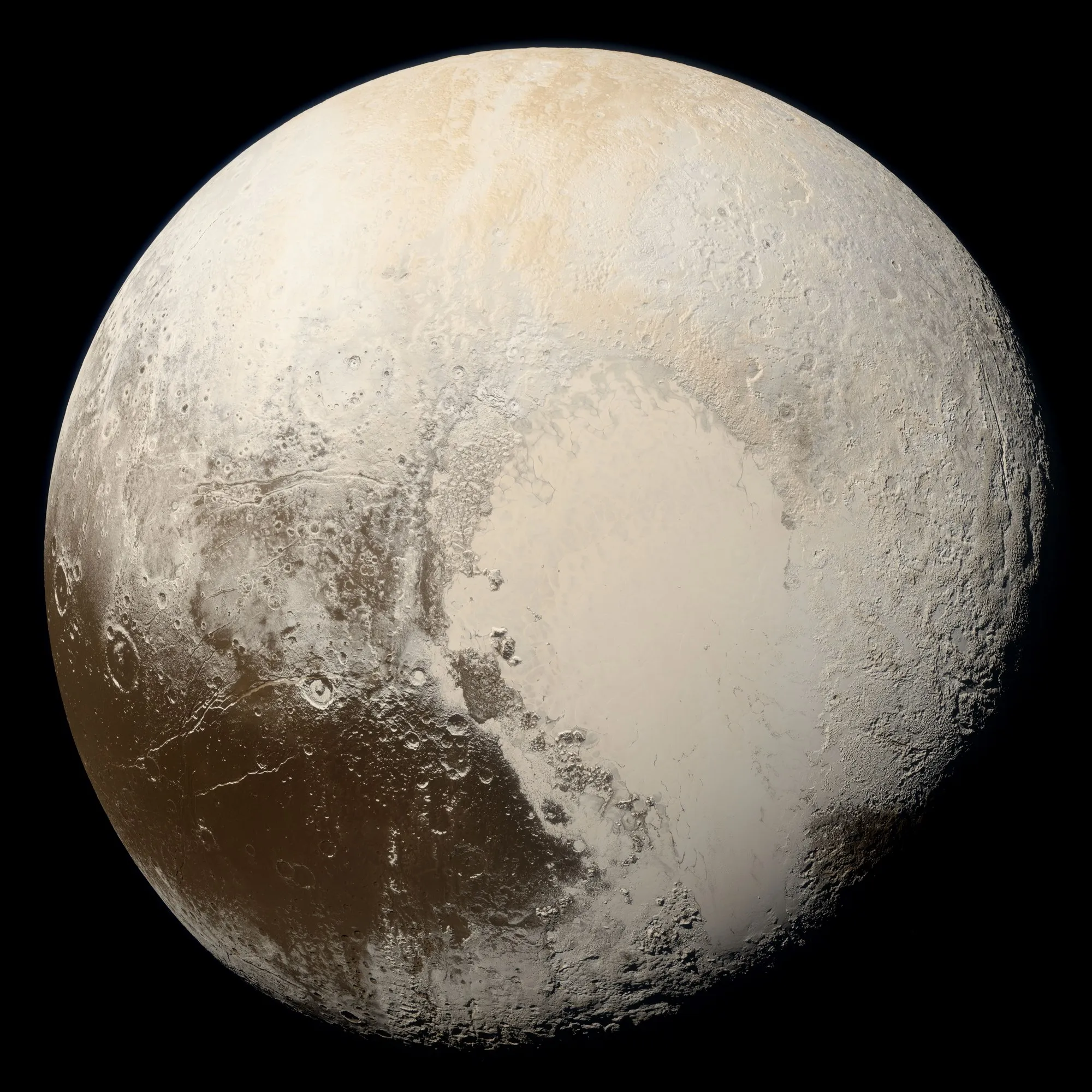
Pluto
Pluto is a dwarf planet 5.9 billion km from the Sun, smaller than our Moon, with a 248-year orbit, a heart-shaped ice plain and five moons.
NASA/Johns Hopkins University Applied Physics Laboratory/Southwest Research Institute/Alex Parker
The planet that became a dwarf planet, and turned out to have mountains of ice and a heart-shaped plain.
Pluto is a dwarf planet in the Kuiper belt, the ring of icy bodies beyond Neptune. It was counted as the ninth planet from its discovery in 1930 until 2006. When NASA’s New Horizons flew past in 2015, it revealed a world far more active than expected, with glaciers of nitrogen ice, mountains of water ice and a hazy blue sky.
How big is Pluto?
Pluto is about 2,377 km across, less than one fifth of Earth’s diameter and about two thirds the width of our Moon. If you could lay it across the United States, it would cover only about half the distance from coast to coast.
Its mass is about 1.30 × 10²² kg, roughly 0.2% of Earth’s mass and 18% of the Moon’s. With a density of 1.85 g/cm³, Pluto is thought to be about two thirds rock and one third ice. Surface gravity is about 0.62 m/s², around 6% of Earth’s, so a person weighing 70 kg on Earth would feel as if they weighed about 4.5 kg. Pluto is slightly larger than Eris, though Eris is more massive.
How far is Pluto from the Sun?
Pluto orbits the Sun at an average of about 39.5 AU, or 5.9 billion km. Sunlight takes about 5.5 hours to reach it. Its orbit is stretched and tilted 17° to the plane of the planets. At its closest it comes to about 29.7 AU (4.4 billion km), nearer than Neptune, and at its farthest it drifts out to about 49.3 AU (7.4 billion km).
From 1979 to 1999 Pluto was closer to the Sun than Neptune. The two never collide, because Pluto completes two orbits for every three of Neptune’s, a resonance that keeps them far apart. Try our scale walk to get a feel for these distances.
How long is a day and a year on Pluto?
One Pluto year lasts about 248 Earth years. Pluto has not completed a single orbit since its discovery in 1930, and will not do so until 2178. One Pluto day, a full rotation, takes about 6.4 Earth days (153.3 hours).
Pluto’s axis is tilted about 120°, so it spins on its side and in the opposite direction to most planets. Over its long year, large regions face constant sunlight or constant darkness for decades at a time. Our lesson on seasons explains how tilt shapes this.
What is Pluto’s surface like?
The most famous feature is Tombaugh Regio, a bright heart-shaped region. Its western lobe is Sputnik Planitia, a basin about 1,000 km across filled with nitrogen ice. The ice slowly churns in convection cells several kilometres wide, renewing the surface, and no craters have been found on it. That makes it one of the youngest surfaces in the solar system, probably less than 10 million years old.
Around it rise mountains of water ice, which is as hard as rock at Pluto’s temperatures. Some peaks reach 3 to 6 km. Nitrogen glaciers flow into the basin, and features such as Wright Mons may be ice volcanoes, though that is still debated. Some scientists think a liquid water ocean lies deep beneath the ice; this is possible but not confirmed.
The surface is very cold, around −230 °C on average (NASA’s planetary fact sheet lists a mean of −225 °C), and it varies with season and terrain.
Does Pluto have an atmosphere?
Yes, a thin one. It is mostly nitrogen with traces of methane and carbon monoxide, and its surface pressure is about 1 pascal, roughly 1/100,000 of Earth’s. New Horizons saw around 20 layers of blue haze, made of particles formed as sunlight breaks down methane. As Pluto moves away from the Sun, scientists expect much of this atmosphere to freeze back onto the surface over the coming decades.
Pluto’s moons
Pluto has five known moons. Charon, found by James Christy in 1978, is about 1,212 km across, more than half Pluto’s width. Pluto and Charon orbit a point in space between them, every 6.4 days, and each always shows the same face to the other. Some astronomers call them a double dwarf planet. The four small moons, Nix and Hydra (found in 2005), Kerberos (2011) and Styx (2012), were all discovered with the Hubble Space Telescope.
Discovery, demotion and New Horizons
Clyde Tombaugh found Pluto at Lowell Observatory in Arizona on 18 February 1930 by comparing photographs taken days apart. Eleven-year-old Venetia Burney of Oxford suggested the name. As more Kuiper belt objects were found, including Eris in 2005, the International Astronomical Union defined “planet” on 24 August 2006. Pluto had not cleared its orbital zone of other bodies, so it became a dwarf planet, alongside Ceres and later Makemake and Haumea.
New Horizons launched on 19 January 2006 and flew past Pluto on 14 July 2015 at about 12,500 km. It then visited the Kuiper belt object Arrokoth on 1 January 2019.
Can you see Pluto from Earth?
Not without a sizeable telescope. Pluto shines at about magnitude 14.5, around 2,500 times fainter than the faintest stars you can see with your eyes. You need at least a 250 mm telescope, a dark sky and a detailed chart. In the 2020s it lies near the border of Sagittarius and Capricornus. Compare photos taken a few nights apart, as Tombaugh did, to see which faint dot has moved. Check its position in the orrery.
Data sources
Tools and lessons use simplified models for learning only. They must not be used for navigation, mission planning or any operational decision. Certificates are free and non-accredited. Read the educational content disclaimer