
Neptune
Neptune is the farthest planet, 4.5 billion km from the Sun, with 2,000 km/h winds and a 165-year orbit. Its size, moons and discovery.
NASA/JPL
A planet found with a pencil before it was seen through a telescope, and home to the fastest winds known on any planet.
Neptune is the eighth and farthest planet from the Sun, an ice giant similar in size to Uranus but slightly denser and more massive. It is too faint to see with the naked eye, and only one spacecraft has ever visited it. Its winds are the fastest measured in the solar system.
How big is Neptune compared with Earth?
Neptune is 49,528 km across at the equator, almost four times the width of Earth, and about 58 Earths would fit inside it. It is the fourth largest planet by diameter, just smaller than Uranus, yet it holds about 17 Earth masses against Uranus’s 14.5.
That makes Neptune the densest of the giant planets, at about 1.64 g/cm³. Like Uranus, it probably has a small rocky core wrapped in a deep layer of hot, dense water, methane and ammonia, under an atmosphere of hydrogen and helium.
How far is Neptune from the Sun?
Neptune orbits at an average of about 4.5 billion km, 30 times Earth’s distance (30 AU). Its orbit is nearly circular, ranging from about 4.47 to 4.56 billion km. Sunlight takes about 4 hours 10 minutes to get there, and is about 900 times weaker than on Earth.
How long is a year and a day on Neptune?
One orbit takes about 164.8 Earth years. Neptune completed its first full orbit since its discovery in July 2011. A day is much shorter, about 16 hours 7 minutes, and the axis is tilted 28.3°, close to Earth’s 23.4°, so Neptune has seasons that each last about 40 years. Kepler’s laws explain why such a distant planet moves so slowly, at about 5.4 km/s.
Pluto crosses inside Neptune’s orbit for part of its path but can never collide with it, because the two are locked in a 3:2 resonance: Pluto goes round twice for every three Neptune orbits. See Pluto.
What is the weather like on Neptune?
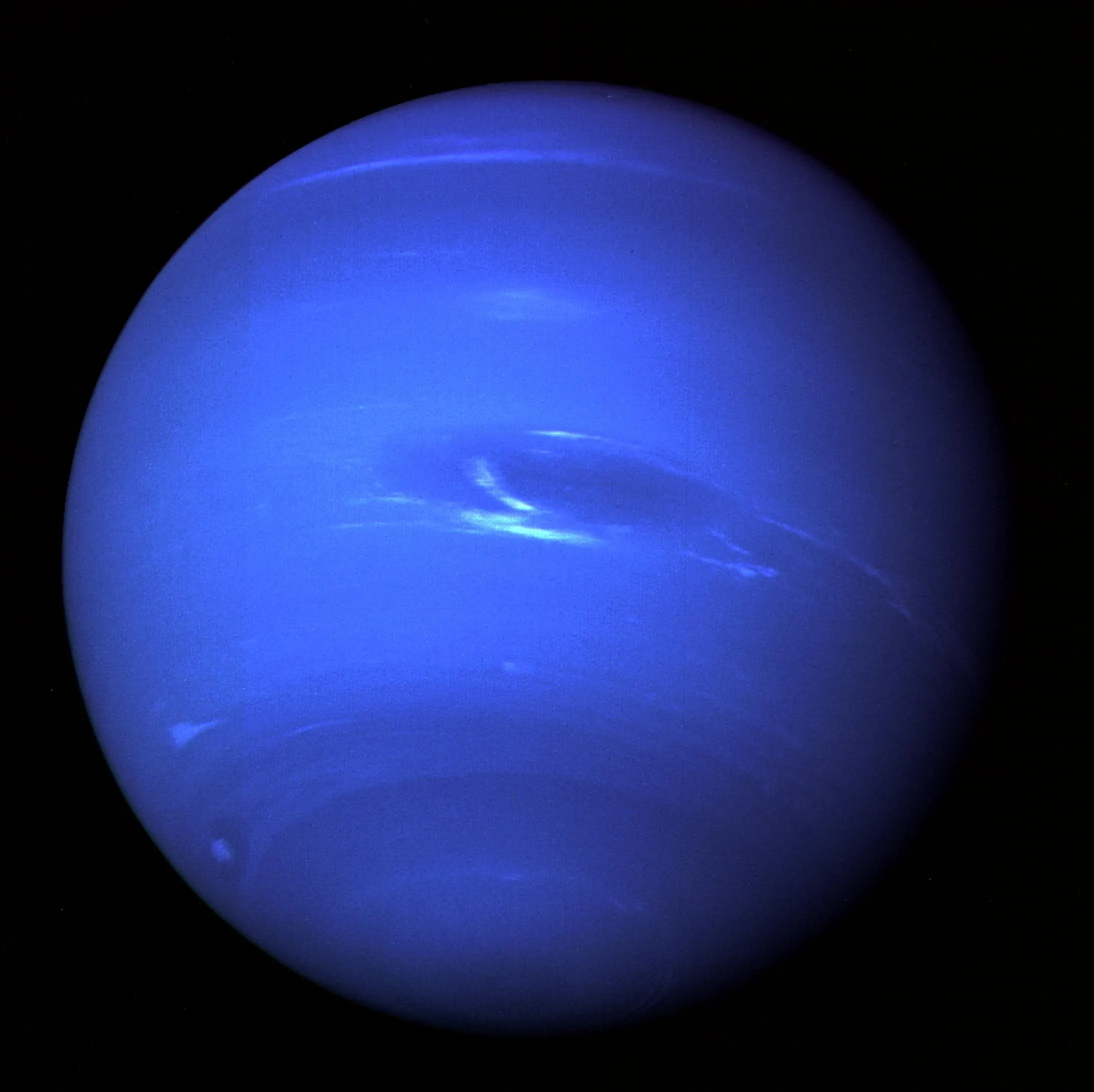
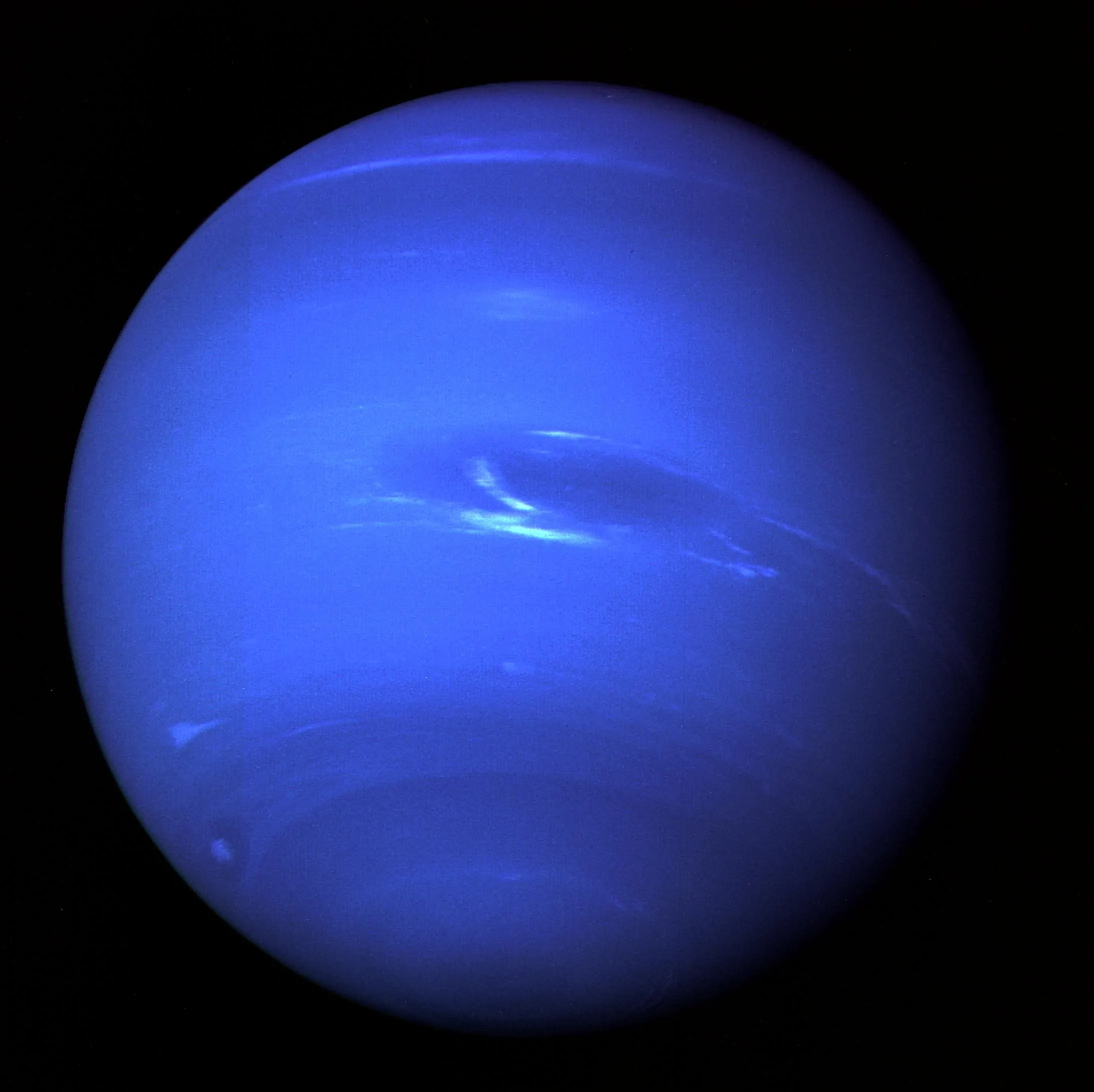
Neptune’s upper atmosphere is about 80% hydrogen, 19% helium and 1.5% methane. Methane absorbs red light, giving the planet its blue colour. Reprocessed Voyager images published in 2024 suggest Neptune is a paler greenish blue than the deep blue in older pictures, close to Uranus’s shade.
Temperatures at the 1-bar level are about -200 °C, yet the weather is violent. Winds reach about 2,000 km/h, faster than the speed of sound on Earth. Voyager 2 saw a storm the size of Earth, the Great Dark Spot, in 1989; when Hubble looked in 1994 it had gone, and new dark spots have come and gone since. Neptune radiates more than twice as much energy as it receives from the Sun, and this internal heat helps drive the storms.
How many moons and rings does Neptune have?
Neptune has 16 known moons; the most recent two were announced in 2024. Triton is by far the largest, about 2,707 km across, and orbits backwards, against Neptune’s spin. That suggests it is a captured object from the Kuiper belt. Voyager 2 saw plumes of nitrogen gas and dark dust rising about 8 km above its frozen surface.
The planet also has five main rings, named after astronomers linked to its discovery. They are dark and dusty. The outermost, the Adams ring, contains bright clumps called arcs, which should spread out over time but are held together, probably by the gravity of the small moon Galatea.
How was Neptune discovered?
Astronomers noticed that Uranus was drifting from its predicted path. In 1846 Urbain Le Verrier in France calculated where an unseen planet must be to pull it off course. On 23 September 1846, Johann Galle and Heinrich d’Arrest at the Berlin Observatory found Neptune within about 1° of the predicted spot. In England, John Couch Adams had made similar calculations, and the credit was argued over for years.
Galileo had in fact sketched Neptune in 1612 and 1613 while watching Jupiter, but took it for a star. Lassell discovered Triton just 17 days after Neptune itself.
Which missions have visited Neptune?
Only Voyager 2, which passed about 4,950 km above the north pole on 25 August 1989, the closest it came to any planet. It used gravity assists at Jupiter, Saturn and Uranus to get there in 12 years. It found six moons, confirmed the rings and photographed Triton’s geysers. Since then, Hubble and the James Webb Space Telescope have followed its storms and rings.
Can you see Neptune from Earth?
Not with the naked eye. At around magnitude 7.8, Neptune is about five times too faint, but binoculars or a small telescope show it as a bluish star. You need a finder chart, because it looks almost like the stars around it. A larger telescope shows a tiny blue disc about 2 arcseconds wide.
In the mid-2020s Neptune lies in Pisces, close to Saturn in the sky, and it is best seen around its opposition each September. The orrery shows its current position.
Moons in the knowledge base
Data sources
Tools and lessons use simplified models for learning only. They must not be used for navigation, mission planning or any operational decision. Certificates are free and non-accredited. Read the educational content disclaimer