
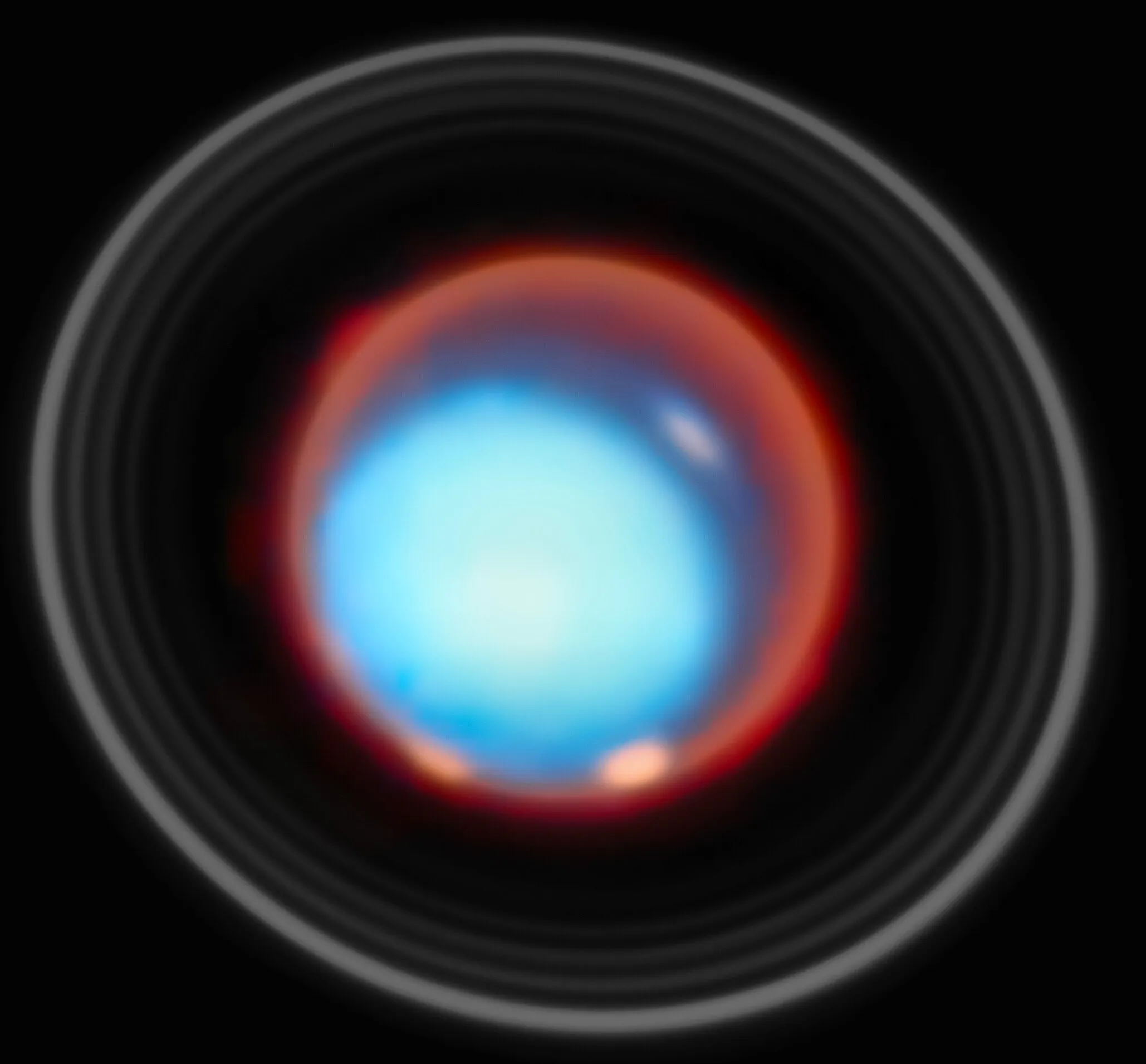
Uranus
Uranus spins on its side, tilted 98 degrees, and takes 84 years to orbit the Sun. Its size, rings, moons, cold air and how to spot it.
ESA/Webb, NASA, CSA, STScI, P. Tiranti, H. Melin, M. Zamani (ESA/Webb) (CC BY 4.0)
A planet knocked on its side, where each pole gets decades of daylight and then decades of night.
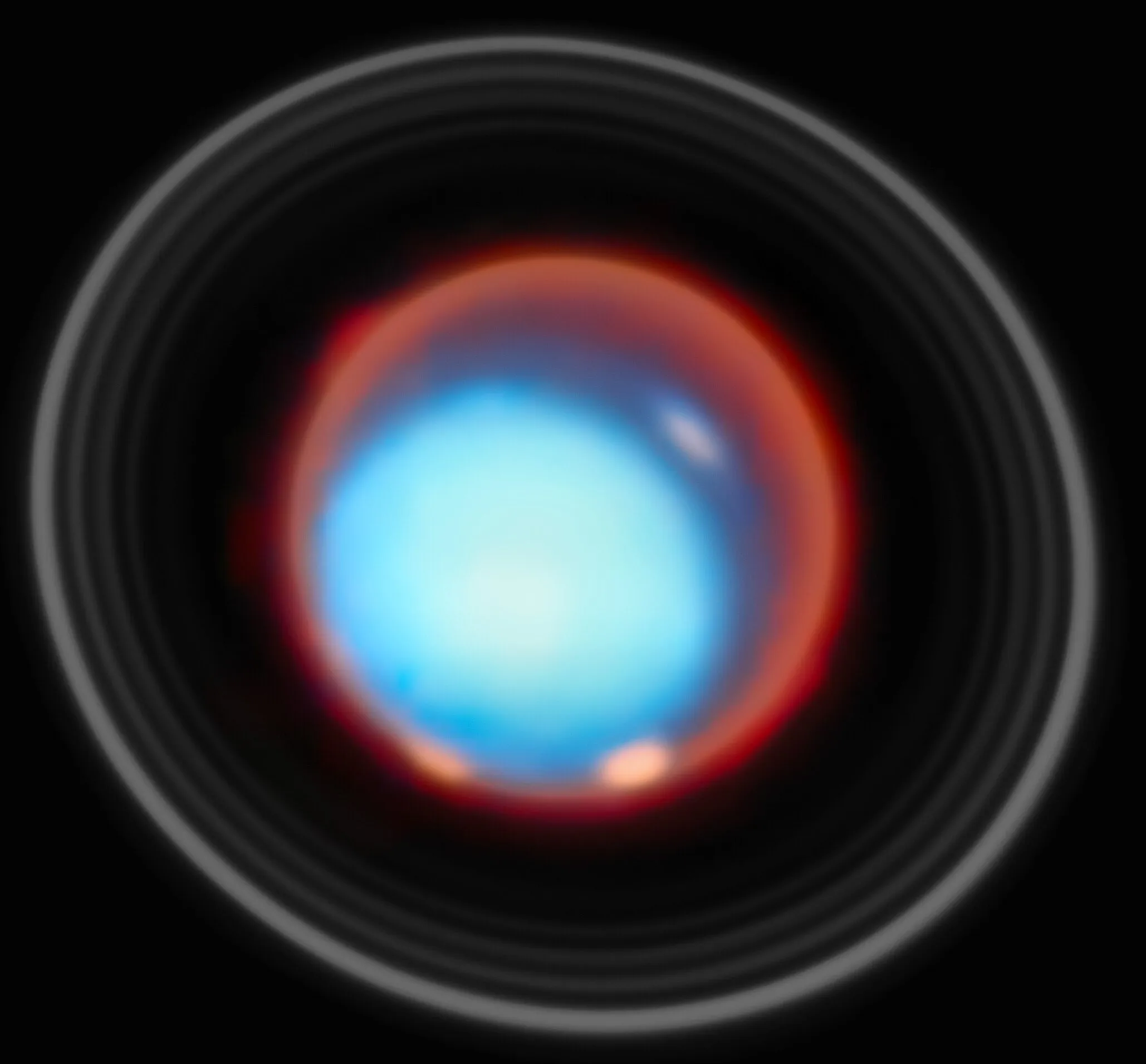
Uranus is the seventh planet from the Sun and the first found with a telescope. It is an ice giant, with a thick layer of water, methane and ammonia beneath its hydrogen and helium atmosphere. Methane in the air absorbs red light, which gives the planet its pale blue-green colour.
How big is Uranus compared with Earth?
Uranus is 51,118 km wide at the equator, about four times the width of Earth, and about 63 Earths would fit inside it. It is the third largest planet by diameter, slightly bigger than Neptune, but it is the lighter of the two, at about 14.5 Earth masses.
Its average density is about 1.27 g/cm³, a little more than water. That is too dense for a ball of pure hydrogen and helium like Saturn, which is why scientists think most of its mass is in icy material and rock.
Why is Uranus tilted on its side?
Uranus’s axis is tilted 97.8°, so it rolls around the Sun on its side. Over one orbit each pole points almost straight at the Sun for part of the year, then away from it. The result is about 42 years of continuous daylight followed by 42 years of darkness at each pole. See seasons for how tilt shapes the year on Earth.
Nobody knows for certain what caused the tilt. The most common idea is that one or more large collisions with Earth-sized bodies knocked the young planet over. Other models suggest a slower tipping caused by the gravity of a former moon. Because Uranus also spins in the opposite sense to most planets, its rotation counts as retrograde.
How long is a day and a year on Uranus?
A day on Uranus lasts about 17 hours 14 minutes, a figure refined in 2025 from Hubble observations of its aurorae. A year lasts 84 Earth years. Since William Herschel discovered it in 1781, Uranus has completed fewer than three orbits.
It orbits at an average of about 2.87 billion km from the Sun, or 19.2 AU, moving at about 6.8 km/s. Sunlight takes about 2 hours 40 minutes to arrive. Its distance ranges from about 2.73 to 3.00 billion km.
What is the atmosphere of Uranus like?
The upper atmosphere is about 83% hydrogen, 15% helium and 2% methane. Temperatures at the 1-bar level average about -195 °C, and Voyager 2 measured a minimum of about -224 °C near the tropopause, the coldest atmosphere recorded on any planet. Uranus gives off very little heat from inside, unlike the other giants, and the reason is still unclear.
Beneath the clouds lies a hot, dense fluid of water, methane and ammonia, often called the icy mantle even though it is not solid. A rocky core sits at the centre. The magnetic field is tilted about 59° from the spin axis and offset from the planet’s centre, so it wobbles strongly as Uranus turns.
Rings and moons
Uranus has 13 known rings, dark and narrow, first detected in 1977 when they dimmed a star passing behind the planet. NASA lists 28 known moons, named after characters from Shakespeare and Alexander Pope, and a 29th was reported from Webb images in 2025. The five largest are Miranda, Ariel, Umbriel, Titania and Oberon. Titania, the biggest, is about 1,578 km across.
Which missions have visited Uranus?
Only one. Voyager 2 flew past on 24 January 1986, coming within about 81,500 km of the cloud tops. In a few hours it found 10 new moons and two new rings and measured the magnetic field. Its route through the outer planets relied on gravity assists.
Since then, Hubble, the Keck telescopes and the James Webb Space Telescope have tracked its storms, rings and seasons from Earth orbit and the ground. In 2022 the US planetary science decadal survey named a Uranus orbiter and atmospheric probe as its top priority for a new flagship mission, but it is not yet funded or scheduled.
Can you see Uranus from Earth?
Just about. At around magnitude 5.7, Uranus sits at the limit of what your eyes can see under a dark, moonless sky away from city lights, if you know exactly where to look. Binoculars show it easily as a faint star, and a telescope reveals a small blue-green disc.
In the mid-2020s Uranus lies in Taurus, not far from the Pleiades, and it is best seen around opposition each autumn. The orrery shows its current position. Herschel at first took it for a comet; earlier astronomers, including John Flamsteed in 1690, had recorded it as a star without noticing it moved.
Data sources
Tools and lessons use simplified models for learning only. They must not be used for navigation, mission planning or any operational decision. Certificates are free and non-accredited. Read the educational content disclaimer