
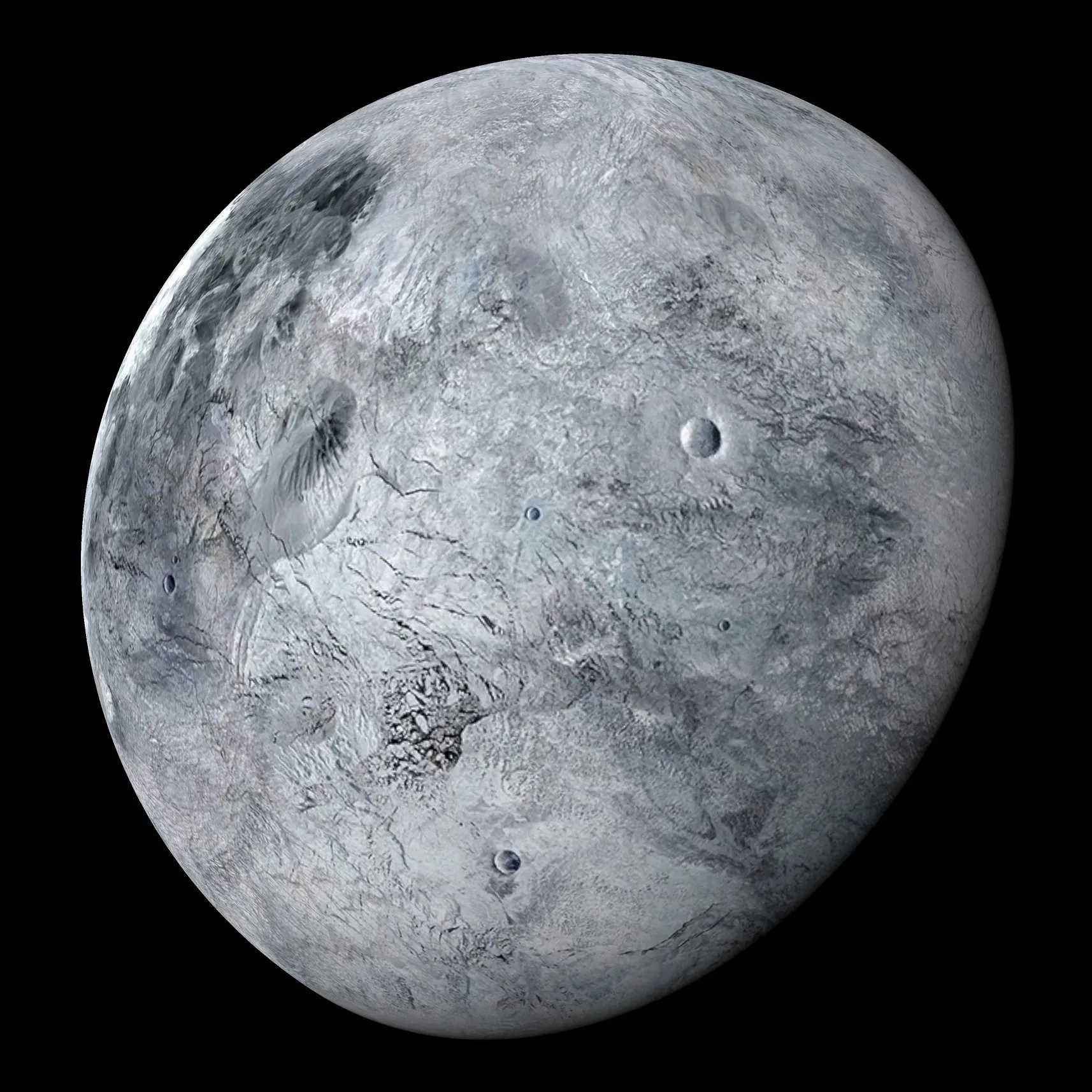
Eris
Eris is a dwarf planet slightly smaller than Pluto but 27% more massive, orbiting up to 98 au out. Its discovery led to the 2006 definition of planet.
Local Solar System Foundation · Solar System Scope (CC BY 4.0)
The world that made astronomers decide what a planet is, and the reason Pluto was reclassified.
Eris is a dwarf planet in the far outer solar system, almost the same size as Pluto but noticeably heavier. It was discovered in 2005, and the argument over whether it was the “tenth planet” ended with a new definition of the word planet in 2006. Today it sits about 96 au from the Sun, close to the farthest point of its long, tilted orbit.
How big is Eris?
A stellar occultation in November 2010, when Eris passed in front of a faint star, gave a diameter of about 2,326 km, with an uncertainty of around 12 km. Older estimates ran up to about 2,400 km, which is the figure JPL and NASA still list. Either way, Eris is very slightly smaller than Pluto (2,377 km across) and smaller than Earth’s Moon (3,475 km).
Mass is a different story. JPL gives Eris a mass of about 1.66 × 10²² kg, roughly 27% more than Pluto and about 0.28% of Earth’s mass. That makes Eris the most massive known dwarf planet. Because it is about the same size but heavier, its average density (about 2.3 to 2.5 g/cm³) is higher than Pluto’s, which suggests a larger share of rock under its ice.
How far away is Eris, and how long is its year?
Eris orbits the Sun at an average distance of about 68 au (10.2 billion km). Its orbit is strongly eccentric (e ≈ 0.44), so its distance swings from about 38 au at perihelion to about 98 au at aphelion. Sunlight takes more than nine hours to reach it on average, and over 13 hours at its farthest.
One trip around the Sun takes about 557 Earth years. Eris passed aphelion in the late 1970s and is now creeping inward; it will not reach perihelion until around the 2250s. Its orbit is tilted about 44 degrees to the plane of the planets. Eris belongs to the scattered disc, a population of icy bodies thrown onto wide, tilted orbits by past encounters with Neptune. You can explore how such orbits work in orbital elements and Kepler’s laws.
How long is a day on Eris?
This figure is debated. Older brightness measurements suggested a rotation of about 25.9 hours, the value NASA and JPL list. Later studies of its light curve, published in 2023, found that Eris most likely rotates once every 15.8 days, the same as the orbital period of its moon, which would mean the two are tidally locked to each other. Treat the shorter figure with caution.
What is Eris made of, and what is its surface like?
Eris is one of the most reflective objects in the solar system. The 2010 occultation measured an albedo (reflectivity) of about 0.96, higher than fresh snow, while JPL lists a more conservative 0.84. Spectra show a surface covered in methane ice, probably mixed with nitrogen ice.
The likely explanation for the brightness is a thin atmosphere that freezes out. When Eris is closer to the Sun, some of its surface ice may turn to gas; as it moves outward, that gas freezes and falls back as fresh frost, repainting the surface white. At its current distance any atmosphere would be frozen onto the ground.
Surface temperatures are estimated at about -243 °C to -217 °C (roughly 30 to 56 K). Inside, Eris is thought to be a mixture of rock and ice, probably with a rocky core, but no spacecraft has measured it directly.
Does Eris have a moon?
Eris has one known moon, Dysnomia, discovered in September 2005 with the Keck Observatory in Hawaii. Dysnomia circles Eris every 15.8 days at a distance of about 37,000 km, in a nearly circular orbit. Its size is uncertain, with estimates of about 600 to 700 km across.
Dysnomia matters because it made it possible to weigh Eris. Tracking how fast a moon orbits gives the mass of the body it orbits, using Newton’s law of gravity. That measurement is how astronomers learned Eris outweighs Pluto.
How was Eris discovered, and why did it change the definition of a planet?
Mike Brown, Chad Trujillo and David Rabinowitz found Eris on 5 January 2005, in images taken on 21 October 2003 at Palomar Observatory in California. The team nicknamed it “Xena”. News reports called it the tenth planet.
That forced a question astronomers had avoided: if Eris was not a planet, why was Pluto? In August 2006 the International Astronomical Union adopted a formal definition. A planet must orbit the Sun, be massive enough to pull itself into a round shape, and have cleared its orbital neighbourhood of other objects. Pluto and Eris fail the third test, so both became dwarf planets, along with Ceres.
In September 2006 the IAU named the object Eris, after the Greek goddess of discord, a fitting choice given the argument it caused. Its moon was named Dysnomia, the daughter of Eris and the spirit of lawlessness.
Can you see Eris from Earth?
Not with the naked eye or binoculars. Eris shines at about magnitude 18.7, thousands of times too faint for your eyes and beyond most backyard telescopes. Experienced amateurs with large telescopes and cameras can record it as a slow-moving dot over several nights. It currently lies in the constellation Cetus.
No spacecraft has visited Eris, and none is planned. To get a feel for how far out it is, try the scale walk or watch it crawl around its orbit in the orrery.
Data sources
Tools and lessons use simplified models for learning only. They must not be used for navigation, mission planning or any operational decision. Certificates are free and non-accredited. Read the educational content disclaimer