
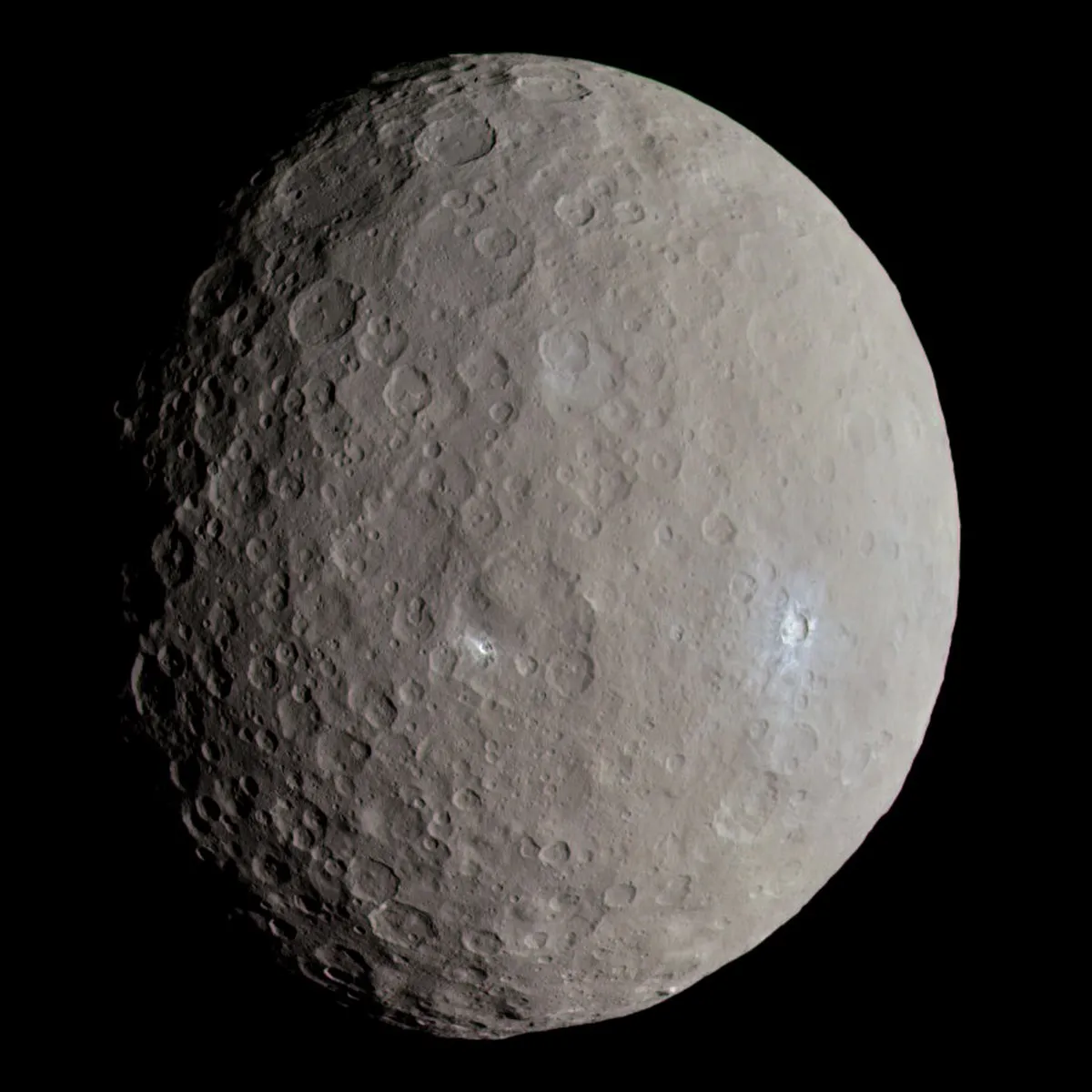
Ceres
Ceres is the largest object in the asteroid belt: a 940 km dwarf planet with salty bright spots, an ice volcano and a 4.6-year orbit.
NASA/JPL-Caltech/UCLA/MPS/DLR/IDA, processed by Justin Cowart
First a planet, then an asteroid, now a dwarf planet: Ceres has changed category more often than any other world.
Ceres is the largest object in the asteroid belt between Mars and Jupiter, and the only dwarf planet in the inner solar system. It holds roughly a quarter of the belt’s total mass. NASA’s Dawn spacecraft orbited it from 2015 to 2018 and found a world of ice, salt and clay, with signs of brine beneath the surface.
How big is Ceres?
Ceres is about 940 km across on average, a little wider at the equator (about 964 km) than pole to pole. That is roughly a quarter of the Moon’s diameter and about 7% of Earth’s. It is big enough for its own gravity to have pulled it into a nearly round shape, which is one of the tests for a dwarf planet.
Its mass is about 9.38 × 10²⁰ kg, around 1.3% of our Moon’s mass. Its density of 2.16 g/cm³ shows it is a mix of rock and water-rich material. Surface gravity is about 0.28 m/s², under 3% of Earth’s, and the escape speed is about 0.5 km/s.
Where is Ceres and how long is its year?
Ceres orbits the Sun at an average distance of about 2.77 AU, or 414 million km, between 2.55 and 2.98 AU over its slightly oval orbit. Its path is tilted about 10.6° to Earth’s. One Ceres year lasts 4.6 Earth years.
It spins once every 9 hours 4 minutes, so a day on Ceres is shorter than half an Earth day. Its axis is tilted only about 4°, so seasons are very weak, and some craters near the poles stay permanently in shadow, cold enough to trap water ice. Our Kepler’s laws lesson explains how orbital distance sets the length of a year.
What is Ceres made of?
Dawn’s measurements suggest a layered interior. There is probably a dense rocky interior, a mantle rich in hydrated rock and possibly residual brine, and a crust about 40 km thick of ice, salts, rock and clay. The surface is dark, reflecting about 9% of sunlight.
The clays contain ammonia, which is more common in the cold outer solar system. Some scientists think Ceres formed farther from the Sun and moved inwards, or gathered material that did. This is a hypothesis, not a settled result. Surface temperatures are estimated at around −105 °C on average, varying with latitude and time of day.
The bright spots and the ice volcano
As Dawn approached in 2015, it saw bright spots inside Occator crater, which is 92 km wide. The brightest, Cerealia Facula, is made mostly of sodium carbonate, a salt left behind when salty water reached the surface and evaporated. Dawn’s later close-up data, published in 2020, pointed to a deep reservoir of brine, about 40 km down, that may still be partly liquid. These deposits are thought to be only a few million years old.
Ahuna Mons is a mountain about 4 km tall and 17 km wide that stands alone on a smooth plain. It is thought to be a cryovolcano, built by an eruption of salty mud and ice rather than molten rock. Dawn also found organic material near Ernutet crater. In 2014, the Herschel space telescope detected water vapour coming from Ceres.
Discovery: planet, asteroid, dwarf planet
Italian astronomer Giuseppe Piazzi discovered Ceres from Palermo on 1 January 1801. He lost it in the Sun’s glare, but Carl Friedrich Gauss calculated its orbit and astronomers found it again at the end of that year. Piazzi named it after Ceres, the Roman goddess of agriculture, which is also where the word “cereal” comes from.
For about 50 years Ceres was listed as a planet. As more objects turned up in the same zone, it was reclassified as an asteroid. In 2006 the IAU made it a dwarf planet, alongside Pluto and Eris.
The Dawn mission
NASA’s Dawn launched on 27 September 2007 and used ion engines to reach the asteroid Vesta, which it orbited from 2011 to 2012. It then travelled on and entered orbit around Ceres on 6 March 2015. That made Dawn the first spacecraft to orbit two different bodies beyond Earth and the Moon, and the first to orbit a dwarf planet. The mission ended on 1 November 2018, when it ran out of fuel to point its antenna, and it remains a silent satellite of Ceres.
Can you see Ceres from Earth?
Yes, with binoculars. At its best, near opposition, Ceres reaches about magnitude 6.7, at the edge of naked-eye visibility from a very dark site. Most of the time it is between magnitude 7 and 9, an easy target for binoculars or a small telescope if you know where to look. Watch it over a few nights and you will see it move against the stars. The orrery shows where it is now, and our night sky guide helps with finding faint objects.
Data sources
Tools and lessons use simplified models for learning only. They must not be used for navigation, mission planning or any operational decision. Certificates are free and non-accredited. Read the educational content disclaimer