
Mars
Mars is half Earth's width with a 687-day year, a thin carbon dioxide sky and the tallest volcano known. Its moons, rovers and when to see it.
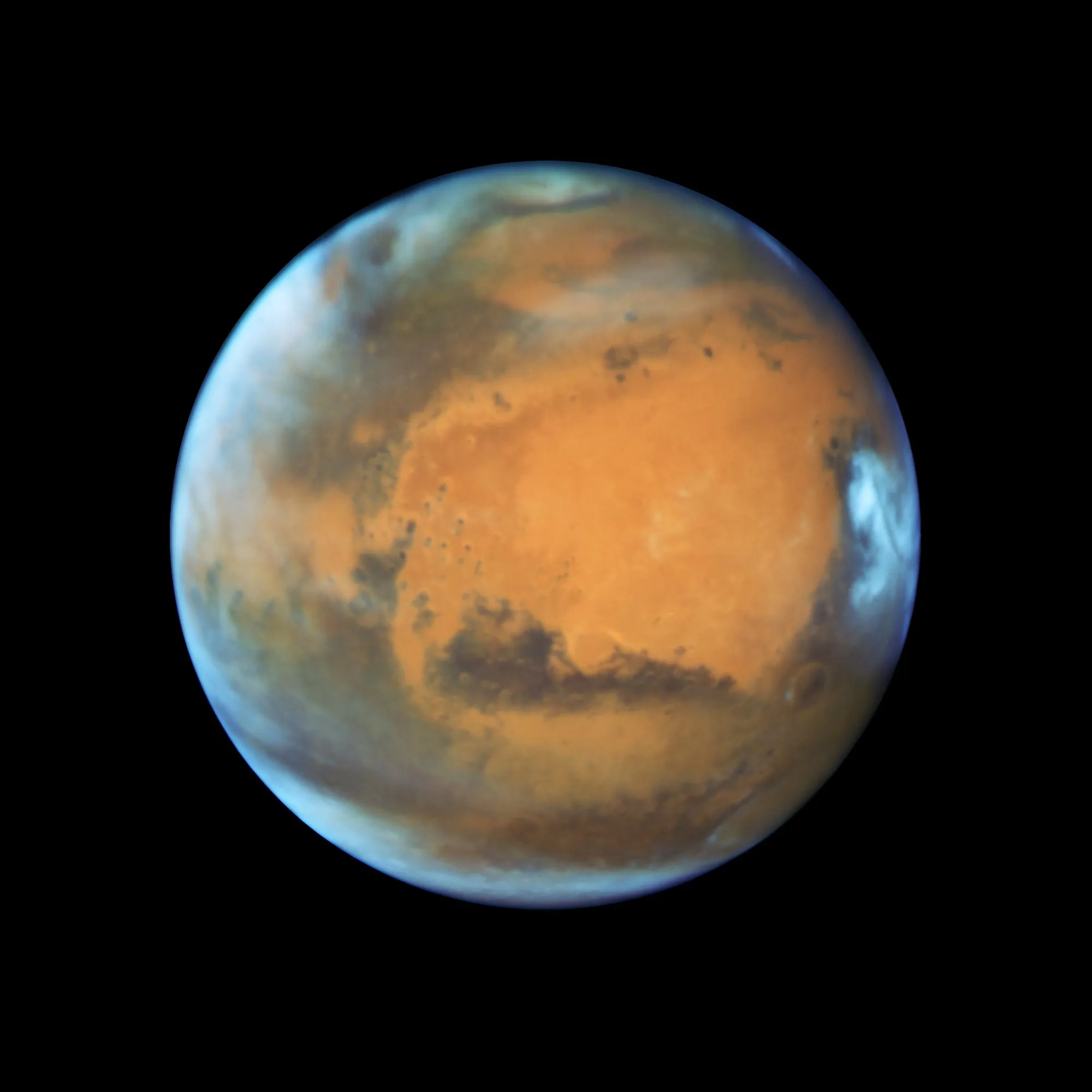
NASA, ESA, the Hubble Heritage Team (STScI/AURA), J. Bell (ASU), and M. Wolff (Space Science Institute)
A cold red desert with the largest volcano and one of the longest canyons in the solar system.
Mars is the fourth planet from the Sun and the outermost of the rocky planets. Iron oxide (rust) in its dust gives it its red colour. Today it is a cold, dry desert, but its surface shows clear signs that water once flowed there.
How big is Mars?
Mars has a diameter of about 6,779 km, roughly 53% of Earth’s. Its mass is about 6.42 × 10²³ kg, only around 11% of Earth’s, and its density is 3.93 g/cm³.
Surface gravity is 3.71 m/s², 38% of Earth’s. Someone who weighs 60 kg on Earth would feel like about 23 kg on Mars. Although it has about half Earth’s width, its land area is close to that of all Earth’s continents together, because Mars has no oceans.
How far is Mars from the Sun and from Earth?
Mars orbits at an average distance of about 227.9 million km (1.52 AU). Its orbit is fairly oval, ranging from about 206.7 million km to 249.3 million km from the Sun. It moves at an average of 24.1 km/s.
Its distance from Earth varies hugely, from about 55 million km at the closest oppositions to around 400 million km when it is on the far side of the Sun. Missions therefore launch in windows that open about every 26 months, when a Hohmann transfer takes the least fuel. See Launch windows.
How long is a day and a year on Mars?
A Mars day, called a sol, lasts 24 hours 39 minutes 35 seconds, only a little longer than an Earth day. A Mars year lasts 687 Earth days, or about 669 sols.
Mars is tilted 25.2°, close to Earth’s 23.4°, so it has seasons. Because the year is so long, each season lasts roughly twice as long as on Earth, and the oval orbit makes southern summers shorter and hotter than northern ones.
What is the atmosphere and weather on Mars like?
The atmosphere is about 95% carbon dioxide, with around 2.8% nitrogen and 2% argon. It is very thin: surface pressure averages about 6 millibars, less than 1% of Earth’s. Liquid water cannot last long on the surface today, because it would quickly boil away or freeze.
The average temperature is about -65 °C. On a summer afternoon near the equator the ground can reach about 20 °C, while winter nights at the poles fall to around -150 °C. Dust storms are common, and every few years one grows to cover the whole planet. A global storm in 2018 ended the Opportunity rover’s mission by blocking sunlight to its solar panels.
What is the surface of Mars like?
Mars has the tallest known volcano in the solar system, Olympus Mons. It rises about 22 km above the surrounding plains and its base is about 600 km wide. Nearby, the Tharsis region holds three more giant volcanoes.
Valles Marineris, a canyon system about 4,000 km long and up to 7 km deep, would stretch across the United States. The northern hemisphere is mostly smooth lowland, while the south is older and heavily cratered.
Water on Mars
Dry river channels, deltas and lake beds show that liquid water flowed on Mars billions of years ago. Today water survives as ice: in the polar caps, which also gain a seasonal layer of frozen carbon dioxide, and beneath the surface at mid to high latitudes. Whether Mars ever hosted life is one of the biggest open questions in planetary science.
What are the moons of Mars?
Mars has two small, lumpy moons, Phobos and Deimos, found by Asaph Hall in 1877. Phobos is about 22 km across and circles Mars three times a day. It is slowly spiralling inwards and is expected to break up or crash into Mars in roughly 50 million years. Deimos is about 12 km across and orbits farther out. Their origin, either captured asteroids or debris from an impact, is still debated.
Which missions have explored Mars?
- Mariner 4 (NASA, 1965): the first successful flyby and first close-up pictures.
- Mariner 9 (NASA, 1971): the first spacecraft to orbit another planet.
- Viking 1 and 2 (NASA, 1976): the first successful long-lived landers.
- Mars Pathfinder (NASA, 1997): delivered Sojourner, the first rover on Mars.
- Spirit and Opportunity (NASA, 2004): twin rovers. Opportunity drove over 45 km and worked until 2018.
- Curiosity (NASA, 2012): exploring Gale Crater and climbing Mount Sharp.
- Perseverance (NASA, 2021): collecting rock samples in Jezero Crater. It carried Ingenuity, the first aircraft to fly on another planet, which made 72 flights.
- Tianwen-1 and Zhurong (China, 2021): an orbiter and China’s first Mars rover.
Orbiters including ESA’s Mars Express (2003), NASA’s Mars Reconnaissance Orbiter (2006) and MAVEN (2014), India’s Mangalyaan (2014) and the UAE’s Hope (2021) have also studied the planet.
Can you see Mars from Earth?
Yes. Mars looks like a bright, reddish-orange star that does not twinkle as much as real stars. It is easiest to see around opposition, when Earth passes between Mars and the Sun. Mars then rises at sunset, stays up all night and is at its brightest.
Oppositions happen about every 26 months. The most recent was in January 2025, and the next is in February 2027. Through a small telescope at opposition you may spot a polar cap and dark surface markings. The night sky guide and the orrery show where Mars is now.
Moons in the knowledge base
Data sources
Tools and lessons use simplified models for learning only. They must not be used for navigation, mission planning or any operational decision. Certificates are free and non-accredited. Read the educational content disclaimer