
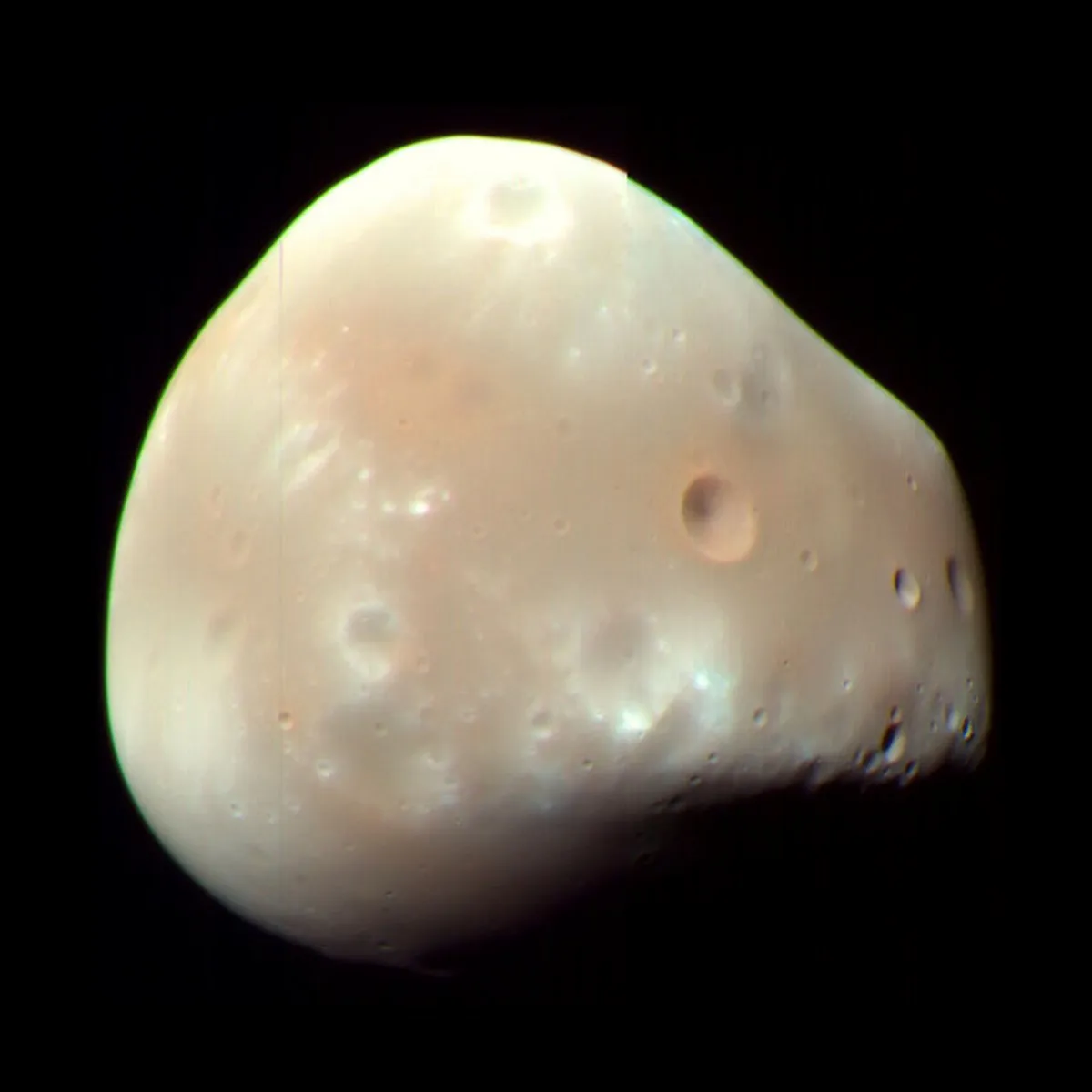
Deimos
Deimos is the smaller, outer moon of Mars: a dusty 12 km world that orbits every 30.3 hours and looks like a bright star from Mars.
NASA/JPL-Caltech/University of Arizona
A tiny, dusty moon, only about 12 km across, whose origin is still a mystery.
Deimos is the smaller and outer of the two moons of Mars. It is a dark, lumpy body about 12 km across, smoother than its sibling Phobos because a thick layer of dust fills most of its craters. Whether it is a captured asteroid or a fragment of Mars is one of the open questions about the planet.
How big is Deimos?
Deimos measures about 15 × 12 × 11 km, with a mean diameter of about 12.4 km. You could walk across it in an afternoon, if you could keep your feet on the ground. Its mass is about 1.4 × 10¹⁵ kg, around one seventh of the mass of Phobos and roughly one fifty-millionth of our Moon’s.
Its density is only about 1.47 g/cm³, which means it is very porous, possibly a loosely bound pile of rubble or rock mixed with ice. Gravity at the surface is about 0.003 m/s², roughly 1/4,000 of Earth’s. The escape speed is only about 5.6 m/s, so you could leave Deimos by riding a bicycle off a ramp.
How does Deimos orbit Mars?
Deimos orbits about 23,460 km from the centre of Mars, or about 20,000 km above the surface. One orbit takes 30.3 hours. It is tidally locked, so the same side always faces Mars, and its orbit is almost perfectly circular and close to the Martian equator.
Deimos orbits a little outside the height where a moon would keep pace with Mars’s rotation. Tides therefore push it very slowly outwards, the opposite of Phobos, which is spiralling in. The change is tiny, and Deimos will stay in orbit for billions of years. Our lesson on orbital elements explains how such an orbit is described.
What does Deimos look like from Mars?
Because its orbit is only a little slower than Mars’s rotation, Deimos creeps across the Martian sky. It rises in the east and takes roughly two and a half days to reach the western horizon. During that time it goes through its phases more than once.
From the surface it looks like a bright star rather than a disc, less than one tenth the width of the full Moon as seen from Earth. Rovers on Mars have photographed it, and Curiosity and Perseverance have recorded it passing in front of the Sun as a tiny dark dot.
What is the surface of Deimos like?
Deimos is very dark, reflecting only about 7% of sunlight, similar to soot-coloured carbon-rich asteroids. Its surface looks smooth in pictures because a layer of fine dust, possibly tens of metres deep in places, buries most small craters. Only the freshest ones stand out.
The two named craters are Swift and Voltaire, about 1 to 2 km wide, named after writers who imagined two moons of Mars before they were discovered. Jonathan Swift’s Gulliver’s Travels (1726) described two Martian moons more than 150 years before anyone saw them. That was a lucky guess, not an observation.
Where did Deimos come from?
Its dark colour and spectrum resemble outer asteroid-belt objects, which supports the idea that Deimos is a captured asteroid. Its circular, equatorial orbit is hard to reach by capture, though, and fits better with the idea that both Martian moons formed from a disc of debris after a giant impact on Mars.
In 2023 the UAE’s Hope orbiter made close flybys, passing about 100 km from Deimos on 10 March. Its measurements suggested the surface resembles Martian material more than a typical asteroid, which supports the impact idea. The question is not settled. For context on Mars and its neighbours, see Ceres and Vesta in the asteroid belt.
Discovery and exploration
American astronomer Asaph Hall discovered Deimos on 12 August 1877 at the US Naval Observatory, using a 66 cm refracting telescope. He found Phobos six days later. The names come from the sons of Ares, the Greek god of war: Deimos means dread or terror.
Mariner 9 took the first close-up images in 1971. Viking Orbiter 2 passed within about 30 km in 1977 and photographed boulders on the surface. Mars Reconnaissance Orbiter imaged it in colour in 2009. JAXA’s MMX spacecraft, launched on 20 October 2026, is designed mainly to sample Phobos but will also observe Deimos.
Can you see Deimos from Earth?
Only with a large telescope and patience. Deimos shines at about magnitude 12.4, faint in itself, and it sits close to Mars, whose glare swamps it. The best chance is near opposition, when Mars is closest to Earth; the next is in February 2027. Find Mars with the orrery.
Data sources
Tools and lessons use simplified models for learning only. They must not be used for navigation, mission planning or any operational decision. Certificates are free and non-accredited. Read the educational content disclaimer