
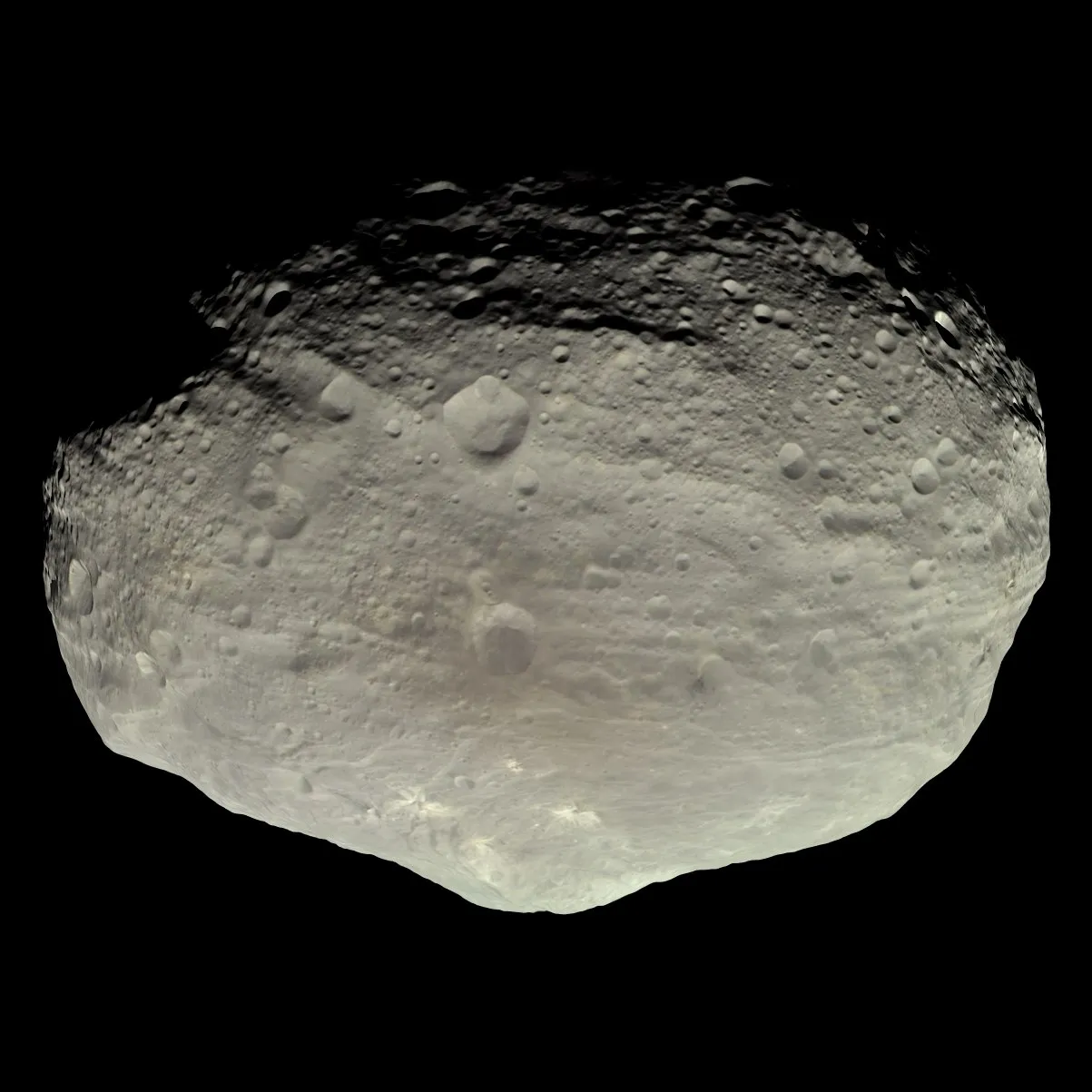
Vesta
Vesta is the second most massive body in the asteroid belt, 525 km across, with a core, mantle and crust. NASA's Dawn orbited it in 2011 and 2012.
NASA/JPL/MPS/DLR/IDA, processed by Björn Jónsson
A failed planet: a world with a core, a mantle and a crust, and the source of meteorites that land on Earth.
Vesta is the second most massive object in the main asteroid belt between Mars and Jupiter, holding almost 9% of the belt’s total mass. Only the dwarf planet Ceres is heavier. Unlike most asteroids, Vesta melted early in its history and separated into layers, so it is best described as a surviving protoplanet: a building block of the rocky planets that never grew into one.
How big is Vesta?
Vesta measures about 569 by 554 by 453 km, with a mean diameter of about 525 km. That is roughly the distance from London to Edinburgh, about one twenty-fourth of Earth’s diameter and around half the width of Ceres. It is almost round, but not quite round enough to count as a dwarf planet, largely because a giant impact knocked a chunk out of its southern hemisphere.
Its mass is about 2.59 × 10²⁰ kg, roughly 0.004% of Earth’s mass and about a quarter of Ceres’s. Its density of about 3.46 g/cm³ is high for an asteroid and close to that of rocky planets, which fits a body with a metal core. Surface gravity is only about 0.25 m/s², around 2.5% of Earth’s, so a 70 kg person would weigh what about 1.8 kg weighs on Earth.
How far from the Sun is Vesta, and how long are its day and year?
Vesta orbits at an average of about 2.36 au (353 million km) from the Sun, in the inner part of the asteroid belt. Its orbit is slightly eccentric (e ≈ 0.09), ranging from about 2.15 to 2.57 au, and tilted about 7 degrees to Earth’s orbit. One orbit takes about 3.63 Earth years.
Vesta spins quickly, once every 5 hours 20 minutes. Its axis is tilted about 27 degrees, so it has seasons, as Earth does (see seasons). Surface temperatures are estimated to range from about -190 °C in shadow to around -20 °C at the warmest sunlit spots. It has no atmosphere.
What is Vesta made of?
Vesta has an iron-nickel core, perhaps about 220 km across, surrounded by a rocky mantle and a crust of basalt, the same kind of volcanic rock that forms Earth’s ocean floors. NASA’s Dawn mission showed why: Vesta formed within 1 to 2 million years of the birth of the solar system. Short-lived radioactive elements heated it so much that it melted, letting heavy metal sink to the centre and lighter rock rise.
Bodies that formed later did not get as hot, which is why most asteroids are unlayered rubble or rock. Vesta is therefore a time capsule from the stage when rocky planets like Earth were being assembled.
What does Vesta’s surface look like?
Vesta’s southern hemisphere is dominated by Rheasilvia, an impact basin about 500 km wide, almost as wide as Vesta itself. At its centre stands a mountain about 20 to 25 km high, one of the tallest peaks in the solar system. Rheasilvia partly overlaps an older basin, Veneneia, about 400 km wide. The collision that made Rheasilvia, probably less than a billion years ago, removed about 1% of Vesta’s mass.
Those impacts may have cracked the whole crust. A system of huge troughs circles Vesta’s equator; the largest, Divalia Fossa, is bigger than the Grand Canyon. Vesta also has one of the widest ranges of brightness of any rocky body: bright patches are native rock, while dark patches are thought to be material from roughly 300 dark asteroids, 1 to 10 km across, that hit it over the last 3.5 billion years.
Do meteorites come from Vesta?
Yes. The Rheasilvia impact blasted rock into space, creating a swarm of small asteroids called the Vesta family. Some of these fragments later drifted into orbits that cross Earth’s. The howardite, eucrite and diogenite meteorites, known together as HEDs, match Vesta’s surface composition closely, and Dawn’s measurements confirmed the link. HEDs make up roughly 5 to 6% of all meteorites that fall to Earth, so you can hold a piece of Vesta in a museum.
How was Vesta discovered and explored?
Heinrich Wilhelm Olbers discovered Vesta from Bremen, Germany, on 29 March 1807. It was the fourth asteroid ever found. Carl Friedrich Gauss, who calculated its orbit, named it after Vesta, the Roman goddess of the hearth.
NASA’s Dawn spacecraft launched in September 2007 and used a gravity assist at Mars in 2009 (see gravity assists). It entered orbit around Vesta on 16 July 2011 and stayed until 5 September 2012, mapping the surface in detail from as close as about 210 km. Its ion engines then carried it on to Ceres, making Dawn the first spacecraft to orbit two different bodies beyond Earth and the Moon. You can read how spacecraft slip into orbit in orbital insertion.
Can you see Vesta from Earth?
Yes, sometimes with the naked eye. Vesta is the brightest asteroid in our sky because its surface is relatively reflective (albedo about 0.42) and it orbits fairly close to the Sun. Near opposition, when Earth passes between Vesta and the Sun about every 17 months, it can reach magnitude 5.2 to 6.5. Under a dark sky that is just visible without optical aid, and binoculars show it easily as a star-like point that shifts against the background stars from night to night. Check a star chart or planetarium app for its position, and see the night sky guide for observing tips.
Data sources
Tools and lessons use simplified models for learning only. They must not be used for navigation, mission planning or any operational decision. Certificates are free and non-accredited. Read the educational content disclaimer