
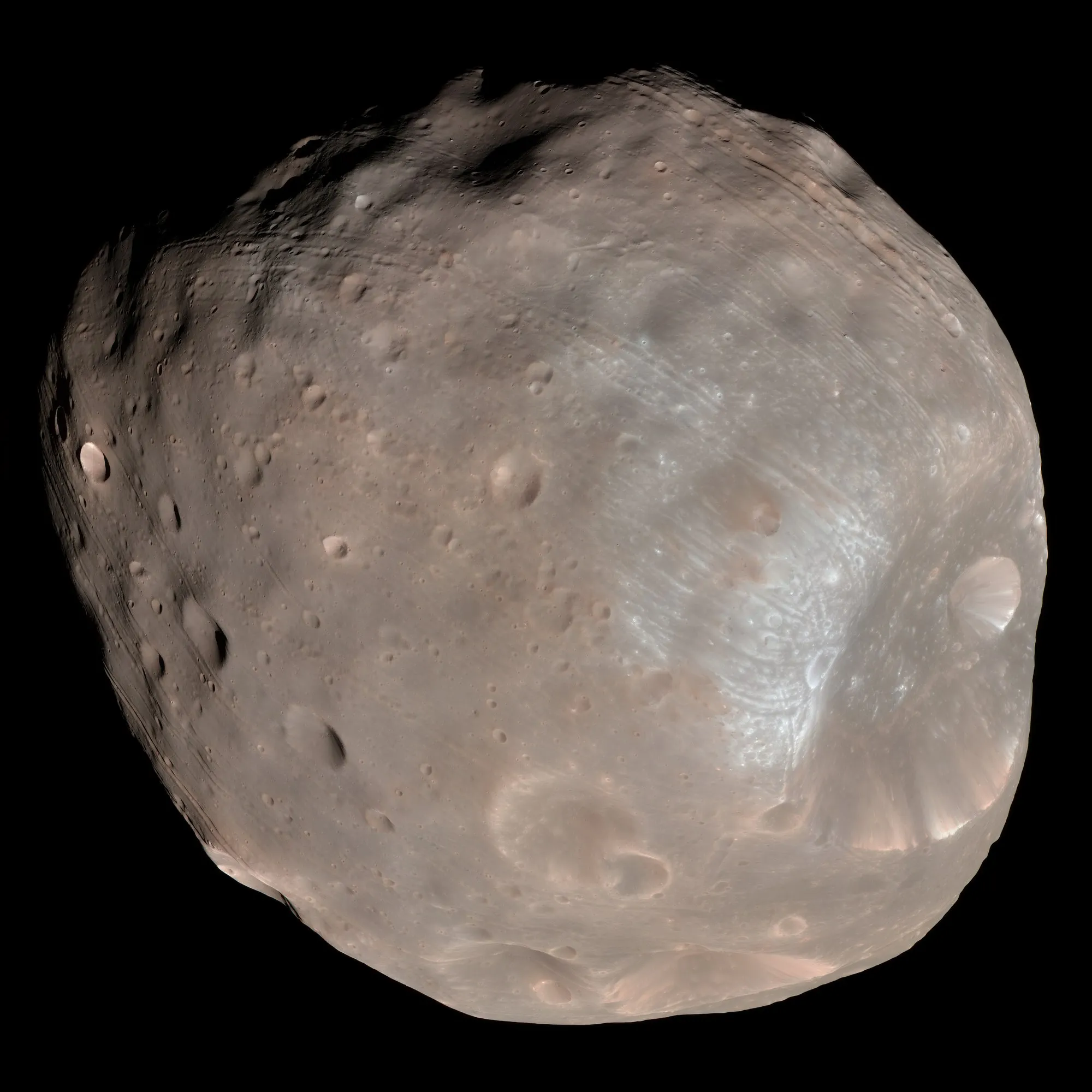
Phobos
Phobos is the larger moon of Mars: 22 km across, it circles Mars every 7 h 39 min and is spiralling inwards towards a crash or a ring.
NASA/JPL-Caltech/University of Arizona
A moon that rises in the west, crosses the sky in about 4 hours and is slowly falling towards Mars.
Phobos is the larger and inner of the two moons of Mars. It is a lumpy, dark body about 22 km across that orbits closer to its planet than any other moon in the solar system. Tides are dragging it inwards, and in around 50 million years it will either hit Mars or break up into a ring.
How big is Phobos?
Phobos is not round. It measures about 27 × 22 × 18 km, with a mean diameter of about 22 km, so it would fit inside many large cities. Its mass is about 1.06 × 10¹⁶ kg, roughly one seven-millionth of our Moon’s mass.
Its density is only about 1.87 g/cm³, low for rock. That suggests Phobos is porous: either a loose pile of rubble held together by its own weak gravity, or rock mixed with ice. Surface gravity is about 0.006 m/s², about 1/1,700 of Earth’s. The escape speed is around 11 m/s, so a strong throw could send a ball into orbit around Mars.
How does Phobos orbit Mars?
Phobos orbits about 9,375 km from the centre of Mars, which puts it only about 6,000 km above the surface. One orbit takes 7 hours 39 minutes. Mars rotates once every 24 hours 37 minutes, so Phobos laps the planet about three times a day. It is tidally locked, always showing the same face to Mars.
Because it moves faster than Mars rotates, Phobos rises in the west and sets in the east, crossing the sky in about 4 hours and rising again about 11 hours later. Seen from the equator it looks about one third as wide as the full Moon from Earth. It is so close that it cannot be seen at all from the Martian polar regions, where it stays below the horizon. Rovers including Curiosity and Perseverance have filmed it passing in front of the Sun, a fast partial eclipse that lasts well under a minute.
Why is Phobos falling towards Mars?
Phobos orbits inside the height where a moon would keep pace with the planet’s rotation. Its gravity raises a small tidal bulge on Mars that lags behind it and pulls back on it, so Phobos loses energy and sinks. It is getting about 1.8 metres closer every century.
NASA estimates that in roughly 50 million years Phobos will either crash into Mars or be pulled apart into a ring of debris. Which happens depends on how strong its interior is, which is not yet known. For the physics, see our lessons on why orbits are falling and Kepler’s laws.
What is the surface of Phobos like?
Phobos is one of the darkest objects in the solar system, reflecting only about 7% of the light that hits it. Its surface is covered in fine dust and boulders. The biggest feature is Stickney crater, about 9 km wide, nearly half the moon’s own width. The impact that made it must have come close to shattering Phobos.
Long parallel grooves cross the surface. Some scientists link them to the Stickney impact or to material thrown up from Mars, while others think they are early signs of tidal stress stretching the moon. Temperatures range from about −4 °C on the sunlit side to about −112 °C in shadow.
Where did Phobos come from?
There are two main ideas. Phobos looks like a dark, carbon-rich asteroid, so it may have been captured from the asteroid belt. Its nearly circular orbit close to Mars’s equator is hard to explain by capture, though, and suggests instead that it formed from debris thrown up when a large body struck Mars. The question is still open, and sample return is the main way to settle it.
Missions to Phobos
Asaph Hall discovered Phobos on 18 August 1877, six days after finding Deimos. The name means fear in Greek. Mariner 9 took the first close-up images in 1971, and the Viking orbiters mapped it in 1977. The Soviet Phobos 2 craft reached Mars in 1989 but was lost shortly before it was due to approach the moon, and Russia’s Phobos-Grunt sample mission failed in Earth orbit in 2011.
ESA’s Mars Express has made many close flybys since 2003, passing about 45 km from Phobos in 2013. NASA’s Mars Reconnaissance Orbiter has photographed it in detail. JAXA’s Martian Moons eXploration (MMX) mission launched on 20 October 2026. It is designed to orbit Mars, land on Phobos, drop a small rover and bring at least 10 grams of Phobos to Earth, with return targeted for 2031.
Can you see Phobos from Earth?
Barely. Phobos shines at about magnitude 11.3, but it never strays far from Mars, which is thousands of times brighter. Amateur astronomers can sometimes catch it near opposition, using a large telescope and a technique that hides Mars’s glare. Mars next reaches opposition in February 2027. Check its position in the orrery.
Data sources
Tools and lessons use simplified models for learning only. They must not be used for navigation, mission planning or any operational decision. Certificates are free and non-accredited. Read the educational content disclaimer