
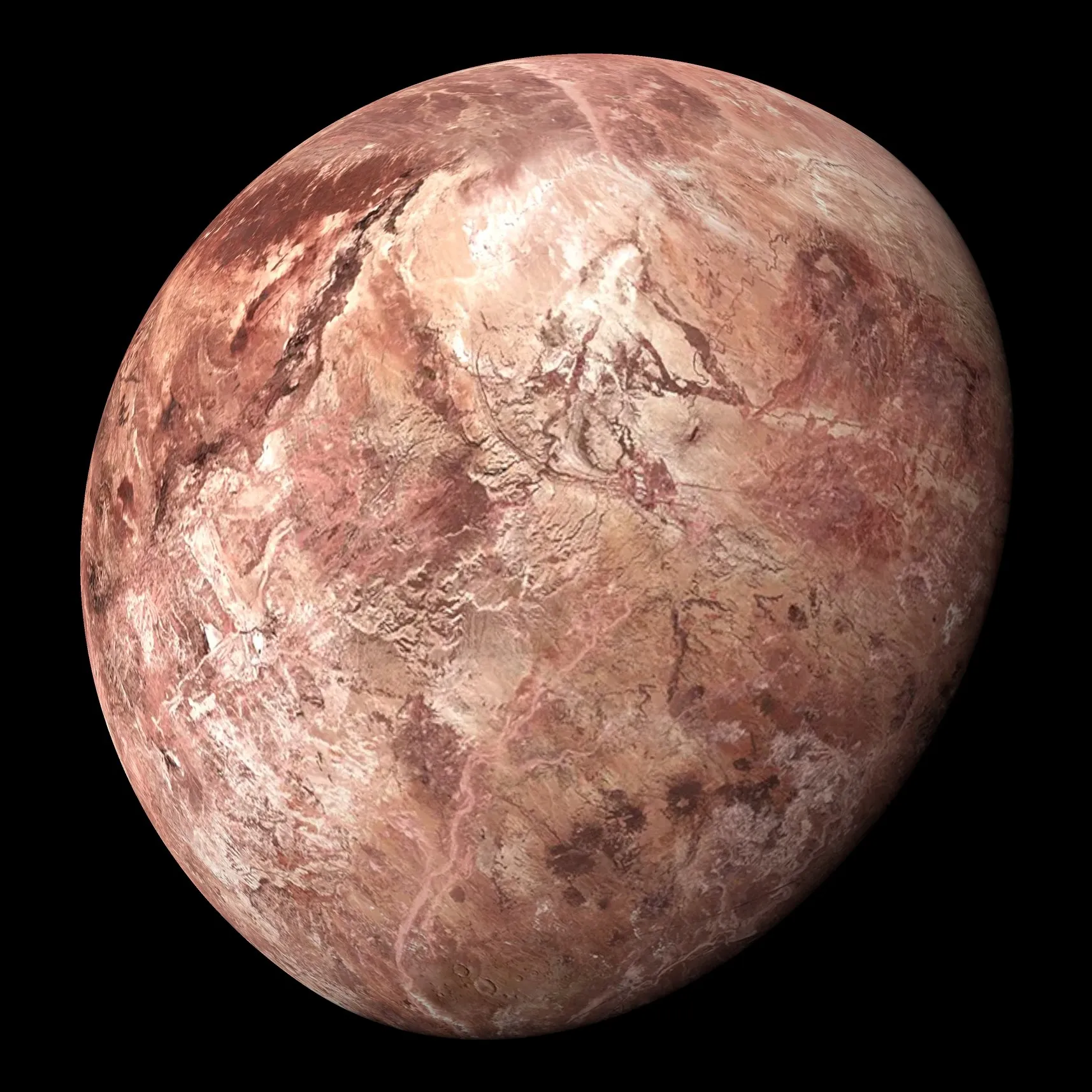
Makemake
Makemake is a reddish dwarf planet in the Kuiper belt, about 1,430 km wide and coated in methane ice. It takes 305 years to orbit the Sun and has one moon.
Local Solar System Foundation · Solar System Scope (CC BY 4.0)
A frozen, bright world far beyond Neptune, coated in methane ice.
Makemake is one of the largest objects in the Kuiper belt, the zone of icy worlds beyond Neptune. After Pluto, it is the brightest Kuiper belt object seen from Earth, thanks to a reddish surface of frozen methane. Its discovery in 2005, alongside Eris, helped push astronomers to create the category of dwarf planet.
How big is Makemake?
Makemake is about 1,430 km across, roughly two thirds the width of Pluto and about one ninth the width of Earth. If Earth were the size of a coin, Makemake would be a mustard seed. It is slightly flattened, with JPL listing an equatorial radius of 717 km and a mean radius of 714 km.
Its mass is less certain than Pluto’s or Eris’s. JPL’s current estimate is about 3.1 × 10²¹ kg, around a quarter of Pluto’s mass and about 0.05% of Earth’s, giving a density of about 2.1 g/cm³. The mass should improve once the orbit of its moon is properly pinned down, because a moon’s orbit is how astronomers weigh a distant world.
How far away is Makemake, and how long is its year?
Makemake orbits the Sun at an average distance of about 45.6 au (6.8 billion km). Its orbit is moderately eccentric (e ≈ 0.16), so its distance varies from about 38 au to about 53 au, and it is tilted about 29 degrees to the plane of the planets. Sunlight takes about 6 hours 20 minutes to reach it.
One trip around the Sun takes about 305 Earth years. Makemake is currently near the far end of its orbit, a little over 52 au away. It is a “classical” Kuiper belt object, meaning its orbit is not locked in a resonance with Neptune, unlike Pluto’s. You can see the difference by comparing their paths in the orrery.
How long is a day on Makemake?
Makemake rotates about once every 22.5 hours, so its day is close to the length of a day on Earth or Mars. Its brightness changes very little as it turns, which made the rotation hard to measure.
What is Makemake’s surface like?
Makemake looks reddish-brown, a colour similar to Pluto’s. Spectra show abundant methane ice, along with ethane and other hydrocarbons that form when sunlight and cosmic rays break down methane. NASA notes that some of the methane may be in pellets up to about 1 cm across. Nitrogen ice, common on Pluto, appears to be scarce.
The surface is very reflective, with an albedo of about 0.8 (it reflects around 80% of the light that falls on it). That brightness keeps it extremely cold: temperatures are estimated at around -240 °C, roughly 30 to 40 K.
Does Makemake have an atmosphere?
Probably not much of one at present. On 23 April 2011 Makemake passed in front of a faint star, and the starlight vanished and reappeared abruptly rather than fading gradually, as it would through a thick atmosphere. That ruled out a global atmosphere like Pluto’s, though a very thin or patchy one could still exist. NASA notes that Makemake may develop a thin nitrogen atmosphere near perihelion, when it is closest to the Sun.
More recent infrared observations with the James Webb Space Telescope reported traces of methane gas above the surface. If confirmed, this suggests some activity, such as ice turning to gas in sunlit areas or venting, but the interpretation is still debated.
Does Makemake have a moon?
Makemake has one known moon, provisionally designated S/2015 (136472) 1 and nicknamed MK 2. The Hubble Space Telescope spotted it in April 2015, and the discovery was announced in April 2016. It is more than 1,300 times fainter than Makemake and was seen about 21,000 km away. NASA estimates a radius of about 80 km.
The moon appears very dark, like charcoal, which contrasts sharply with its bright parent. Astronomers do not yet know its orbit well, which is why Makemake’s mass remains uncertain.
How was Makemake discovered?
Mike Brown, Chad Trujillo and David Rabinowitz found Makemake on 31 March 2005 in images from Palomar Observatory in California, and announced it on 29 July 2005. Because it was found just after Easter, the team nicknamed it “Easterbunny”; its provisional designation was 2005 FY9.
In July 2008 the International Astronomical Union recognised it as the fourth dwarf planet and named it Makemake, after the creator god of fertility in the mythology of the Rapa Nui people of Easter Island.
Can you see Makemake from Earth?
Not with the naked eye or binoculars. Makemake shines at about magnitude 17, so you need a large amateur telescope with a camera, or a professional instrument, to record it. It currently lies in the constellation Coma Berenices. No spacecraft has visited Makemake, and none is planned; at over 50 au, a probe would take decades to arrive. For a feel for the distance, try the scale walk.
Data sources
Tools and lessons use simplified models for learning only. They must not be used for navigation, mission planning or any operational decision. Certificates are free and non-accredited. Read the educational content disclaimer