
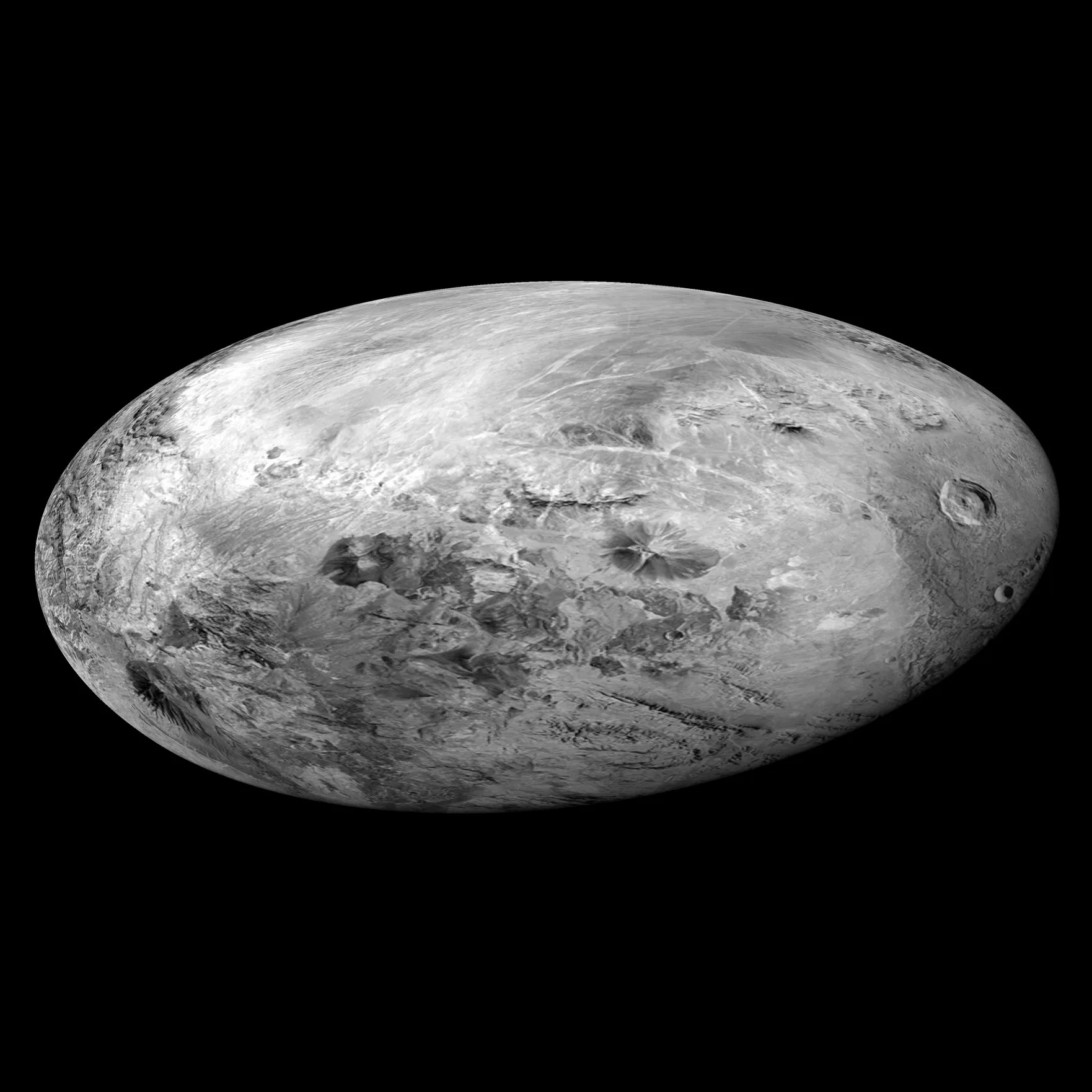
Haumea
Haumea is an egg-shaped dwarf planet beyond Neptune that spins once every 3.9 hours. It has a ring, two moons and a 284-year orbit around the Sun.
Local Solar System Foundation · Solar System Scope (CC BY 4.0)
A world spinning so fast that it has stretched into the shape of an egg.
Haumea is a dwarf planet in the Kuiper belt, the ring of icy bodies beyond Neptune. It turns once every 3.9 hours, faster than any other known object of its size, and that spin has pulled it into a stretched, rugby-ball shape. It also has a ring and two moons, and it seems to be the largest survivor of an ancient collision.
How big is Haumea?
Haumea is not round, so it has no single diameter. Measurements from a stellar occultation in January 2017 gave axes of roughly 2,320 km by 1,700 km by 1,030 km. Its longest axis is about as long as Pluto is wide, but its shortest is less than half that. NASA quotes an equatorial diameter of about 1,740 km, and JPL lists a mean radius of 715 km; the different figures come from different ways of averaging an elongated body.
Its mass is about 4.0 × 10²¹ kg, roughly a third of Pluto’s and about 0.07% of Earth’s. Its density has been estimated at about 1.9 to 2.6 g/cm³, depending on which shape model is used, so it is mostly rock with an icy outer layer.
Why is Haumea shaped like an egg?
A day on Haumea lasts just 3.9 hours (3 hours 55 minutes). At that speed, material at the equator moves fast enough that gravity and rotation reach a balance in a stretched shape rather than a sphere. Physicists call this a Jacobi ellipsoid. A slower world of the same mass would settle into a ball.
The leading explanation for the fast spin is a large collision billions of years ago. The impact would have set Haumea spinning, knocked off icy fragments and probably created its moons. A group of icy Kuiper belt objects with orbits and surface ice very similar to Haumea’s, called the Haumea family, is thought to be debris from that event.
How far away is Haumea, and how long is its year?
Haumea orbits the Sun at an average of about 43 au (6.5 billion km). Its orbit is moderately eccentric (e ≈ 0.19), taking it from about 35 au to about 51 au from the Sun, and it is tilted about 28 degrees to the plane of the planets. Sunlight takes about six hours to reach it.
One orbit takes about 284 Earth years. Haumea passed its farthest point from the Sun in the early 1990s and is now slowly moving closer. For a sense of what these distances mean, see our place in space.
What is Haumea’s surface like?
Haumea is bright, reflecting most of the light that hits it. Its surface is covered in crystalline water ice, which is surprising: in deep cold, ice slowly loses its crystal structure under radiation, so the surface may have been renewed relatively recently, perhaps by the collision that formed the family. Observations have also shown a darker, redder spot on one side, though its nature is unclear.
Temperatures are very low, below about -220 °C (around 50 K). No atmosphere has been detected, and NASA notes that little is known about either its surface or any gases around it.
Does Haumea have rings and moons?
Yes to both. On 21 January 2017 astronomers in several European countries watched Haumea pass in front of a star. The starlight dimmed briefly before and after the main event, revealing a narrow ring about 70 km wide, roughly 2,290 km from Haumea’s centre. It was the first ring found around a Kuiper belt object, and the ring particles circle Haumea once for every three spins of the dwarf planet.
Haumea has two known moons, both found in 2005 at the Keck Observatory:
Hiʻiaka
The outer and larger moon, roughly 300 to 400 km across, orbiting about every 49 days. It is named after the patron goddess of the island of Hawaiʻi and of hula dancers.
Namaka
The smaller inner moon, perhaps 150 to 200 km across, orbiting about every 18 days. It is named after a water spirit in Hawaiian mythology. Both moons show water ice like Haumea itself, consistent with an origin as collision debris.
Who discovered Haumea?
The discovery is disputed. Mike Brown’s team at Caltech first saw Haumea in December 2004 in images from Palomar Observatory and nicknamed it “Santa”. In July 2005, before Brown’s team announced it, a team led by José Luis Ortiz at the Sierra Nevada Observatory in Spain reported it from images taken in March 2003. It later emerged that the Spanish team’s computers had accessed the American team’s observing logs, which led to a long argument.
The IAU lists the discovery site as Sierra Nevada Observatory with no named discoverer, but accepted the name proposed by Brown’s team. In September 2008 it became Haumea, after the Hawaiian goddess of fertility and childbirth, and the fifth recognised dwarf planet.
Can you see Haumea from Earth?
Not without a large telescope. Haumea shines at about magnitude 17.3, far too faint for the naked eye or binoculars, though skilled amateurs with big telescopes and cameras can image it. It currently lies in the constellation Boötes. No spacecraft has visited it, and none is planned. You can follow its orbit in the orrery.
Data sources
Tools and lessons use simplified models for learning only. They must not be used for navigation, mission planning or any operational decision. Certificates are free and non-accredited. Read the educational content disclaimer