
Seasons Explorer
Earth's tilt, the Sun's height and the length of the day for any place and date.
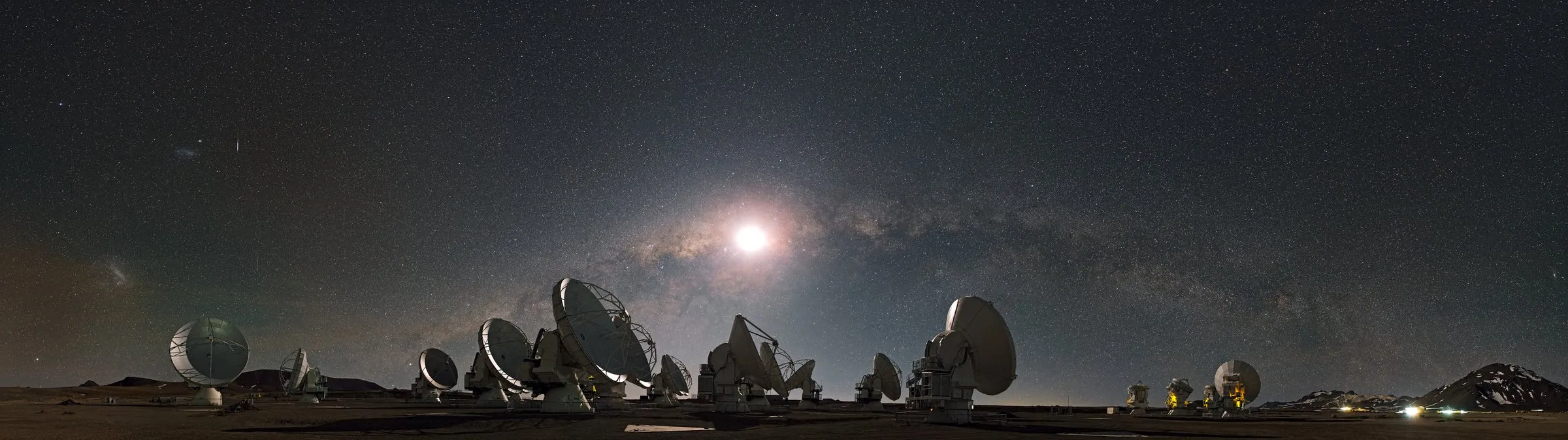
ESO/S. Guisard (www.eso.org/~sguisard) (CC BY 4.0)
Seasons Explorer
What is this? Why are summers warm and winters cold? Earth's spin axis is tilted, so through the year each place sees the Sun higher or lower in the sky, and for more or fewer hours. This tool shows that for any place and any date.
How to use it: Choose your city under "Your place" (or drag the latitude), then drag the date or press a solstice button. Drag the 3D Earth to turn it.
Your place: London
See how the Sun behaves where you live, on the date you picked above.
Your browser will ask you first. Your position is used only on this page, to do the sums. It is never stored or sent anywhere.
- Sunrise
- Sunset
- Daylight
- Sun highest at
- Sun's highest angle
City list: GeoNames (geonames.org), CC BY 4.0. Sunrise, sunset and the Sun's position: formulas of the NOAA Global Monitoring Laboratory solar calculator, from J. Meeus, Astronomical Algorithms. Sunrise and sunset are when the top edge of the Sun touches a flat horizon, allowing for the way air bends light, so they give slightly longer days than the geometric figure above. Time zones come from your own browser.
Day length here is geometric (the centre of the Sun on a flat horizon). Air bends sunlight, so real days are a few minutes longer.
Try this
- Pick your own city, then press "June solstice" and "December solstice".Notice: How much longer is your longest day than your shortest? The farther you live from the equator, the bigger the gap.
- Choose Quito, on the equator, and press Play.Notice: The day stays close to 12 hours all year and the noon Sun is always high. Near the equator the seasons are about rain, not daylight.
- Choose Reykjavík and press "June solstice".Notice: The Sun sets just after midnight and rises again before 3 a.m., and it never gets fully dark. North of the Arctic Circle (66.6° N) it does not set at all.
- Drag the axial tilt to 0°, then to 90°.Notice: With no tilt, every day is 12 hours long everywhere and the seasons vanish. With a huge tilt, like Uranus, which is tipped on its side, the seasons become extreme.
How far north or south of the equator a place is, from 0° at the equator to 90° at the North or South Pole. London is at about 51.5° N; Sydney is at about 33.9° S.
How far Earth's spin axis leans compared with its path round the Sun: about 23.4°. The tilt, not our distance from the Sun, is what causes the seasons.
More in the glossary →The latitude where the Sun is straight overhead at noon on a given day. It swings from 23.4° N in June to 23.4° S in December and back.
More in the glossary →The two days a year, around 21 June and 21 December, when the Sun reaches its farthest north or south. They bring the longest and shortest days.
More in the glossary →The two days a year, around 20 March and 22 September, when the Sun is overhead at the equator and day and night are roughly equal everywhere.
More in the glossary →The moment the Sun is highest in the sky on a given day. On the clock it is often not 12:00, because of time zones and summer time.
Near the poles the Sun can stay up for the whole 24 hours in summer (midnight sun) and stay below the horizon all day in winter (polar night).
Data table (text alternative)
| Latitude | Equinox | June solstice | December solstice |
|---|---|---|---|
| 0° N | 12 h | 12 h | 12 h |
| 23.44° N | 12 h | 13.4 h | 10.6 h |
| 40° N | 12 h | 14.8 h | 9.16 h |
| 51.5° N | 12 h | 16.4 h | 7.6 h |
| 60° N | 12 h | 18.5 h | 5.51 h |
| 66.56° N | 12 h | 24 h | 0 h |
| 80° N | 12 h | 24 h | 0 h |
Tools and lessons use simplified models for learning only. They must not be used for navigation, mission planning or any operational decision. Certificates are free and non-accredited. Read the educational content disclaimer