Agrivoltaics: solar over crops
A hectare of farmland can grow wheat or make electricity. Raise the panels high enough and it can do a large part of both. The question is which crops, where, and at what price.
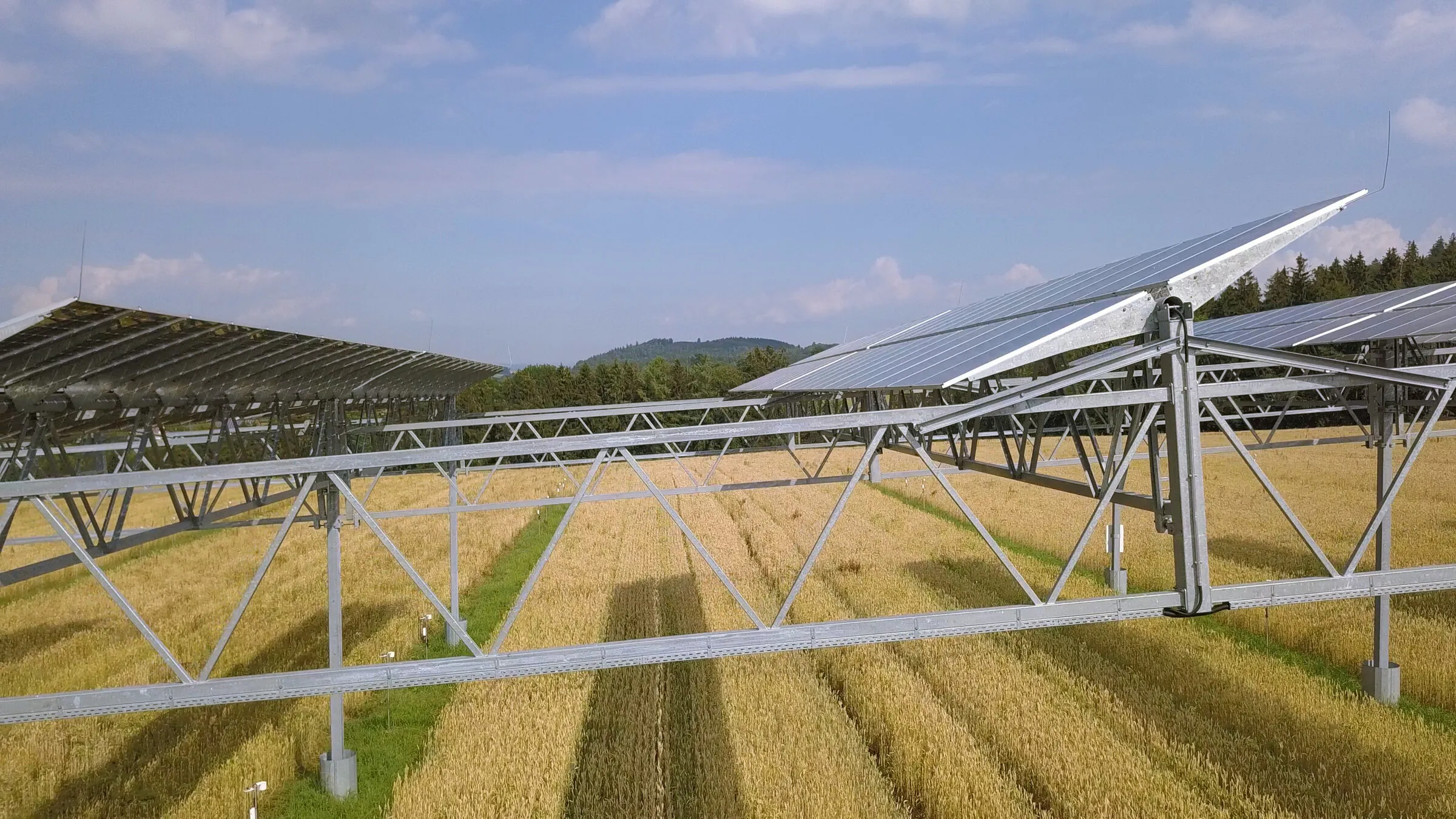
Tobi Kellner (CC BY-SA 4.0)
Solar farms need land, and the best land for solar, open, flat and sunny, is often farmland. That sets up a quiet conflict between food and energy. Agrivoltaics (also called agrophotovoltaics or solar sharing) tries to dissolve it: panels on tall supports or in widely spaced rows, with crops or grazing underneath and between them.
The honest summary: agrivoltaics is proven to raise the total output of a hectare, often by 50 to 80%, but it always gives up some electricity compared with a normal solar farm, often gives up some crop yield compared with an open field, and costs more to build than either. It wins where shade helps the crop, where the land is too valuable to give up, or where rules require farming to continue.
What it is
There are three broad designs (Fraunhofer ISE, 2024):
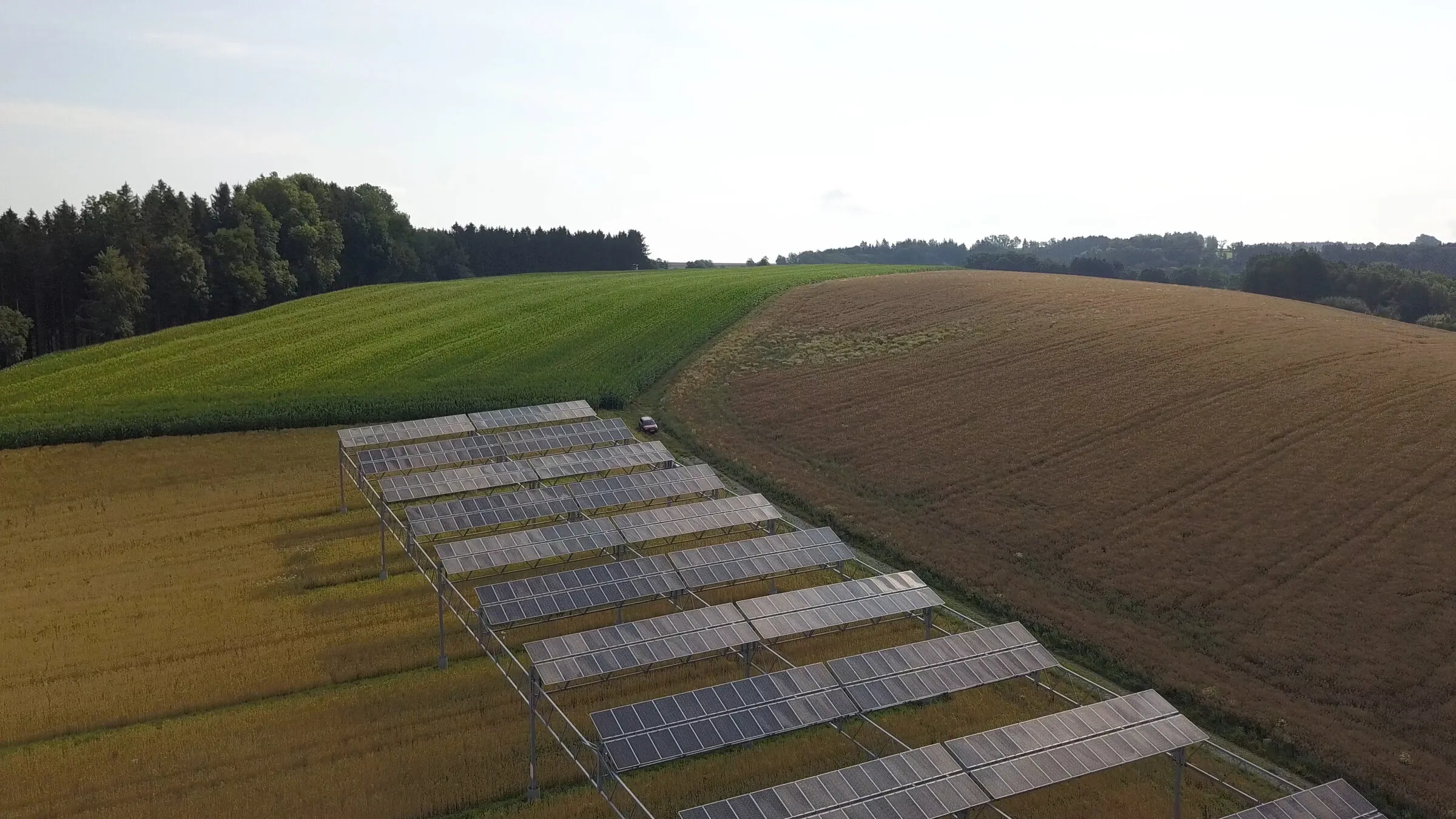
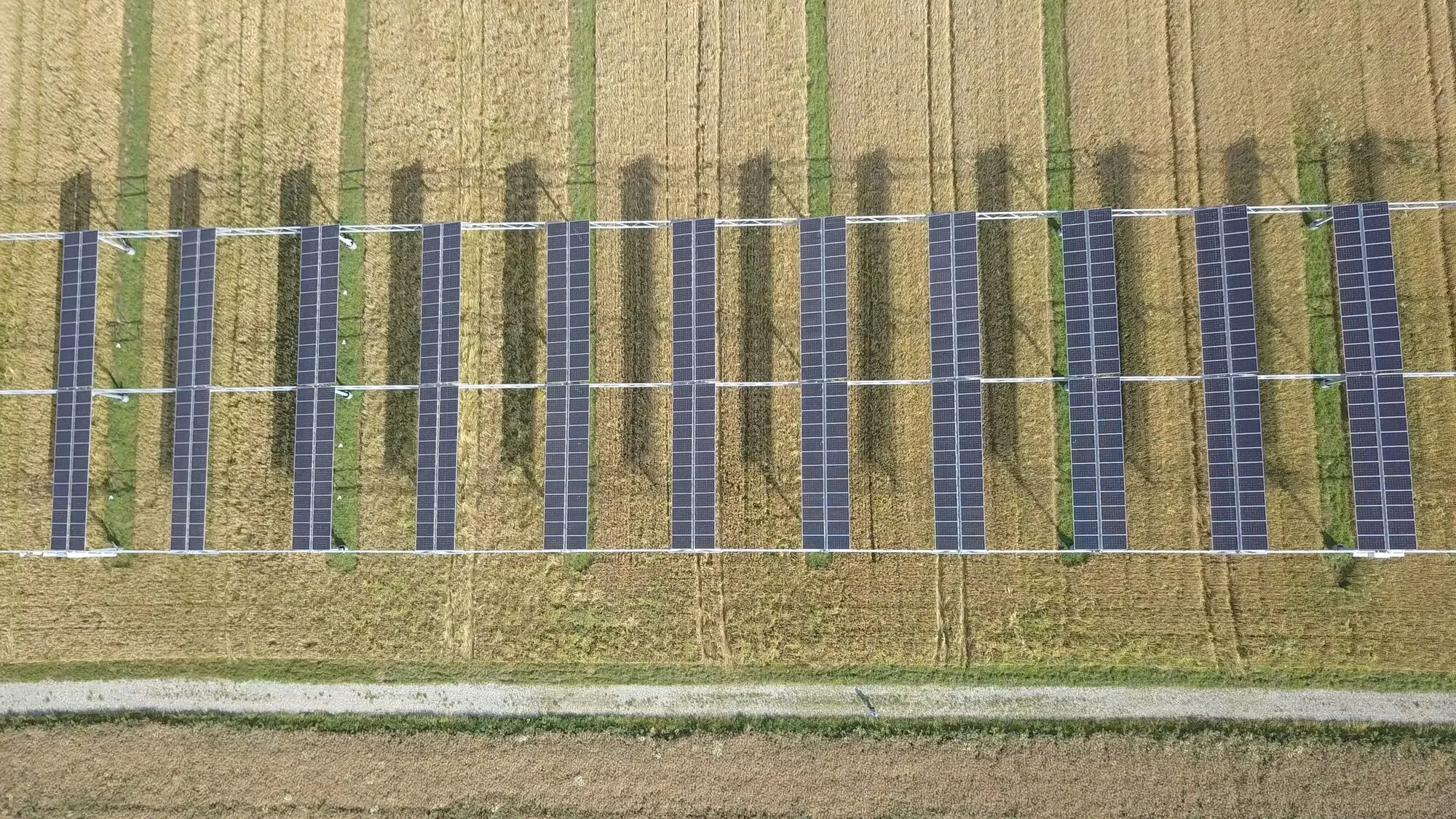
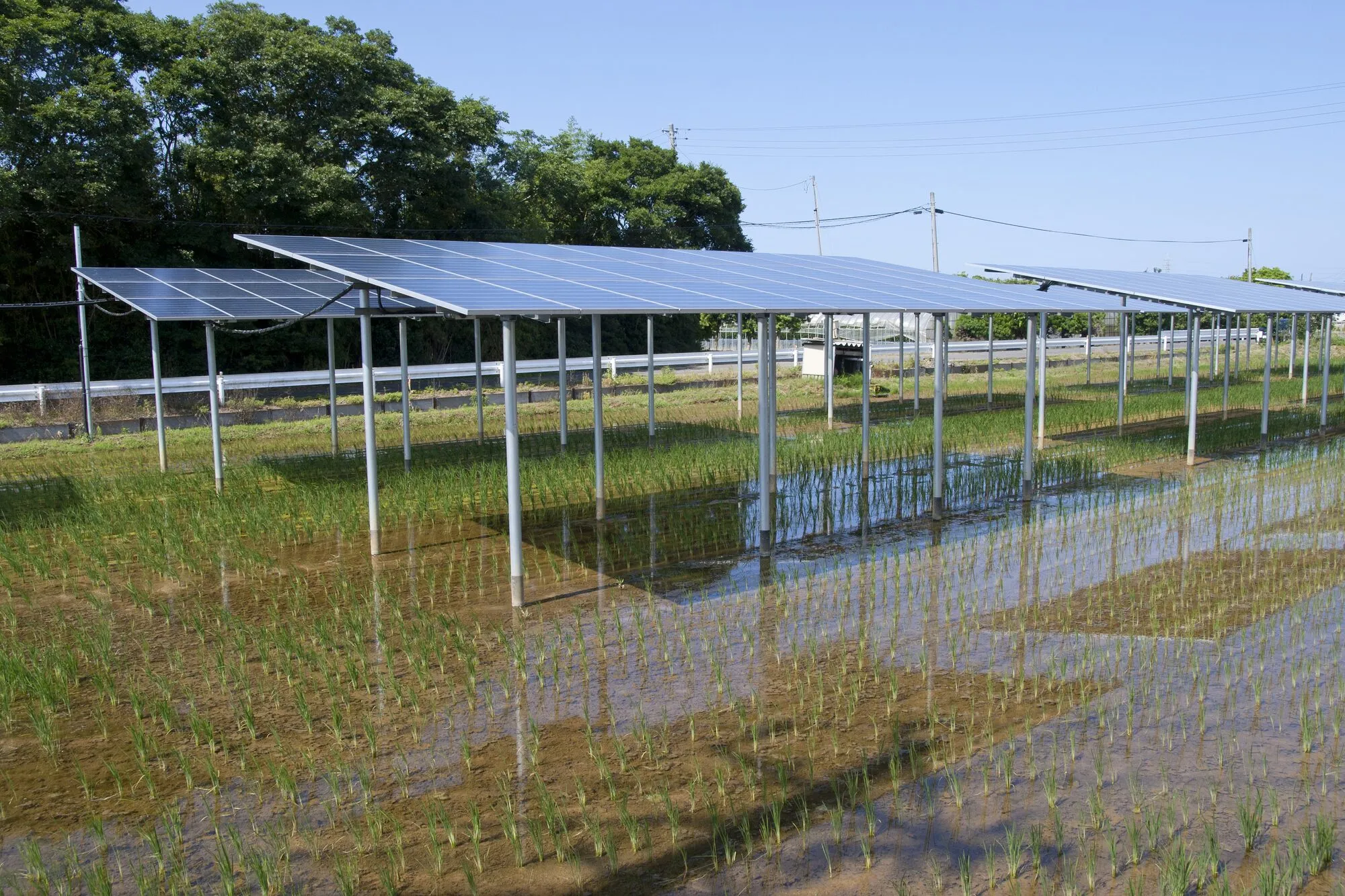
- Overhead (stilted) systems. Panels on a frame four to six metres high, so tractors and combine harvesters can pass underneath. The best-studied example is Heggelbach in southern Germany.
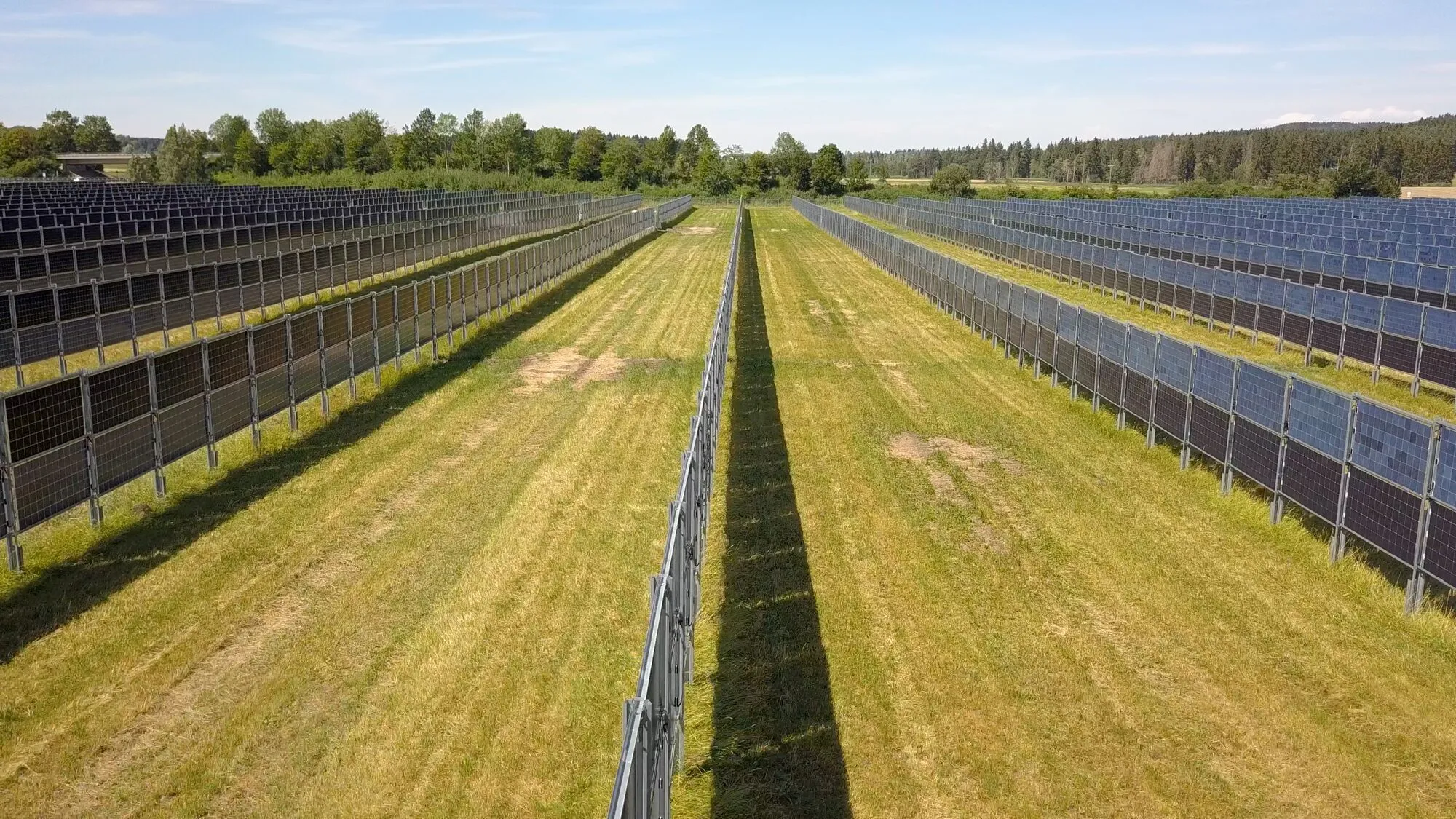
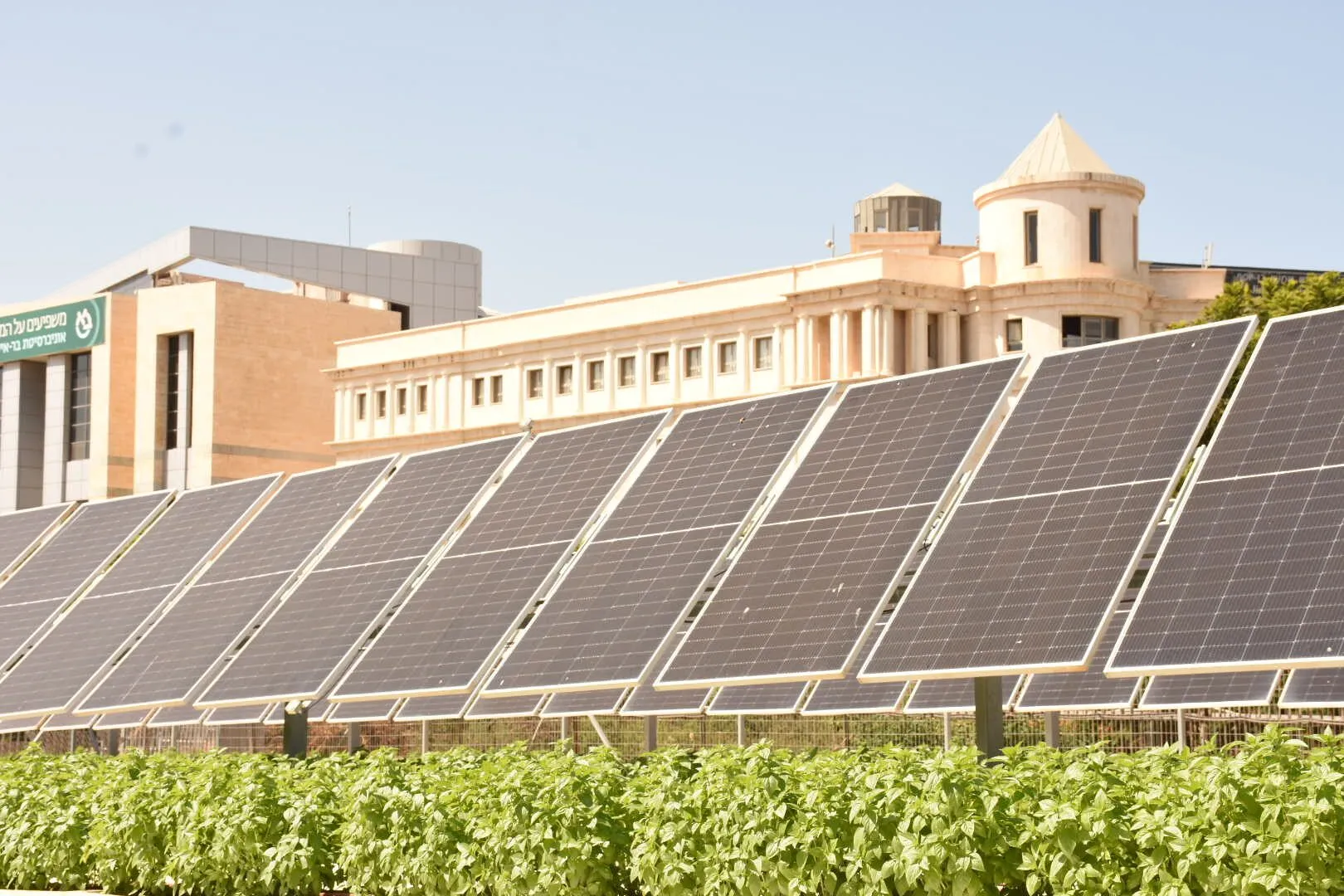
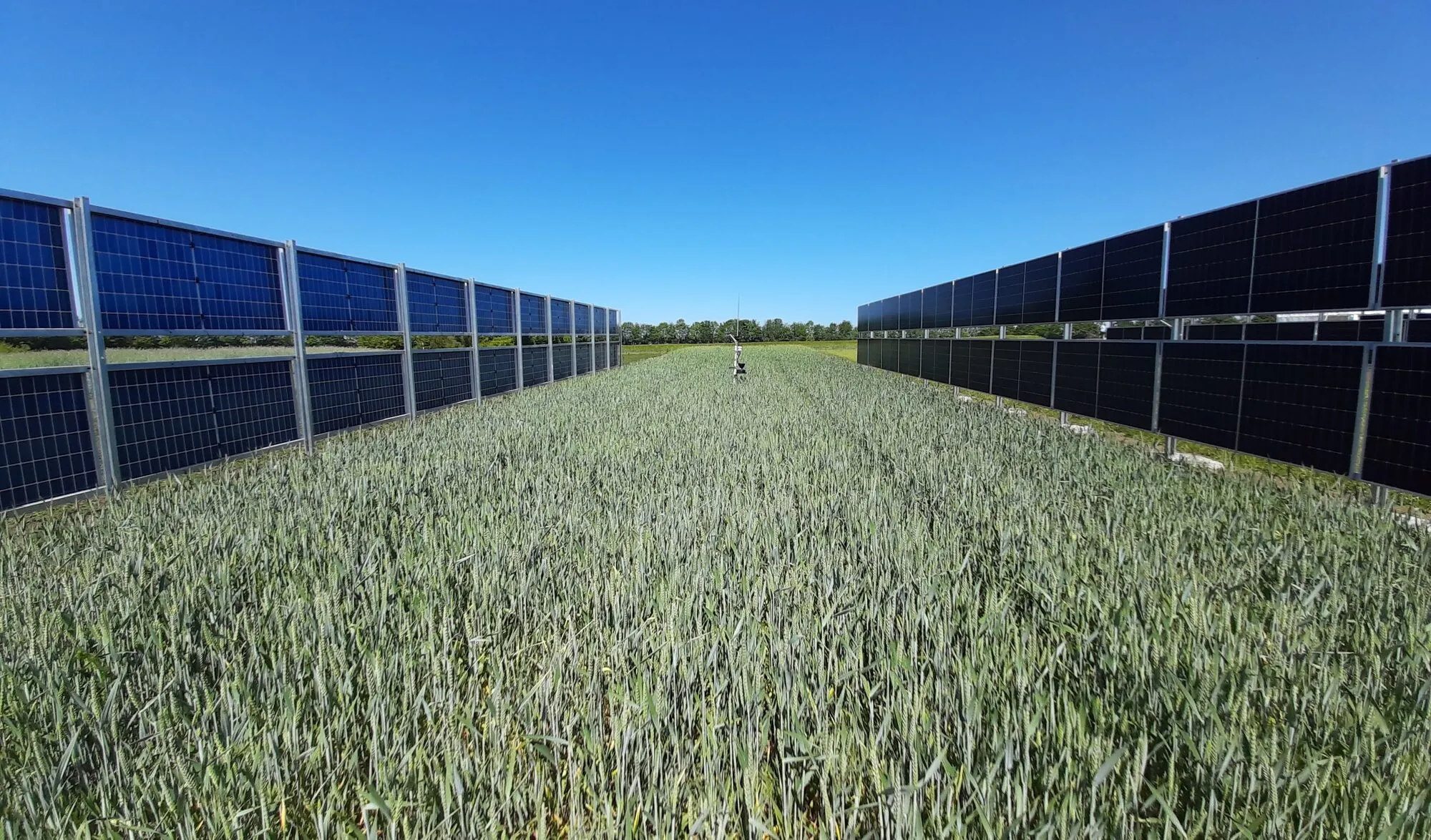
- Interspace systems. Rows of panels at normal height with wide farmed strips between them. Vertical, two-sided (bifacial) panels facing east and west are one version: at Eppelborn-Dirmingen in Germany a 2 MW vertical system leaves at least 90% of the land farmable.
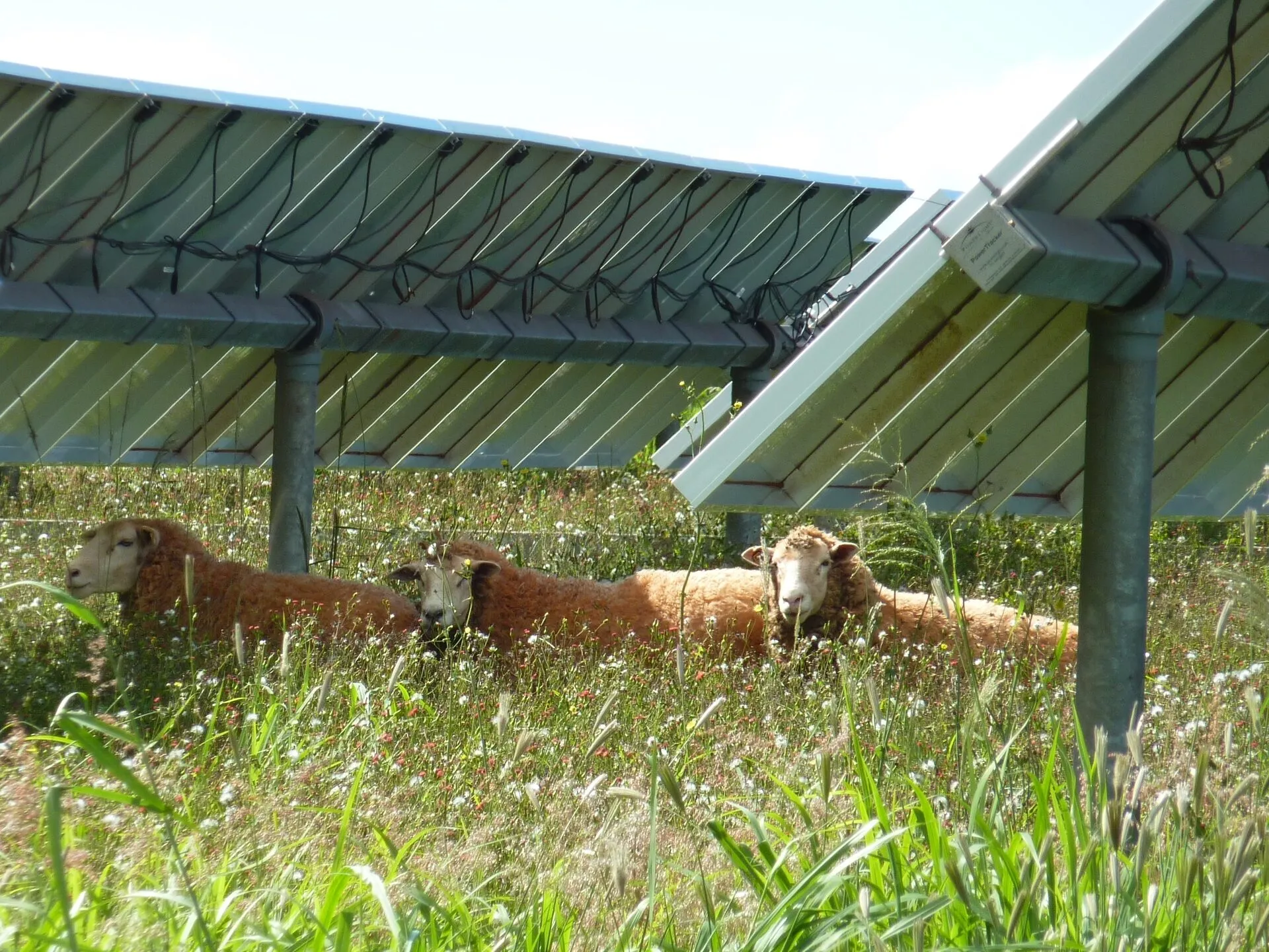
- Grazing and pollinator habitat under conventional solar farms. Sheep under panels are common; the farming value per hectare is lower, and some experts do not count this as agrivoltaics at all.
Greenhouses with solar roofs and panels over orchards, vineyards and berries (where they can replace hail nets and plastic covers) sit between these types.
How it works
Light is shared, not doubled. Sunlight on a field is a fixed budget: about 1,000 to 2,000 kWh per square metre a year in most farming regions. Panels intercept part of it and the crop gets the rest. The trick is that many crops cannot use full summer sunlight. Photosynthesis in a leaf rises with light and then flattens at a light saturation point; above it, extra light adds heat and water stress rather than growth. Shade-tolerant crops such as leafy vegetables, clover grass, many fruits and berries saturate early and lose little when part of the light is taken away (Fraunhofer ISE, 2024). Sun-hungry crops such as maize or wheat in a cool year lose more.
The land equivalent ratio. The standard way to judge a shared field is LER = Y_crop,shared / Y_crop,alone + Y_power,shared / Y_power,alone. In plain words: add the share of a normal harvest you still get to the share of a normal solar farm’s electricity you get. An LER of 1.0 means sharing is no better than splitting the land in two; 1.6 means a shared hectare does the work of 1.6 separate ones. Modelling by Dupraz and colleagues predicted 1.35 to 1.73 for wheat and solar in southern France (Dupraz et al., 2011).
Shade changes the microclimate. Under panels the soil stays cooler in spring and summer, less water evaporates, and in hot, dry spells the crop can do better than in the open field (Barron-Gafford et al., 2019; Fraunhofer ISE, 2019). The panels also gain: the moist air above plants keeps them slightly cooler than panels over bare ground.
Electricity per hectare falls. Rows must be spaced for light and machines, so fewer panels fit. At Heggelbach the installed capacity per hectare was about 25% lower than a conventional solar farm, but two-sided panels high off the ground caught extra reflected light, so the electricity per hectare was 83% of a normal farm’s.
The limits
Theoretical. Sunlight is shared: every kilowatt-hour of light the panels take, the crop does not get. Agrivoltaics can only beat separate land use when the crop was not using all the light it received (or was harmed by it). At high panel density both harvests shrink: a normal solar farm covers much more of the ground than any crop can tolerate.
Practical.
- Crop choice. Overhead systems in a normal German year cost wheat, potatoes and celeriac 18 to 19% of their yield. That is acceptable only if the electricity income makes up for it and the harvest stays above what farmers consider marketable (about 80%).
- Structure costs. Tall frames that span a combine harvester need more steel and deeper foundations: Fraunhofer estimates €372 per kWp for the mounting of overhead systems against €76 for ground-mounted solar (Fraunhofer ISE, 2024).
- Uneven light and rain. Shade and drip lines move across the day, so crops grow unevenly, and rain runs off panel edges in lines unless it is collected or spread.
- Farm work. Supports get in the way; at Heggelbach the strips around them took 8% of the field out of production.
- Rules and land. In many countries a field under panels loses its agricultural status or subsidies unless rules define what counts as real dual use, as Germany’s DIN SPEC 91434 standard and France’s dedicated agrivoltaics tenders do (Fraunhofer ISE, 2024).
Real projects, measured
| Project | What it is | What was measured or reported | Source |
|---|---|---|---|
| Heggelbach, Germany (2016 onwards) | 194 kWp of two-sided panels on 5 m supports over a third of a hectare; rows 9.5 m apart; wheat, potatoes, celeriac, clover grass | 2017: clover −5.3%, other crops −18 to −19%; land use efficiency 160%. 2018 (hot, dry): celeriac +12%, potatoes +11%, wheat +3%, clover −8%; land use efficiency 186%. Light on the crop 30% lower. Electricity 1,266 kWh per kW in the first year and 1,285 kWh per kW in 2018 (249,857 kWh), against a German average of about 950 | Fraunhofer ISE, 2017; 2019 |
| Biosphere 2 test site, Arizona, United States | Vegetable crops grown under panels in a dry climate, compared with open plots and a normal solar array | Shade reduced plant drought stress and raised food production for some crops; panels over plants ran cooler than over bare ground | Barron-Gafford et al., 2019 |
| Gelsdorf, Germany (2021) | 258 kWp of semi-transparent panels over an organic apple orchard, compared with hail nets and plastic covers | Research on light, crop protection and public acceptance (results in progress) | Fraunhofer ISE, 2024 |
| Gobi desert edge, China | 700 MWp over berry plantations, also meant to slow desertification | Capacity reported; no independent crop data published | Fraunhofer ISE, 2024 |
| Japan, “solar sharing” | More than 3,000 small systems since 2013 subsidies | Number of systems reported | Fraunhofer ISE, 2024 |
Two lessons stand out. First, the same system gave a 160% result in one year and 186% in the next, because the weather changed what shade meant for the crops: agrivoltaics has to be judged over many seasons. Second, the largest systems in the world publish the least crop data. The strongest evidence still comes from a handful of research sites.
See-through solar: sharing light by colour
Ordinary panels share light by space: one strip of the field is in shade, the next is in sun. A newer family of panels tries to share it by colour instead. Plants grow on visible light, from violet at 400 nanometres to deep red at 700, the band scientists call photosynthetically active radiation. Red light drives photosynthesis most efficiently for each particle of light, but blue and green light are used too (McCree, 1971). Only 43% of the energy in sunlight at the ground falls in that band; about 5% is ultraviolet and 52% is infrared, which crops cannot use to grow (our integration of the ASTM G173 reference spectrum). A panel that took only the ultraviolet and infrared would, in principle, leave the crop almost all the light it can use.
Five approaches are being tried, at very different stages:
- Semi-transparent panels with spaced cells (commercial). Ordinary silicon cells are set apart on glass so that light falls through the gaps; the Gelsdorf apple orchard in the table above uses them. The trade is simple: electricity falls in step with the area left without cells (Traverse et al., 2017). In a comparison of four commercial greenhouse types in Europe, the light inside over a year fell on average by 0.8% for each extra 1% of roof covered with panels, and a north-south layout and a checkerboard pattern spread the light more evenly (Cossu et al., 2018).
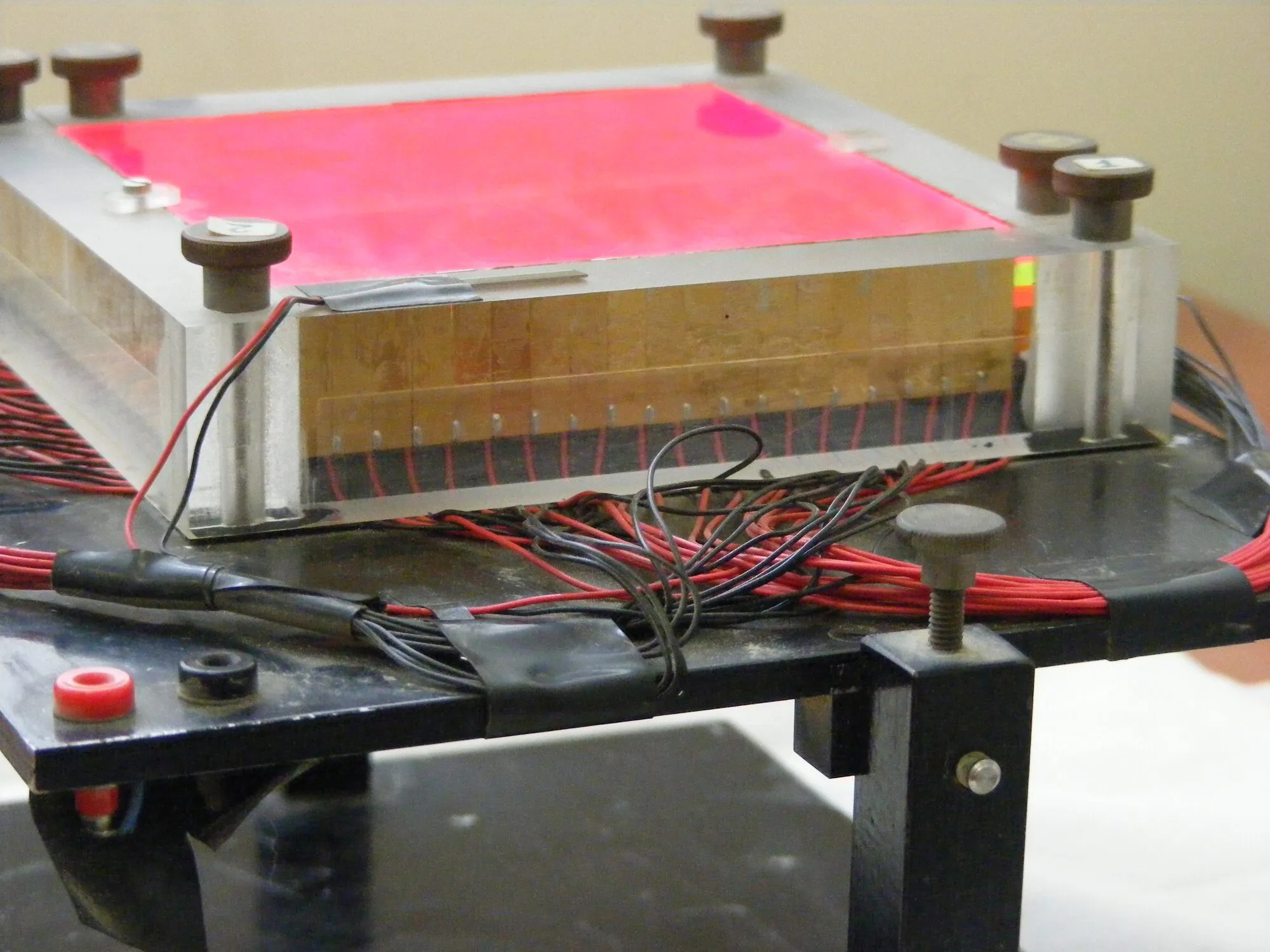
- Coloured, luminescent panels (small commercial installations). A dye in the glass absorbs part of the blue and green light and guides it to strips of silicon cells; the rest passes through, which gives the glass its magenta glow. In trials by the University of California, Santa Cruz, with a commercial grower, tomatoes under these panels showed little change in the number and weight of their fruit and used slightly less water (Loik et al., 2017). The maker, Soliculture, says it introduced the first commercial luminescent solar concentrator in 2012 and has installed its panels in greenhouses in the United States and Canada (Soliculture).
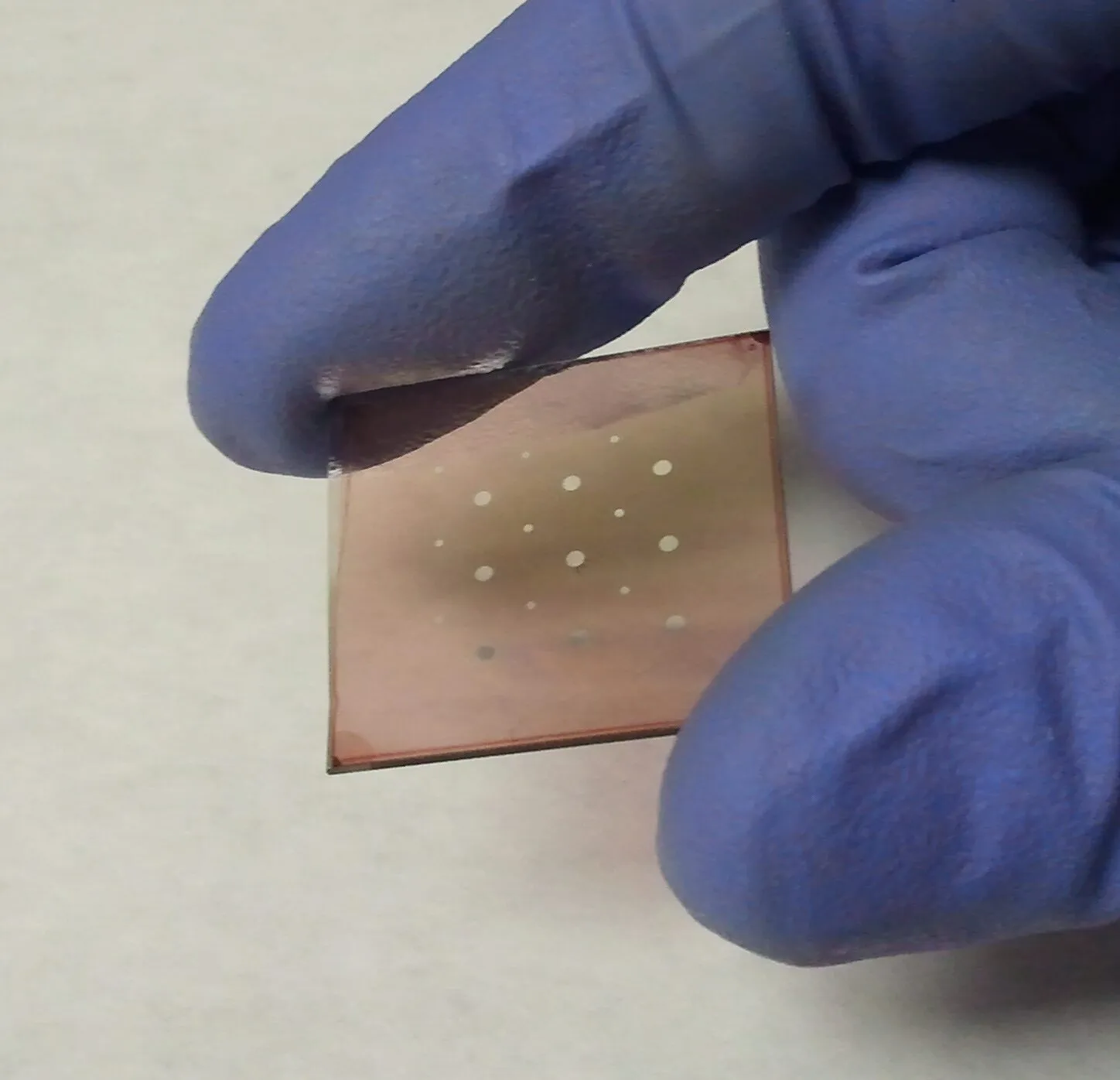
- Semi-transparent organic solar cells (laboratory and pilot). Thin carbon-based films can be tuned to absorb mostly deep red and near-infrared light. Researchers at North Carolina State University grew red leaf lettuce under filters made from three different organic cell materials and found no significant difference in fresh weight or chlorophyll (Ravishankar et al., 2021). Their energy model found that greenhouses roofed with such cells could make more energy in a year than they use in warm and moderate climates of the United States (Ravishankar et al., 2020). In the laboratory, a semi-transparent organic cell has reached 8.8% efficiency while letting 41% of visible light through (Bates et al., 2023). How long organic cells last outdoors is still the big open question (Traverse et al., 2017).
- Fully transparent panels (laboratory, first window products). These absorb only ultraviolet and near-infrared light and look almost like clear glass. The first, in 2011, turned 1.3% of sunlight into electricity while passing more than 65% of visible light (Lunt and Bulović, 2011). Companies such as Ubiquitous Energy now make transparent solar coatings for windows. We found no published field trials of crops under them yet.
- Light-shifting films that make no electricity (commercial). Quantum dot films, sold for greenhouses by UbiQD, turn ultraviolet and blue light into red. Red romaine lettuce grown under films that emitted at 600 and 660 nanometres gained 13% and 9% more edible dry mass than under a plain film (Parrish et al., 2021). They belong here because the same trick, catching the colours a crop uses least, is what luminescent solar panels do.
Other companies sell glass for farms with their own claims. Brite Solar in Greece offers semi-transparent panels with a nanocoating that it says converts ultraviolet light into red light, with transparency chosen between 30% and 80% for each crop (Brite Solar). Insolight in Switzerland sells a crop cover that it says sends about 20% of the light to electricity and keeps 80% for the plants at a 1.6 hectare plant nursery (Insolight). These are the companies’ own figures, not independent trials.
What this adds up to. Colour-selective panels are the most elegant idea in agrivoltaics, and the crop results so far are encouraging: lettuce and tomatoes grew about as well under them as without them, and lettuce under light-shifting film grew better. The catch is electricity. A panel that leaves the crop most of the visible light has to live on ultraviolet and infrared, and today’s transparent and organic cells turn only a few percent to under 10% of sunlight into power, while commercial silicon panels have climbed from about 17% to just under 25% in ten years (Fraunhofer ISE, Photovoltaics Report, 2026). We found no independent published costs for luminescent, organic or transparent greenhouse panels. For a grower, the test is the one this page keeps coming back to: one season of weighed harvests and metered electricity under the new glass, beside an identical house without it.
What it costs
| Option | Cost of electricity | Year and source |
|---|---|---|
| Tall overhead agrivoltaics (over 4 m), Germany | about €0.08 per kWh on average (8.15 euro cents), about 50% above ground-mounted solar | 2024, Fraunhofer ISE guideline |
| Interspace agrivoltaics, Germany | about €0.06 per kWh on average (6.03 euro cents), slightly above ground-mounted solar | 2024, same source |
| Agrivoltaics in general | €0.06 to €0.10 per kWh | 2024, same source |
| Extra installed cost over a ground-mounted solar farm, United States | $0.07 to $0.80 per W (highest for crops under tall structures) | 2020, NREL, Horowitz et al. |
| Utility-scale solar, United States | $0.04 to $0.10 per kWh | June 2026, Lazard LCOE+ version 19 |
| Benchmark: rooftop solar on a building | about $0.19 central | our Fan Wall model |
| Commercial and community rooftop solar, United States | $0.09 to $0.20 per kWh | June 2026, Lazard |
What the table says: against the site’s rooftop benchmark, agrivoltaics is cheap electricity; against a normal solar farm, it is dearer. Its case is not the cheapest kilowatt-hour but the kilowatt-hour that does not cost a harvest. Fraunhofer notes that a farm using its own power, instead of buying electricity at 14 to 16 euro cents per kWh, saves 7 to 9 euro cents on each kWh it generates.
Where it can win, and where it cannot
It can win:
- Hot, dry and sunny regions, where shade and lower evaporation help crops and cut irrigation.
- Fruit, berries, vines and vegetables that already need hail nets, rain covers or shade cloth: the panels replace a cost the farmer pays anyway.
- Shade-tolerant crops and grassland such as clover grass, lettuce, spinach and many herbs.
- Places where farmland is protected and a normal solar farm would not be permitted, or where communities object to losing fields.
- Farms that use their own power for irrigation pumps, cold stores, milking, drying or electric machinery.
It cannot win:
- On the cheapest electricity alone. A normal solar farm on land nobody wants to farm will always be cheaper.
- With sun-hungry crops in cool, cloudy climates, where every bit of light counts for yield.
- Where large machines must work freely, unless the structure is tall and wide, which is exactly what makes it expensive.
- Where subsidies or rules make it a solar farm in disguise. Grazing a few sheep under densely packed panels is useful, but it is not the land-sharing gain this page is about.
What is proven, plausible and speculative
Proven: that shared land can reach a land equivalent ratio well above 1 (160% and 186% measured at Heggelbach); that shade cuts yields of sun-hungry crops in normal years by around a fifth at 30% light reduction; that shade helps some crops in hot, dry conditions; that tall structures raise the cost of electricity.
Plausible: that agrivoltaics improves crop resilience to heat and drought as the climate warms (supported by trials and modelling, such as simulated rainfed maize in northern Italy that yielded more and more steadily under panels (Amaducci et al., 2018)); that panels can replace hail nets and plastic covers in fruit growing; that Germany alone has room for about 1,700 GW of agrivoltaics on suitable crops (Fraunhofer ISE, 2024).
Speculative: large global estimates such as “less than 1% of cropland could offset global energy demand” (Adeh et al., 2019), which ignore storage, grids and crops; long-term effects on soil and farm economics over 25 to 30 years; how crops respond under very different panel geometries that have not been field-tested.
Open research questions
- Which crops, in which climates, keep at least 80% of their yield under 20 to 40% shade, over ten seasons, not one or two?
- Can tracking panels that turn to let light through in critical crop stages beat fixed panels enough to justify their cost?
- How should rainwater from panels be collected and spread so it helps rather than erodes?
- What do tall structures really cost to maintain over 30 years on working farms, and how do they affect insurance and machinery?
- How do rules count “real” farming under panels without inviting solar farms in disguise?
- Who owns the value: the farmer, the landowner or the energy developer?
What a working prototype would need
For a new agrivoltaic idea (a new structure, a new tracking strategy, a new crop system), a working model means a real crop and real panels, measured against a reference plot without panels, for at least one full season.
| Phase | Work | What it proves | Rough cost | Time |
|---|---|---|---|---|
| 0. Design study | Light and shade simulation over the year, crop model for the chosen crop, structure and cost estimate | The design keeps enough light for the crop on paper | $10k to $30k | 2 to 3 months |
| 1. Small plot test | A few kilowatts of panels over a replicated plot with an open reference plot; light sensors (PAR), soil moisture, yield at harvest, electricity metered | Measured crop yield and electricity, a first land equivalent ratio | $40k to $120k | 1 growing season |
| 2. Multi-season field trial | 50 to 200 kW over a working field with a farmer, two or more seasons, agronomist-led sampling | Year-to-year variability, machinery access, farmer acceptance | $250k to $600k | 2 to 3 years |
| 3. Commercial pilot | Permits, grid connection, structural certification, crop insurance | A bankable project | depends on size | 1 to 2 years |
Phases 0 to 2 cost roughly $300,000 to $750,000, mostly for steel and the years of agronomy. These are our estimates, not quotes.
Who we need
- Agronomist or crop physiologist to choose crops, design replicated plots and measure yield and quality.
- PV system designer familiar with bifacial and tracking systems and shade modelling.
- Structural engineer for tall, long-span structures under wind and snow loads.
- Farmer partner with a field, machinery and patience for a multi-year trial.
- Hydrologist for rain distribution, soil moisture and irrigation savings.
- Agricultural economist and land-use lawyer to test the business case and the rules.
Have a better idea?
Perhaps you have a cheaper structure, a crop system that loves shade, or a smarter way to move panels through the day. Some members of the Local Solar System Foundation may have contacts who could hear a pitch for a strong energy idea. To be pitched, an idea needs a working, real-life model that actually produces power, measured on an instrument, not claimed. Paper ideas are welcome too: if the physics and the numbers are solid, we can publish them here on the website. Raising capital without a working model is very difficult, and we cannot promise funding, returns or introductions.
For agrivoltaics, the cheapest measurement that counts as a working model is one growing season of a small plot under panels next to an identical open plot, with light sensors, the harvest weighed and the electricity metered. That gives a first measured land equivalent ratio. Send it through the contribution form, and see how it compares with other ideas on the idea radar. Sibling approaches: floating solar uses water surfaces instead of fields, and PV-thermal roofs make roofs do two jobs.
Sources
- Fraunhofer ISE (2017). Harvesting the sun for power and produce: agrophotovoltaics increases the land use efficiency by over 60 percent. Press release, Heggelbach first-year results.
- Fraunhofer ISE (2019). Agrophotovoltaics: high harvesting yield in hot summer of 2018. Press release.
- Trommsdorff, M. et al. (2024). Agrivoltaics: opportunities for agriculture and the energy transition. A guideline for Germany, 3rd edition. Fraunhofer ISE.
- Weselek, A., Ehmann, A., Zikeli, S. et al. (2019). Agrophotovoltaic systems: applications, challenges, and opportunities. A review. Agronomy for Sustainable Development 39, 35.
- Dupraz, C., Marrou, H., Talbot, G. et al. (2011). Combining solar photovoltaic panels and food crops for optimising land use: towards new agrivoltaic schemes. Renewable Energy 36(10), 2725-2732.
- Barron-Gafford, G.A., Pavao-Zuckerman, M.A., Minor, R.L. et al. (2019). Agrivoltaics provide mutual benefits across the food-energy-water nexus in drylands. Nature Sustainability 2, 848-855.
- Amaducci, S., Yin, X. and Colauzzi, M. (2018). Agrivoltaic systems to optimise land use for electric energy production. Applied Energy 220, 545-561.
- Adeh, E.H., Good, S.P., Calaf, M. and Higgins, C.W. (2019). Solar PV power potential is greatest over croplands. Scientific Reports 9, 11442.
- Horowitz, K., Ramasamy, V., Macknick, J. and Margolis, R. (2020). Capital costs for dual-use photovoltaic installations: 2020 benchmark for ground-mounted PV systems with pollinator-friendly vegetation, grazing, and crops. NREL/TP-6A20-77811.
- Lazard (June 2026). Levelized Cost of Energy+, version 19: utility solar $40 to $98 per MWh; community and C&I solar $88 to $197 per MWh.
- McCree, K.J. (1971). The action spectrum, absorptance and quantum yield of photosynthesis in crop plants. Agricultural Meteorology 9, 191-216.
- ASTM G173-03 reference air mass 1.5 spectra, via the National Laboratory of the Rockies (formerly NREL). Shares of energy by band are our integration of the global tilt spectrum.
- Traverse, C.J., Pandey, R., Barr, M.C. and Lunt, R.R. (2017). Emergence of highly transparent photovoltaics for distributed applications. Nature Energy 2, 849-860.
- Cossu, M., Cossu, A., Deligios, P.A. et al. (2018). Assessment and comparison of the solar radiation distribution inside the main commercial photovoltaic greenhouse types in Europe. Renewable and Sustainable Energy Reviews 94, 822-834.
- Loik, M.E., Carter, S.A., Alers, G. et al. (2017). Wavelength-selective solar photovoltaic systems: powering greenhouses for plant growth at the food-energy-water nexus. Earth’s Future 5, 1044-1053.
- Ravishankar, E., Charles, M., Xiong, Y. et al. (2021). Balancing crop production and energy harvesting in organic solar-powered greenhouses. Cell Reports Physical Science 2, 100381.
- Ravishankar, E., Booth, R.E., Saravitz, C. et al. (2020). Achieving net zero energy greenhouses by integrating semitransparent organic solar cells. Joule 4, 490-506.
- Bates, M., Malhado, C., Yang, C., Herrera, C.K. and Lunt, R.R. (2023). High efficiency transparent and semi-transparent photovoltaics based on a layer-by-layer deposition. Solar RRL 7, 2200962.
- Lunt, R.R. and Bulović, V. (2011). Transparent, near-infrared organic photovoltaic solar cells for window and energy-scavenging applications. Applied Physics Letters 98, 113305.
- Parrish, C.H., Hebert, D., Jackson, A. et al. (2021). Optimizing spectral quality with quantum dots to enhance crop yield in controlled environments. Communications Biology 4, 124.
- Fraunhofer ISE (2026). Photovoltaics Report, version of 14 July 2026.
- Company information (the companies’ own statements, not independent trials): Soliculture; Ubiquitous Energy; UbiQD, UbiGro; Brite Solar; Insolight.
- Local Solar System Foundation (2020, model updated 2026). The Fan Wall: open model, rooftop solar benchmark.