
Le ndatshana yabhalwa nguLocal Solar System ilungu leqembu le Foundation futhi ingathuthukiswa ngumbuyekezi oqeqeshiwe. Ingabe uqeqeshiwe kulolu daba? Sicela uhlela
Orrery
Vula ikhasi eligcweleIsikali sangempela: amabanga nama-ubukhulu ngesilinganiso esifanele. Amaplanethi ancane kakhulu kunama-pixels, ngakho enziwe njengezinhlamvu.
Thola ama-worlds amabili
| Iplanethi | Ilanga |
|---|
Ithebula ledatha (ukhetho lombhalo)
| Izwe | Ubukhulu bendawo | Isikhathi sokuhamba kwelanga kusuka eMhlabeni | I-longitude ye-ecliptic |
|---|---|---|---|
| i-Mercury | 0.4659 au | 3 iminithi 52 sec | 264° |
| i-Venus | 0.7271 au | 6 iminithi 3 sec | 352° |
| Iplanethi | 1.002 au | 8 iminithi 20 sec | 6.31° |
| i-Mars | 1.557 au | 12 iminithi 57 sec | 84.7° |
| i-Jupiter | 5.304 au | 44 iminithi 7 sec | 131° |
| i-Saturn | 9.435 au | 1 hora 18 iminithi | 10.8° |
| i-Uranus | 19.44 au | 2 hr 42 iminithi | 62.6° |
| i-Neptune | 29.88 au | 4 hr 8 iminithi | 2.63° |
Izindawo zeplanethi zisebenzisa i-JPL's approximate formulas, ezifanele cishe amaminithi ambalwa e-arc phakathi kuka-3000 BC no-3000 AD.
Look up on a clear night and every star you can see with your own eyes belongs to one galaxy, the Milky Way. You are standing on a spinning ball of rock, circling one ordinary star among billions. This lesson finds out exactly where.
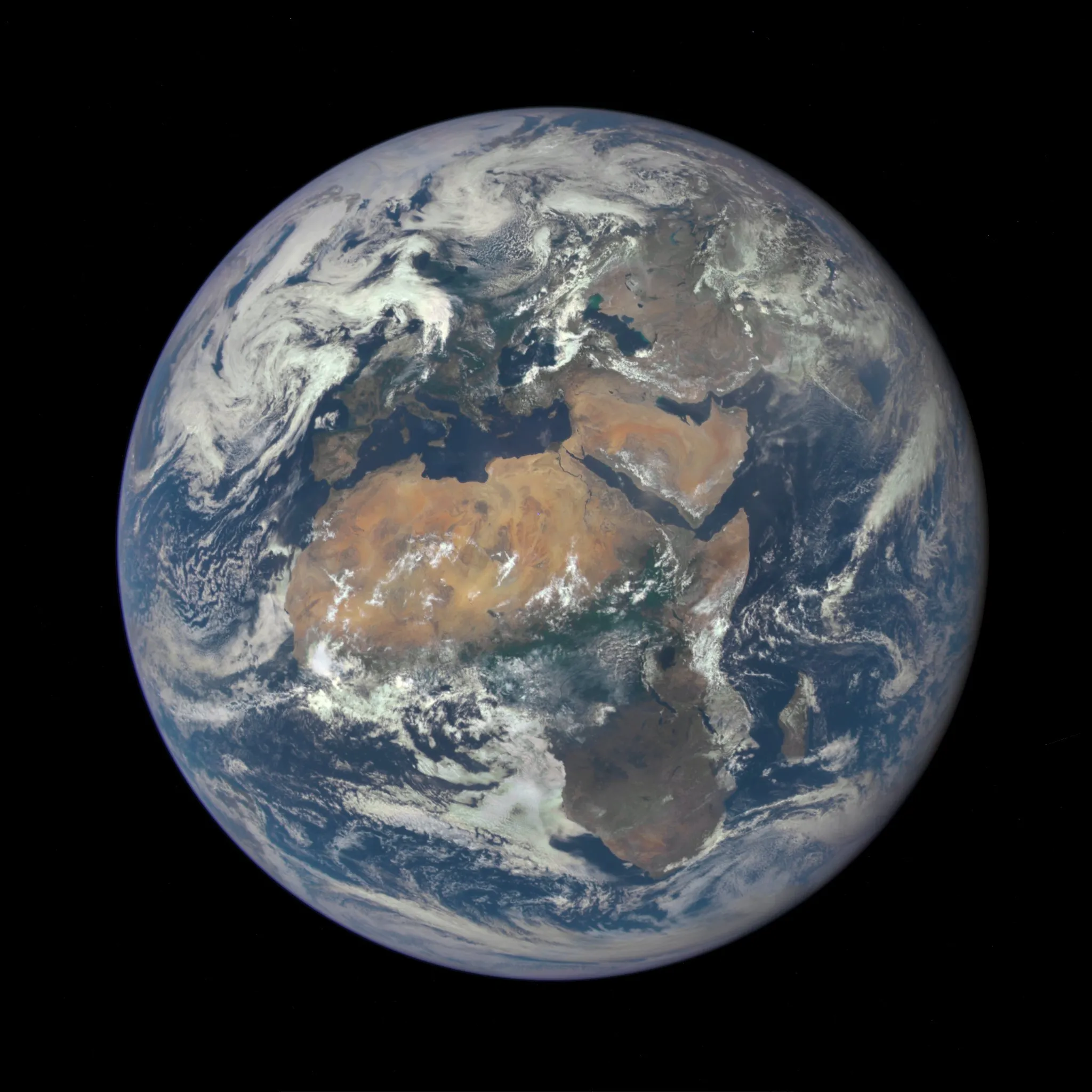
Every star you can see with your own eyes belongs to the Milky Way.
Look
Stand outside on a clear night. The ground under your feet is part of a rocky ball 12,742 km wide. That ball, Earth, is spinning once a day and racing around a star, the Sun, once a year.
The Sun is so big that about 1.3 million Earths would fit inside it. It is so heavy that it holds almost all the mass of everything that orbits it: planets, moons, dwarf planets, asteroids and comets. Together, the Sun and everything held by its gravity is the solar system.
In the orrery above, the yellow dot in the middle is the Sun. Press Play and watch the planets move. The closer a planet is to the Sun, the faster it goes around:
- Mercury takes 88 days.
- Earth takes one year.
- Neptune, the farthest planet, takes almost 165 years.
Our solar system is one of billions of star systems in a huge spiral of stars called the Milky Way. On a very dark night you can see it as a faint band of light across the sky. Every star you can see with your own eyes belongs to it.
Understand
Distances in space are so large that kilometres become awkward, so astronomers use bigger rulers.
The astronomical unit (au) is roughly the average distance between Earth and the Sun. Since 2012 it has an exact value: 149,597,870,700 metres, about 149.6 million km. With it, the solar system becomes easy to picture:
| World | Average distance from the Sun |
|---|---|
| Mercury | 0.39 au |
| Earth | 1.00 au |
| Jupiter | 5.2 au |
| Neptune | 30.1 au |
Light-time is the time light needs to cover a distance. Light moves at 299,792 km per second, so:
time = distance ÷ speed of light
For 1 au: 149,597,871 km ÷ 299,792 km/s ≈ 499 s, or 8 minutes 19 seconds. When you look at the Sun (never directly, it damages your eyes), you see light that left it about eight minutes ago. Sunlight takes over four hours to reach Neptune.
The light-year is the distance light travels in one year: about 9.46 trillion km, or 63,241 au. The nearest star after the Sun, Proxima Centauri, is about 4.2 light-years away. The Milky Way is roughly 100,000 light-years across.
Master
The au used to be measured: it was defined through the Gaussian gravitational constant, so its length in metres was a quantity astronomers had to determine. Radar ranging of Venus and spacecraft tracking in the late twentieth century pinned it down to a few metres. In 2012 the International Astronomical Union made it a fixed number (Resolution B2), so the au is now simply a unit, like the metre.
What we actually measure very precisely today is the Sun’s gravitational parameter, GM☉ = 1.32712440041 × 10²⁰ m³ s⁻², from the motion of planets and spacecraft. The product G × M is known far better than either G or M alone, because G is one of the least precisely known constants in physics. That is why orbital mechanics works with μ = GM throughout, as you will see in the Navigator path.
Two practical consequences:
- Earth’s distance is not constant. Earth’s orbit has an eccentricity of about 0.0167, so its distance from the Sun ranges from about 147.1 million km (early January, perihelion) to 152.1 million km (early July, aphelion). Seasons are not caused by this: January is winter in the northern hemisphere. The real cause is covered in the Seasons lesson.
- Light-time is a real engineering limit. A radio command to a rover on Mars takes between about 3 and 22 minutes one way, depending on where both planets are in their orbits. Spacecraft far away must be able to act on their own.
Zama
In the orrery, set the date to your next birthday. Where is Earth compared with today? Now find the date when Earth is closest to the Sun (early January) and check the distance in the comparison table.
Iningi. Izinhlekelele zikhona lapho ukufunda kuqhubeka khona.
Umbuzo osheshayo
3 imibuzo esheshayo. Khetha impendulo ukuze ubone uma ulungile.
-
About how long does sunlight take to reach Earth?
- A 8 seconds
- B 8 minutes 20 seconds
- C 8 hours
- D 8 days
Bonisa impendulo
B. 8 minutes 20 seconds Earth is on average 149.6 million km from the Sun and light travels 299,792 km every second, so the trip takes about 499 seconds.
-
What is one astronomical unit (au)?
- A The diameter of the Sun
- B The distance light travels in a year
- C About 149.6 million km, roughly the average Earth-Sun distance
- D The distance from Earth to the Moon
Bonisa impendulo
C. About 149.6 million km, roughly the average Earth-Sun distance Since 2012 the au is defined as exactly 149,597,870,700 metres.
-
Which object holds almost all the mass of the solar system?
- A Jupiter
- B The Sun
- C Earth
- D The asteroid belt
Bonisa impendulo
B. The Sun The Sun is about 1,000 times as massive as Jupiter and 333,000 times as massive as Earth.
Ingxenye yelayini
- Idlala nge-interactive
- Funda isifundo
- Ukwenze kanjani isiphakamiso
- Uthathe isifundo
Phawula isifundo siqediwe ukuze uyigcine ekwenzeni kwakho kulolu hlelo.
Isifundo siqediwe. Kulungile!
Phezulu okulandelayo A walk from the Sun to NeptuneAmagama kule ncwadi
Amasu
- NASA NSSDCA Sun Fact Sheet
- NASA NSSDCA Planetary Fact Sheet
- JPL Solar System Dynamics: astrodynamic parameters (astronomical unit, speed of light)
- IAU 2012 Resolution B2 on the astronomical unit (IAU list of resolutions)
- NASA Science: Milky Way galaxy
Le ndatshana ilayisense CC BY-SA 4.0.