
This lesson was drafted by a Local Solar System Foundation team member and could be improved by a qualified reviewer. in iyi Ikintu?
Ibara:
Gufungura Ipaji yuzuyeSisitemu, NONEAHA. Every planet is where it really is today, worked out from NASA JPL's formulas. Press play and time speeds up, so you can watch the planets go round the Sun: the closer a planet is to the Sun, the faster it travels. Tap any world to fly to it and see it turn.
iyi
Readable scale: the planets are drawn far bigger than they really are and the distances are squeezed, so every planet fits on one screen. Switch to true scale to see the real emptiness of space.
Gukoresha
- Gushakisha
- Kuri i Reba., Cyangwa Koresha i + na - Utubuto Kuri Ihindurangano.
- a
- Tap or click a planet to fly to it and follow it. You will see how far it is from the Sun and from Earth, and how fast it turns. The arrow keys step from planet to planet; Escape or the button at the top goes back to the whole system.
- Igihe
- Igihe Imbere Ku i Umuvuduko. Icyo ari cyo cyose Itariki:, Cyangwa Intera Na: i Utubuto Kuri. Inyuma Kuri UYUMUNSI.
- Ipima
- Space is so big that no screen can show both the planets and the distances between them at true scale. Readable scale enlarges the planets and squeezes the distances; true scale shows both as they really are.
Kabiri
| Earth | The Sun |
|---|
Ibyatanzwe imbonerahamwe# Umwandiko Igisubizo
| Isi | Kuva: i NONEAHA | Igihe Bivuye i | Ubuhagarike bw'Ikirere |
|---|---|---|---|
| Mercury | 0,3095 Cyangwa | 2 min 34 s | 93° |
| Venus | 0,7216 Cyangwa | 6 min 0 s | 61,9° |
| Earth | 0,9898 Cyangwa | 8 min 14 s | 50,1° |
| Mars | 1,607 Cyangwa | 13 min 22 s | 106° |
| Jupiter | 5,318 Cyangwa | 44 min 14 s | 135° |
| Saturn | 9,422 Cyangwa | 1 h 18 min | 12,3° |
| Uranus | 19,43 Cyangwa | 2 h 42 min | 63,1° |
| Neptune | 29,88 Cyangwa | 4 h 8 min | 2,9° |
Planet positions use JPL's approximate formulas, accurate to about a few arcminutes between 3000 BC and 3000 AD.
Look up on a clear night and every star you can see with your own eyes belongs to one galaxy, the Milky Way. You are standing on a spinning ball of rock, circling one ordinary star among billions. This lesson finds out exactly where.
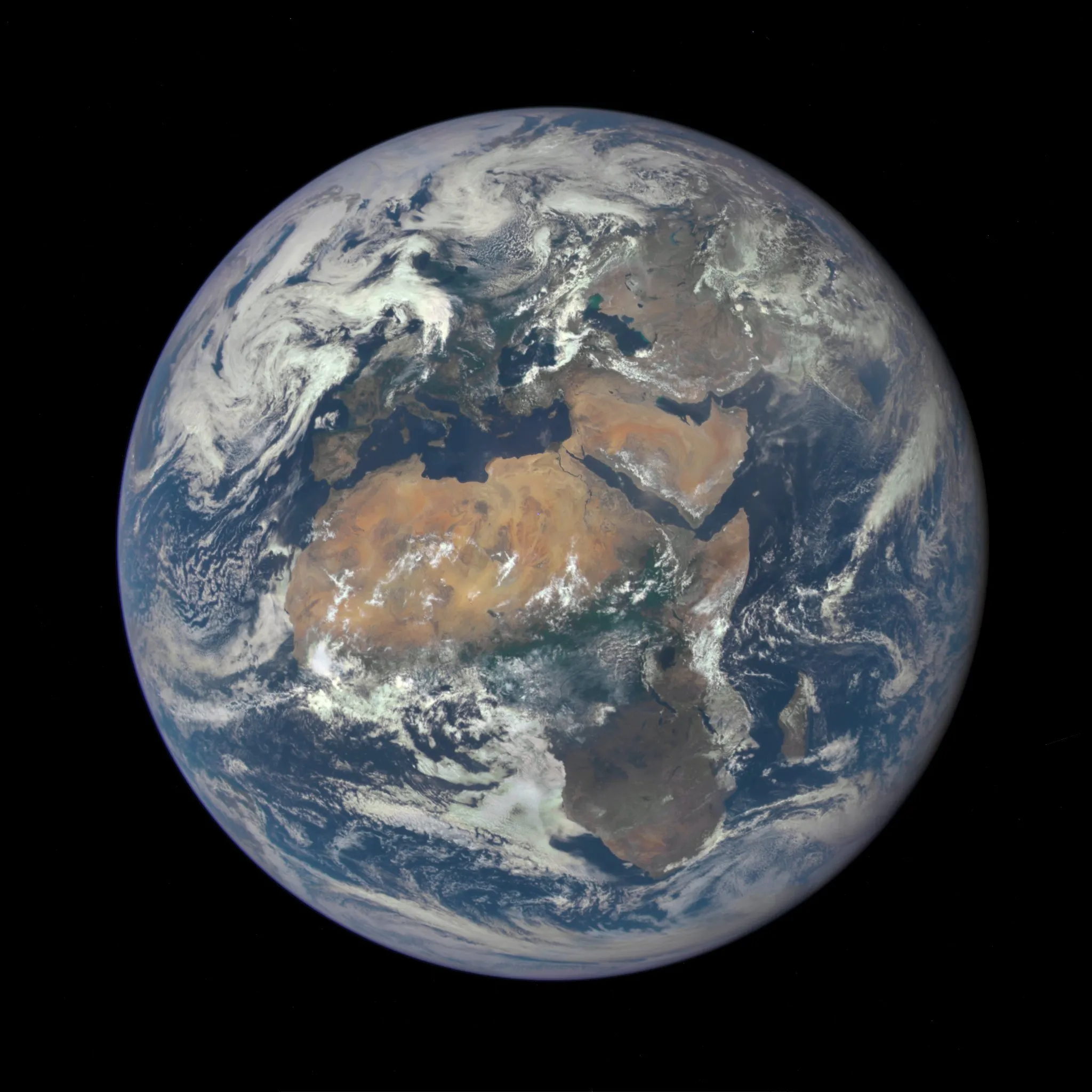
Every star you can see with your own eyes belongs to the Milky Way.
Look
Stand outside on a clear night. The ground under your feet is part of a rocky ball 12,742 km wide. That ball, Earth, is spinning once a day and racing around a star, the Sun, once a year.
The Sun is so big that about 1.3 million Earths would fit inside it. It is so heavy that it holds almost all the mass of everything that orbits it: planets, moons, dwarf planets, asteroids and comets. Together, the Sun and everything held by its gravity is the solar system.
In the orrery above, the yellow dot in the middle is the Sun. Press Play and watch the planets move. The closer a planet is to the Sun, the faster it goes around:
- Mercury takes 88 days.
- Earth takes one year.
- Neptune, the farthest planet, takes almost 165 years.
Our solar system is one of billions of star systems in a huge spiral of stars called the Milky Way. On a very dark night you can see it as a faint band of light across the sky. Every star you can see with your own eyes belongs to it.
Understand
Distances in space are so large that kilometres become awkward, so astronomers use bigger rulers.
The astronomical unit (au) is roughly the average distance between Earth and the Sun. Since 2012 it has an exact value: 149,597,870,700 metres, about 149.6 million km. With it, the solar system becomes easy to picture:
| World | Average distance from the Sun |
|---|---|
| Mercury | 0.39 au |
| Earth | 1.00 au |
| Jupiter | 5.2 au |
| Neptune | 30.1 au |
Light-time is the time light needs to cover a distance. Light moves at 299,792 km per second, so:
time = distance ÷ speed of light
For 1 au: 149,597,871 km ÷ 299,792 km/s ≈ 499 s, or 8 minutes 19 seconds. When you look at the Sun (never directly, it damages your eyes), you see light that left it about eight minutes ago. Sunlight takes over four hours to reach Neptune.
The light-year is the distance light travels in one year: about 9.46 trillion km, or 63,241 au. The nearest star after the Sun, Proxima Centauri, is about 4.2 light-years away. The Milky Way is roughly 100,000 light-years across.
Master
The au used to be measured: it was defined through the Gaussian gravitational constant, so its length in metres was a quantity astronomers had to determine. Radar ranging of Venus and spacecraft tracking in the late twentieth century pinned it down to a few metres. In 2012 the International Astronomical Union made it a fixed number (Resolution B2), so the au is now simply a unit, like the metre.
What we actually measure very precisely today is the Sun’s gravitational parameter, GM☉ = 1.32712440041 × 10²⁰ m³ s⁻², from the motion of planets and spacecraft. The product G × M is known far better than either G or M alone, because G is one of the least precisely known constants in physics. That is why orbital mechanics works with μ = GM throughout, as you will see in the Navigator path.
Two practical consequences:
- Earth’s distance is not constant. Earth’s orbit has an eccentricity of about 0.0167, so its distance from the Sun ranges from about 147.1 million km (early January, perihelion) to 152.1 million km (early July, aphelion). Seasons are not caused by this: January is winter in the northern hemisphere. The real cause is covered in the Seasons lesson.
- Light-time is a real engineering limit. A radio command to a rover on Mars takes between about 3 and 22 minutes one way, depending on where both planets are in their orbits. Spacecraft far away must be able to act on their own.
Gushaka
In the orrery, set the date to your next birthday. Where is Earth compared with today? Now find the date when Earth is closest to the Sun (early January) and check the distance in the comparison table.
. i.
Igisubizo
3 Muhugura Ibibazo. Kuri NIBA ni i Iburyo:.
-
About how long does sunlight take to reach Earth?
- A 8 seconds
- B 8 minutes 20 seconds
- C 8 hours
- D 8 days
i
B. 8 minutes 20 seconds Earth is on average 149.6 million km from the Sun and light travels 299,792 km every second, so the trip takes about 499 seconds.
-
What is one astronomical unit (au)?
- A The diameter of the Sun
- B The distance light travels in a year
- C About 149.6 million km, roughly the average Earth-Sun distance
- D The distance from Earth to the Moon
i
C. About 149.6 million km, roughly the average Earth-Sun distance Since 2012 the au is defined as exactly 149,597,870,700 metres.
-
Which object holds almost all the mass of the solar system?
- A Jupiter
- B The Sun
- C Earth
- D The asteroid belt
i
B. The Sun The Sun is about 1,000 times as massive as Jupiter and 333,000 times as massive as Earth.
Umurongo
- Na: i
- i
- i
- i
i Byuzuye Kuri Kubika Kuri Impinduka ku iyi APAREYE.
in iyi
Inkomoko
- NASA NSSDCA Sun Fact Sheet
- NASA NSSDCA Planetary Fact Sheet
- JPL Solar System Dynamics: astrodynamic parameters (astronomical unit, speed of light)
- IAU 2012 Resolution B2 on the astronomical unit (IAU list of resolutions)
- NASA Science: Milky Way galaxy
This lesson is licensed CC BY-SA 4.0.